

Michael Mann is an intriguing figure in the Hollywood production model that emerged post-Star Wars but has now been transformed into something else. Mann’s last feature film release was Ferrari (US-Italy-UK-China-2023) and I thought it was pretty good but I wasn’t surprised that its box office performance was relatively poor for a mainstream film. It was deemed a successful release but it was nowhere near even covering costs through a cinema release. It occurs to me that as Mann himself became more highly skilled at creating complex narrative features with strong characters, the industry changed in terms of the films it aimed to produce and his audiences melted away. Mann also became more interested in television in which he had already had considerable success with the series Miami Vice (1984) early in his career.

Poor quality image from the distributor but a good representation of the three Mohicans in action
The Last of the Mohicans comes from 1992 and represented the first film production for the director since Manhunter in 1986, the years in between being spent in television production. He was approaching the high point of his commercial film career and his new film would be an ambitious exercise. It would update and significantly change earlier adaptations of the James Fenimore Cooper novel – Wikipedia lists ten film titles for this seminal American story. Mann claims to have been inspired by the 1936 film starring Randolph Scott that he saw as a teenager. I also remember watching one or two episodes of the Canadian TV series based on Cooper’s stories which were shown on UK TV in the late 1950s. The narrative deals with the American ‘front’ in the Seven Years War (1756-63) between Britain and France which also involved several other European nations. In American history the war in North America is termed the ‘French and Indian War’. American history seems to treat the war as fought by ‘Americans’ but they were still colonists/settlers at this point and the British military ran the show – at first fairly unsuccessfully but eventually defeating the French on the Heights of Quebec in 1759 (possibly by clever use of naval power in moving troops?). The location of events in this film narrative is Upper New York state in the Adirondack Mountains but the film was actually shot in the Blue Ridge Mountains in North Carolina. In 1757 the French General Louis-Joseph de Montcalm-Gozon crossed into the British colony of New York with a relatively large force of French soldiers and their Native North American allies hoping to capture Fort William Henry. Meanwhile, further South in Albany a British officer, Major Duncan Heyward (Steven Waddington) is charged with taking the two daughters of Colonel Munro, the British officer i/c Fort William Henry, to join their father. He has a small group of soldiers with him and is assigned a Native American guide. This character is Magua (Wes Studi) masquerading as a Mohawk but actually a Huron, allied to the French.

Magua leads the the British into an ambush by the Hurons but Hawkeye (Daniel Day-Lewis), Chingachgook (Russell Means) and his son Uncas (Eric Schweig) rescue the Major and the two women, killing the Huron captors except for Magua who escapes. Hawkeye is the adopted white son of Chingachgook, who with Uncas is known as “the last of the Mohicans”. In reality, the other Mohicans migrated, eventually ending up in what is now Wisconsin. The remaining trio are living alongside the colonists, but agree to take the rescued British to Fort William Henry. This action-packed opening sets up a complex set of relationships which will underpin the remainder of the narrative. Magua is an implacable enemy of the Mohicans. The two Munro daughters, Cora (Madeleine Stowe) and the younger Alice (Jodhi May) are potential partners for Hawkeye and Uncas but Cora is also being pursued by Major Heyward. The Mohicans are not initially part of the war itself and they tend to identify with the colonists, some of whom have been recruited as militia, rather than to accept orders from the British officers. Mann created what is in generic terms an action-adventure romance with a personal perspective rather than a war combat picture.
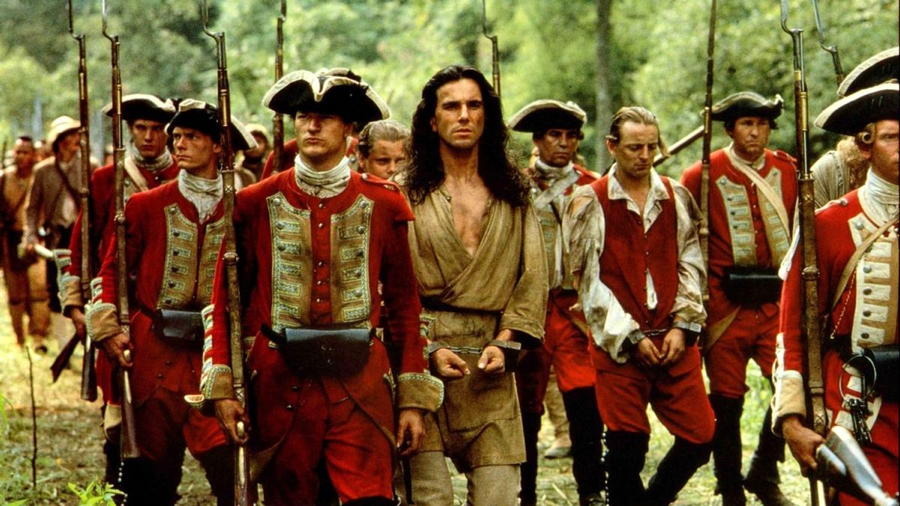
The importance of the film is that three of the seven central characters are what would now be described as ‘Native Americans’ or, in Canada, ‘First Nations’ people and they are played by suitable actors with indigenous backgrounds rather than white actors in ‘brownface/redface’. In addition, the Indigenous characters speak in their own languages as well as English or French. Some of these exchanges are subtitled. Mann’s desire for realism extended to the re-creation of Fort William Henry built on location at a cost of several million $US. IMDb also suggests there were as many as 175 Native American extras used on the shoot to portray the allies of the French and the British. The film offers a high octane action narrative with several spectacular sequences. The location camerawork by Dante Spinotti, who would become Mann’s ‘go to’ cinematographer, is at times breathtaking as presented in 2.35:1 ‘Scope. In some cinemas it was presented on 70mm in 2.20:1 ratio. The score by Randy Edelman and Trevor Jones complements the visuals well. The cast is generally very good though I do feel that with all the action the female roles are not given enough consideration.

I was prompted to watch the film again recently partly because I had been asked to write a review of The Films of Michael Mann by Deryck Swan (Liverpool University Press 2023). Swan takes an unusual approach in the book, taking each Mann film and discussing it in the context of a particular aspect of Mann’s intellectual interests. This, he claims, is a new way of defining a film auteur. He points out that the film was Mann’s choice of a film property that he had first encountered via the 1936 adaptation. We might also note that Mann was one of the two producers of the film. Swan’s choice of a way into his analysis of the film is the concept of professionalism and he explores this both in terms of the professionalism of the characters such as Hawkeye but also the professionalism of Mann himself, particularly on his insistence to plan in great detail the action scenes, the construction of the fort, the weaponry and military procedures etc. I’m not interested so much in the idea of Mann as auteur but I recognise some of these ideas about professionalism and Swan argues that Mann sets out to counter the racist ideology of the original storyteller Cooper and the rather compromised earlier film adaptations in a Studio Hollywood context. Mann’s version would attempt to present a different world to audiences in 1992 as might be expected from a properly professional filmmaker. It’s important to note however that Hollywood in the 1990s was beginning to finally take on board past criticisms and other films were beginning to employ Native Americans more appropriately. Wes Studi had first appeared in Dances With Wolves in 1990 and would star as Geronimo in Geronimo – An American Legend (1993) for Walter Hill as his next leading role. From this point on would develop a long and successful career, including appearing again for Michael Mann in Heat (1995).

I’m not very familiar with contemporary super-hero movies but I’d be surprised if any of them are as well-made and convincing in terms of action films with strong narratives as Last of the Mohicans. It helps, of course, to have a lead actor as dedicated as Daniel Day-Lewis who it seems spent several weeks training for the part with American Special Forces. He seems to be in almost perpetual motion, running and leaping through forests and along mountain paths. Mann trained in the UK at the International Film School in London and here he casts mainly British actors for key British military roles with Maurice Roëves as Colonel Munro and Pete Postlethwaite as one of his captains. I have already suggested that the part of Cora could have been expanded and I wonder if that part too should have had a British actor? This not a comment on Madeleine Stowe’s performance but rather about whether the character needs to evoke the idea of a well-educated young woman from the British landed gentry who finds herself on the run with a character like Hawkeye. Their romance ought perhaps to have more edge?

Michael Mann’s film’s have often been long but this one keeps close to 100 minutes. I watched a broadcast version on Channel 4. I believe there is a longer Director’s Cut’, but not substantially longer. The film was a commercial and critical success and received many nominations for awards but I’m not sure that Michael Mann got the credit he deserved for such an accomplished piece of work. One last thought – is this film also a Western? Is it perhaps the earliest setting for a Western? I must get back to thinking about Ford’s 1939 Drums Along the Mohawk, set 20 years later during the ‘Revolutionary War’.
 itp Global Film
I love this film and watched it many times when working on adaptations. I do think it is a Western and I absolutely agree with your emphasis on motion but also on stillness eg of the fallen body or when the protagonists have to pause to listen. I suppose the women could have been more fully established but there was not much in the book or the genre which would encourage that
LikeLiked by 1 person
Yes, the stillness you mention is an important element of the way the Mohicans hunt, stalk through the forest etc. I take your point about the lack of scope for expanding the women’s roles but Mann and the writers do want us to believe in the romance. Also, when I think about it, the woman’s role is crucial in many of the Westerns in which a young girl is taken by Native American raiders/warriors and raised by the tribe/band – many deriving from the historical story of one such case in Texas. These stories are much later but the speech that Hawkeye makes, encouraging Cora to accept capture by the Hurons and live rather than die fighting is important.
LikeLiked by 1 person