

This is a ‘medium-length’ film, at around 55 minutes. Definitions vary but the distinction is important. It appears to have been a pilot for a bigger project with the working title ‘Floods’ and it has become available online presumably because of the success of Hamaguchi Ryusuke’s films released internationally from 2015. The film ends with the message ‘To be continued’.
There are three or four things that might be important to know before you try to get to grips with this film. First you should know that Hamaguchi’s mentor in film school and subsequently has been Kurosawa Kiyoshi, known for his horror films as well as prize-winning melodramas, and that some of the older man’s ideas might have influenced how this narrative was developed. Second, this film, like some others from Hamaguchi, is interested in detailed study of a specific art form and here it is contemporary dance. Third, the film was produced immediately after Hamaguchi had been interviewing survivors of the earthquake and tsunami that hit North Eastern Honshu in 2011. The Fukushima nuclear disaster was caused by the earthquake and Hamaguchi was one of two directors working together to produce four films in total. Fourthly, the film features an unusual fish known as ‘polypterus endlicherii‘, a freshwater fish found in the wild only in certain rivers of Sub-Saharan Africa.

I don’t think it is a ‘spoiler’ to quote these contextual production factors. I haven’t yet found out where the film was photographed or where it is meant to be set but it is clearly important that several scenes take place next to a river or estuary. The central character is Chihiro, played by Sometani Shôta whose first film was Himizu (Japan 2011), also a narrative set around the time of the impact of the tsunami. As the film opens, Chihiro, a student of 19-20 , is coming back from his father’s funeral with his older half brother Togo and Togo’s partner Satomi. Chihiro is clearly disturbed by his father’s death but Togo and Satomi seem able to respond to his behaviour which becomes a little more understandable when we realise that Chihiro is training with another student Naoya to be able to perform a contemporary dance piece in which the two young men move their bodies in very controlled ways so that they become almost entwined without actually touching. They are watched very closely by their teacher Kondo. The only other principal actors in the narrative are Naoya’s girlfriend Azusa and at the end of the film a female detective, who arrives to investigate a death. The last section of the narrative offers a sudden change of generic elements and a cliffhanger for the larger scale project of which this is the first part of the narrative.
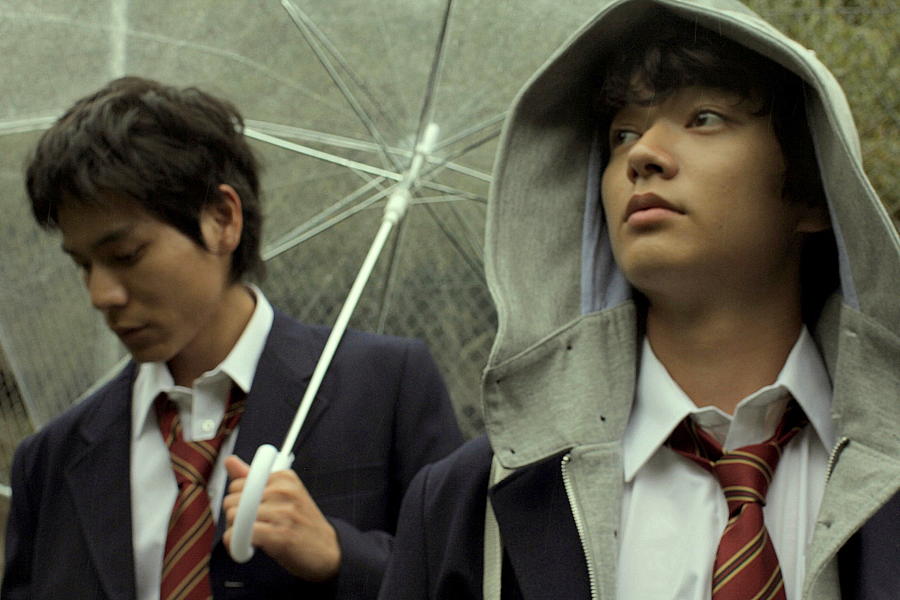
It’s difficult to find this film although it has been shown at various events in the US and there are clips and discussion/reviews available online. Reactions vary from those who find it ‘pretentious’ to more considered pieces which recognise that it offers a good example of Hamaguchi’s developing directorial skills. Here, to a certain extent, the director replaces dialogue with presentation of mood and the movements of dance. This film was written by Takahashi Tomoyuki according to IMDb but I can’t find out anything about the writer. The same name appears as a writer on Happy Hour (2015) but there both Hamaguchi and Takahashi are also subsumed in a group of writers titled ‘Hatano Koubou’. My understanding is that Hamaguchi himself always has a hand in the writing even when drawing on sources written by others. The performances here are very good as is the photography by Sasaki Yasuyuki. I’m guessing that Sasaki met Hamaguchi at the Tokyo University of the Arts film school as he is listed as the DoP for Hamaguchi’s re-imagining of Solaris (2007). He also shot Hamaguchi’s first fully commercial picture Asako I and II (2018). Hamaguchi has said that he doesn’t always choose the same cinematographer because he doesn’t want his films to be seen as defined by a particular visual style. But, on the other hand he does go back to the people he has worked with before and because his narrative ideas seem to have some consistency from film to film, it isn’t difficult to see a particular style evolving. I think that his work with the survivors of the Tokuhoku earthquake had a strong impact on him and I can see something similar in the images created for Happy Hour (2015) and Asako I and II. One of the director’s main strengths is that he can achieve scenes in which the camera appears to be doing very little and actors appear to be almost improvising in their naturalness but close examination reveals that each scene is carefully choreographed and composed. In this film this is heightened by the long sequences of slow dance movements. The music is also important, here composed by Nagashima Hiroyuki. The restrained piano compositions (occasionally more animated) complement the images very well.
I’m gradually working my way through all the Hamaguchi films I can find. It is clear that some actors appear in several of the films. It is also evident that the female roles are as important as the male. Though several of the films do focus on young men, others focus on young women. Critics have suggested that Hamaguchi’s strength is in dialogue scenes and this is certainly evident in this film. Overall, however, across his work it is possible to recognise just how well he makes use of all of the possibilities of cinema. Touching the Skin of Eeriness is an ‘experimental film’ and made me think at moments of Maya Deren’s work, which makes sense for a film which focuses on dance. I was very engaged by most sequences even when I struggled to put them together in terms of a narrative. I have deliberately not attempted to explain the relationship between the fish polypterus endlicherii and the interactions of the two boys and possibly the other characters. Like many other viewers of the film, I do hope that Hamaguchi eventually makes ‘Floods’ as a feature.
 itp Global Film