
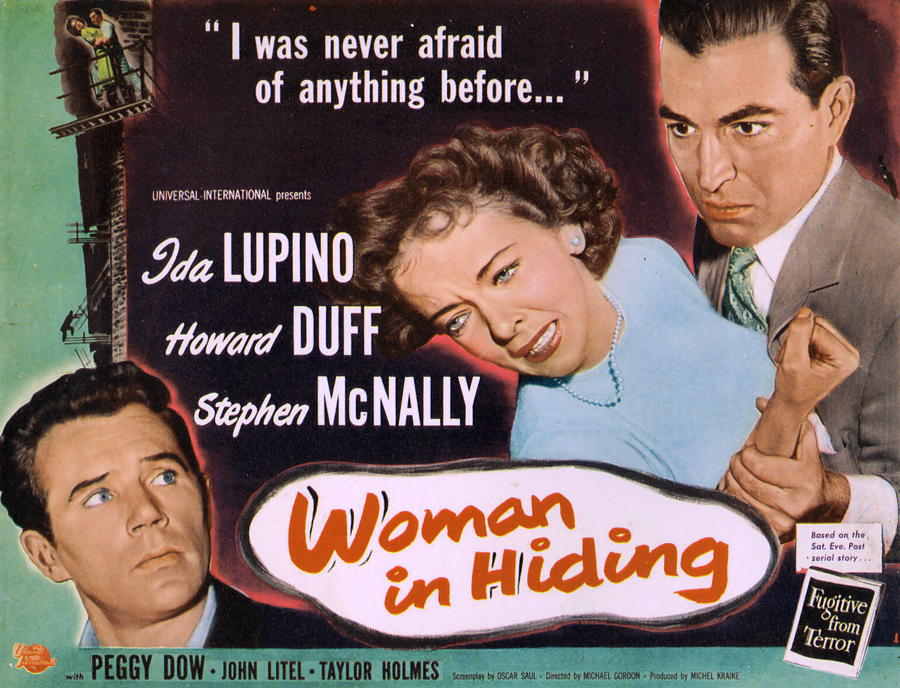
This is a difficult film to find in the UK (like too many Ida Lupino pictures) so when I found it online in an excellent 720p print I was excited to watch it. I don’t understand the reluctance to release a DVD or Blu-ray in the UK. I enjoyed it very much and it presents some different elements to other crime/romance thrillers of the period. I’m surprised it hasn’t turned up in Indicator’s ‘Universal Noir Boxsets’ – perhaps it will appear in a future volume? The first interesting point for me is the timing of the production. The AFI Catalogue tells me that Ida Lupino was cast first and at one point Ronald Reagan was considered for the heroic ‘rescuer’ but he was injured in a charity baseball match and Howard Duff, who was originally to play the villainous husband, switched roles. William Donati in his Lupino biography tells us that Ida was friendly with Reagan and his wife Jane Wyman. At this point Reagan was still a Democrat like Lupino and she got on well with him. I find this odd since he was also President of the Screen Actors Guild from 1947 and as a known anti-communist he would side with HUAC and hurt some of Lupino’s other friends (like John Garfield). Lupino was at first conflicted about Howard Duff, thinking of him as arrogant but she would get to know him well and he eventually became her third husband and the father of her daughter Bridget in 1952.

In 1949 Ida Lupino was preparing for her second feature for her company, The Filmakers, that she had established with her then husband Collier Young and Marvin Wald. She had finally left Warner Bros. in 1947 and had completed two films as a freelance actor, Road House in 1948 for 20th Century Fox and Lust for Gold (1949) for Columbia. She would have preferred to be spending her time on her own productions in 1949. The first, Not Wanted appeared in early 1949. But the second film Never Fear, about a dancer who catches polio, was proving a hard sell to potential investors and required more of Ida’s own money. She presumably took this role at Universal to help pay for Never Fear (which was released at virtually the same time as Woman in Hiding in January 1950).


What would Ida Lupino find at Universal? She had worked for Paramount, Fox, Warner Bros. and Columbia as well as a number of independent producers. She was about to deal with Howard Hughes at RKO. Universal at this point, as we have discussed on this blog with our reviews of the two boxsets of ‘noir‘ productions, was turning out well-made ‘mid-budget’ films. Woman in Hiding is directed by Michael Gordon (see our recent post on The Web (1947)) from a script by Oscar Saul, adapted from a Saturday Evening Post story by Roy Huggins. Most notably perhaps the photography is by the great William Daniels who had lit Garbo in the 1930s. The narrative is located in North Carolina where Lupino’s character Deborah Chandler is the unmarried daughter of a local mill-owner. ‘Mill’ here appears to refer to a factory operation producing wooden chairs. Most of the scenes actually use studio sets at Universal City but some are shot on location around Fresno in Central California. One advantage of working at Universal was that in the UK, Universal films were released by the UK’s major distributor GFD, part of the Rank empire and therefore going out on either the Odeon or Gaumont circuits. I was surprised to find that this film received a full review in Monthly Film Bulletin, January-February 1950 (an American film from a smaller studio would often get only a short ‘notice’). MFB‘s reviewer was not overly impressed but the review demonstrates this was an ‘A’ release.

The film begins with a car careering down a steep mountain road and crashing through a barrier to fall in a river. The next scene a little later shows the car being hauled out of the river and an age-old technique using an ancient cannon to skim cannon-balls across the river in the hope of bringing a body to the surface. On the soundtrack we also hear a husky-voiced Lupino telling us they are searching for her body. Is she dead or did she escape from the car? Before we can come to a conclusion, a flashback reveals Lupino as a Deborah Chandler, driving the same car to her father’s mill. This sequence will explain the back story in which Deborah agrees to marry Selden Clark (Stephen McNally), the mill’s general manager after her father’s death in what is reported as an accident. But the marriage is quickly cast into doubt by the appearance during the honeymoon of Patricia Monahan (Peggy Dow). Deborah flees from the honeymoon cabin and her car crashes. Now we are back to the present and Deborah, a little battered by her escape from the out of control vehicle is on the run away from Selden, via bus and train to Raleigh where she hopes to find a cousin. Along the way she will acquire the friendship of Keith (Howard Duff), a returning soldier who is drifting through odd jobs before setting out to develop his own business in California. But is Keith reliable? Might he succumb to the reward Selden is offering to find his wife alive? I won’t spoil any more of the plot.


There are several things I enjoyed in the way the narrative unfolds. One is the focus on the buses and trains with their busy stations. Another is a sequence involving a local hotel taken over by a convention of raucous salesmen in an almost Hitchcockian presentation of the anonymity of crowds. Overall, I think the narrative works pretty well, though I think there may be a few plot holes and Deborah seems to survive various mishaps from which she emerges with her bag, money etc. always intact. The finale is also handled well with a struggle in the darkened mill. These last scenes and a few others suggest a noir drama, but I think that it is more useful to consider this as a ‘woman in peril’ drama – quite a broad generic category. From the late 1930s onwards there are a number of similar films including the ‘gaslighting’ films of wives whose husbands try to drive them into mental collapse. Then there are the women in peril in dark houses such as The Spiral Staircase (US 1946) and Sorry, Wrong Number (US 1948) in which Barbara Stanwyck is bed bound and fearing an attack from Burt Lancaster. Lupino herself would work with Robert Ryan on Beware, My Lovely (US 1952). The final images of Woman in Hiding also reminded me of Hitchcock’s Suspicion (US 1941). Some of these other films are certainly films noirs and all are in their own ways melodramas. The MFB suggests that Lupino is a “conventionally overwrought heroine” who “never lets up for a minute” in her “panic-stricken flutterings”. I can’t accept that and I think she gives her usual intelligent performance. I think Gordon and Daniels present an exciting entertainment.
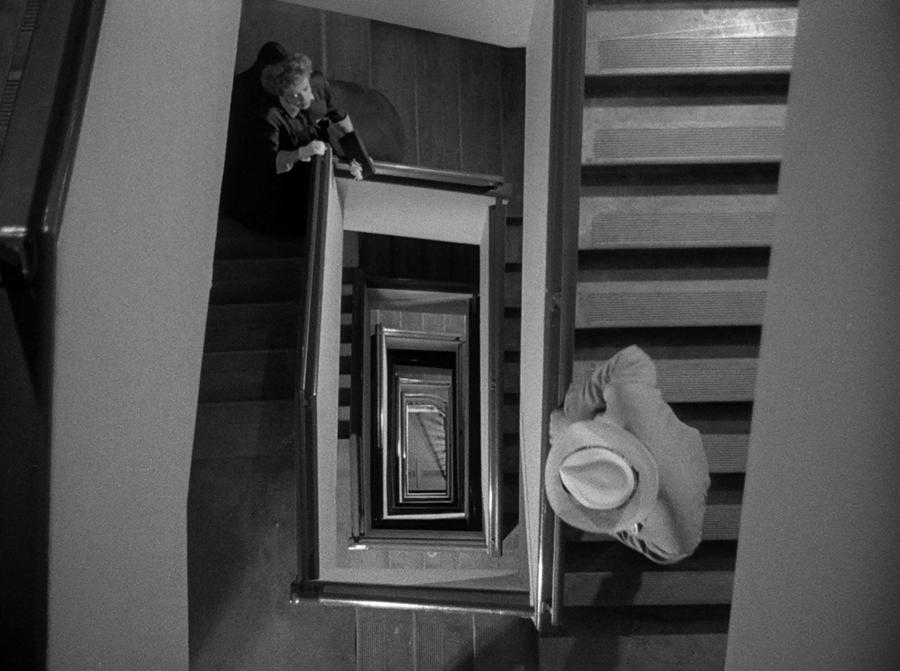
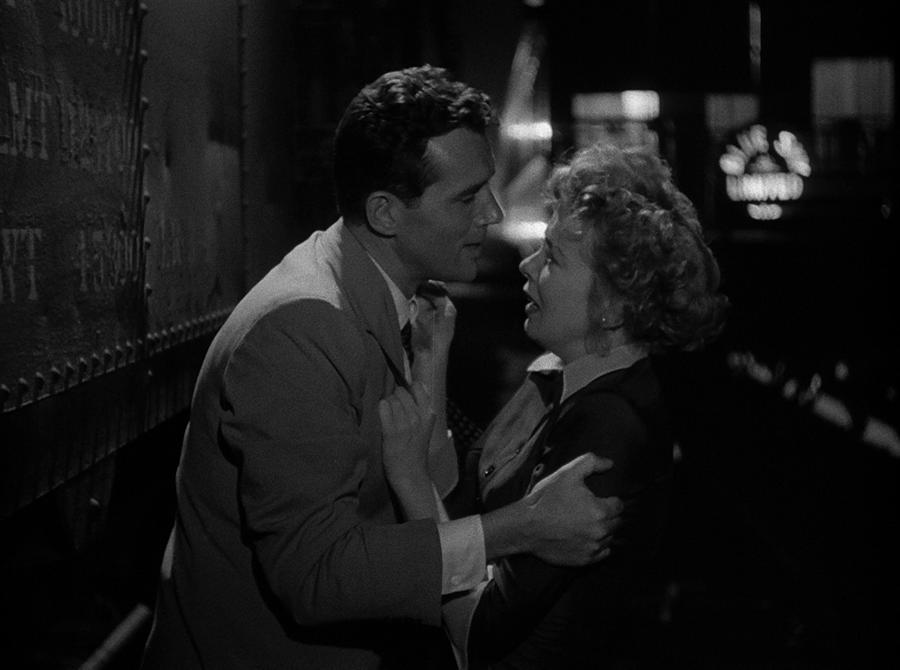
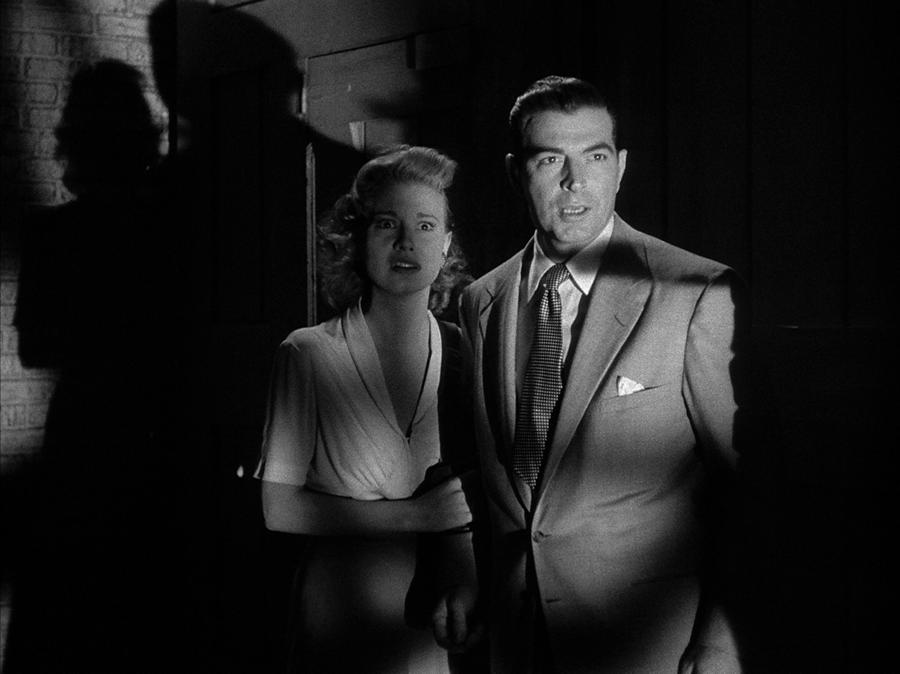
Here’s an Introduction to the film by Eddie Muller on his TCM show ‘Noir Alley’. He describes it as one of his favourite noirs. I’ve indicated I’m not sure about that but he does confirm my thoughts about Lupino and Reagan:
 itp Global Film