
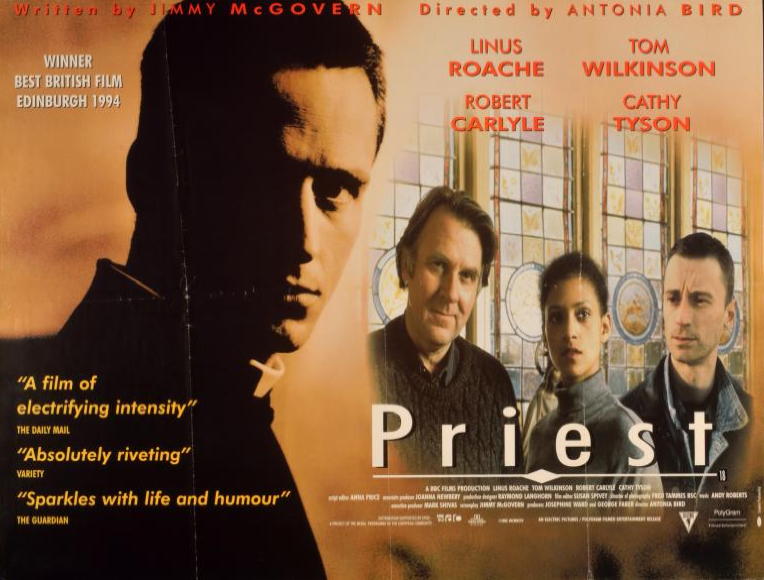
Priest is currently streaming on BBC iPlayer for several months. I watched it recently late at night unable to stop and go to bed. I think I saw it when it came out or perhaps I only watched an excerpt. Watching it now it seems to me the most ‘Liverpool’ thing I’ve ever seen and I think it is very good indeed. Thinking about it afterwards I found it is very interesting in a several ways. Before the recent screening on BBC4, there was a 14 minute introduction by the writer Jimmy McGovern which is also riveting viewing. The introduction gives away the ending of the film, so watch it after viewing the film.
https://www.bbc.co.uk/iplayer/episode/m002bln7/remembers-jimmy-mcgovern-remembers-priest
Jimmy McGovern is one of the great Merseyside writers and there have been a few. I haven’t actually watched many of McGovern’s films and TV work, not because I don’t expect them to be good but mostly because he deals in some of the most dramatic material which I find hard to watch – the TV film Hillsborough (1996) about the Hillsborough football stadium disaster (and scandal) is a good example. Priest developed first from McGovern’s own memories as an Irish Catholic growing up in Liverpool and eventually focused on a gay priest after the writer was introduced to a real young priest. The film’s institutional context came from BBC Films (it was shown on the ‘Screen Two’ strand on BBC2) Polygram in its early phase as a European studio operation and support from Miramax which enabled distribution in the US. This created one of the intriguing questions about the film. Some American critics seem to have been very down on the film. Even the legendary Roger Ebert gave it only one star, despairing of its presentation of the Catholic Church. I fear that these American critics completely fail to understand the culture of Liverpool. In the doldrums of British filmmaking between the late 1970s and early 1990s, many films were made in Liverpool with funding from the BBC or Channel 4/Film 4 as well as many TV plays and series (which probably were not seen abroad to be fair). Liverpool is very much a city in which Irish Catholicism has been important since the 19th century and the hinterland Lancashire Catholicism which includes both the native Catholicism going back to the 16th century and earlier and the more recent Polish Catholicism is an important element. McGovern belongs to that Irish Catholic community. At the start of Priest we see the modern Catholic Cathedral, known locally as ‘Paddy’s Wigwam’ and later we see other Liverpool monuments in long shot including the Liver building on the Waterfront and, I think, the Anglican Cathedral in cinematographer Fred Tammes’ compositions.
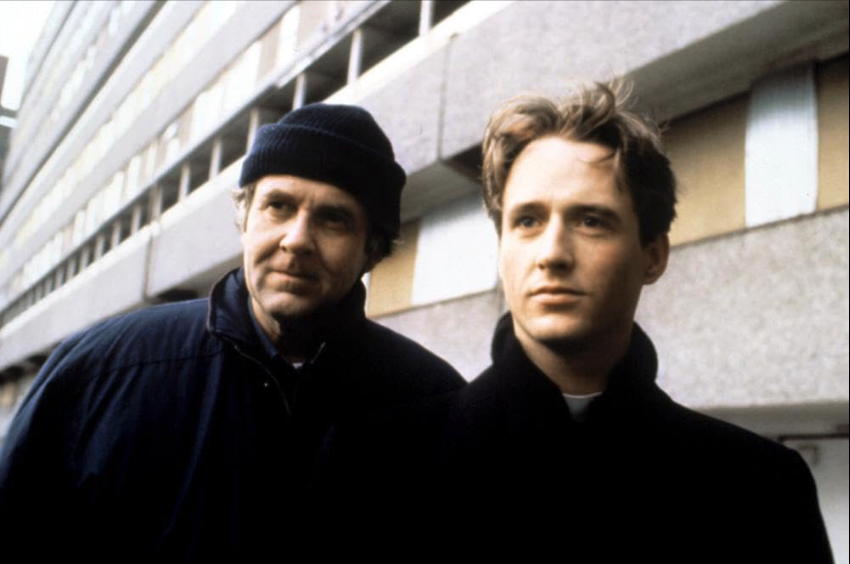

The second important aspect of the film is the direction of Antonia Bird who died relatively young, aged 62, after a stellar career in theatre, television and film. She worked on at least three films featuring the then rising star Robert Carlyle, one of the few non-Liverpool actors in Priest (but as a Glaswegian, no doubt well aware of the Irish Catholic world). I rate Bird highly as a British director and she was certainly supported by Jimmy McGovern. The third aspect then becomes the range of actors associated with Liverpool – either by birth or by experience of working in the city. The film begins with James Ellis (veteran of over 600 episodes of Z-Cars, the cop show associated with Liverpool) as a priest who uses a large crucifix and Christ figure as a weapon to attack the local Bishop’s residence after he has been ‘retired’. We then recognise other well-known faces such as Cathy Tyson, Bill Dean, Christine Tremarco, Paul Barber and Anthony Booth. The young priest who arrives in Liverpool is played by Linus Roache, son of William Roache (the actor behind the UK’s longest-serving soap character, Ken Barlow in Coronation Street). Linus Roache is a Mancunian as is Lesley Sharp and the other principal character is Tom Wilkinson born in Leeds. So, overall we get an approximation of Ken Loach style casting in which the players are relatively close in terms of experience of life in the North of England to the characters they play. Performances all round are very good.
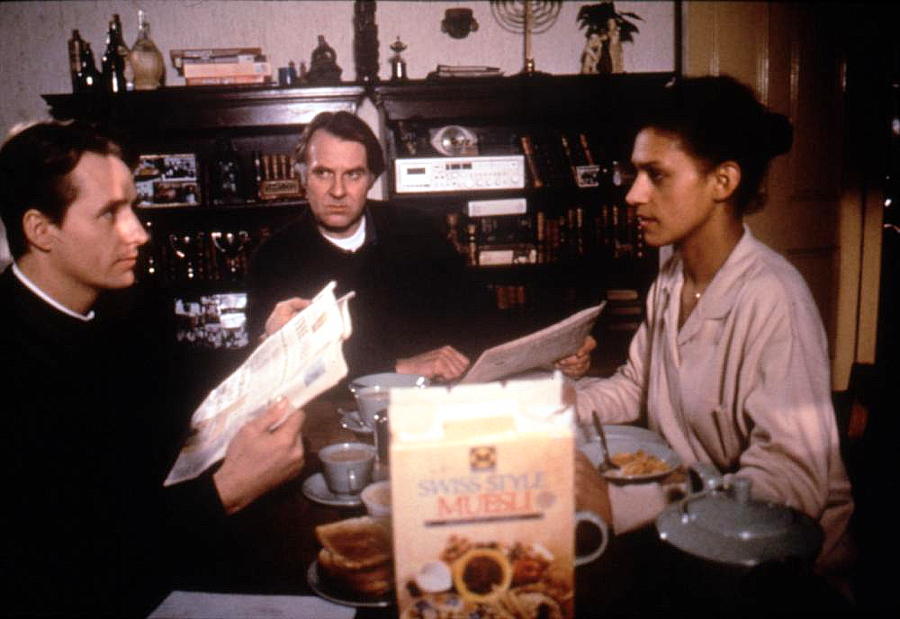
The young priest, Greg Pilkington (Loache) arrives at the presbytery of Father Matthew Thomas (Wilkinson) in a working-class district in Central Liverpool and it is soon apparent that Greg and Matthew are going to prove a combustible pairing. Greg is young but conservative in thinking whereas Matthew has spent several years in Latin America and embodies the thinking of ‘liberation theology’. McGovern is accused by some critics of being too direct in presenting dramatic conflicts. Perhaps he is, the passion is never far away. Here, however, the political allegiances of the two men are summed up by the breakfast view of them with their morning papers – the Guardian for Matthew and the Times for Greg with the topical riposte from Matthew that Greg is accepting the Rupert Murdoch paper into the house. The tension between the two is heightened by Greg’s realisation that Matthew is very close to his housekeeper Maria (Cathy Tyson). The two men deliver sermons to their small loyal flock that are polar opposites in terms of political ideologies but when Greg determines he will go round the district knocking on doors to find his parishioners, Matthew argues against it. The results of the mission confirm Mathew’s wisdom. He is actually deeply embedded in the community.

The central pivot in the drama pushes Greg into a situation where he is seen breaking away from his own interpretation of how a Catholic priest should behave when he meets Graham (Robert Carlyle) in a bar and at the same time faces the quandary about what to do with information given to him in Confession by a young parishioner. Should he break the confessional vow of confidentiality to expose a great sin? This dilemma tears him apart. In the end, despite his own attempt at destruction he is in a sense ‘saved’ partly by the intervention of Matthew and his brand of compassion and common decency which overcomes the prejudice of the church hierarchy and the conservatism of many of the parishioners.

Liverpool has always been a passionate city with a distrust of outsiders. In the 1980s the city was torn apart by the policies of Margaret Thatcher and the struggles of political radicalism. Within the Irish Catholic community was a sense of solidarity, but also elements of social conservatism especially in relation to gay priests. Priest‘s producers faced problems shooting some of the scenes in the city. McGovern suggests that they had to take a large group of actors down to London to record some scenes because churches refused permission to shoot on their premises. But he also tells us that even though he depicted the church hierarchy in a very poor light, he learned later that Archbishop Warlock had seen the film and had said that he didn’t know what the fuss was about and that it was a profoundly Catholic film. I’m not a Catholic, but from my understanding of Catholicism I agree with him. The film isn’t a documentary. Some audiences will recoil from what they consider to be ‘over the top’ scenes but it all works for me. One aspect I haven’t mentioned is the diegetic music. Father Matthew performs Johnny Cash in a karaoke session and there is a boozy sentimental wake with communal singing scenes reminding us of another Liverpool drama, Terence Davies’ Distant Voices, Still Lives (UK 1988).
 itp Global Film