
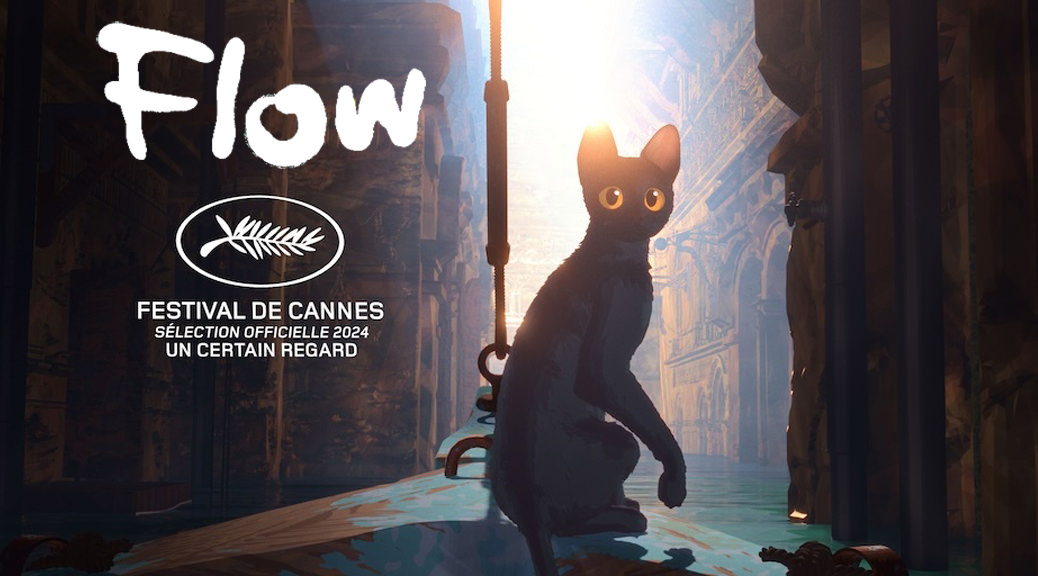
It’s difficult to be objective about this film. At home we have a small and very beautiful black British shorthair cat, similar in many ways to the central character of Flow. Gints Zilbalodis and his team have created a stunning feline adventure using a novel approach to animation. The film was shown at Cannes and then nominated for an Academy Award, which it won – Best Animated Feature 2025. Zilbalodis appears to be almost a one man industry covering roles as producer, music composer, cinematographer, film editor and art director as well as director and co-writer. All of this he had achieved by his 30th birthday. Of course, this new film isn’t a one-person production. Zilbalodis did initially train himself and produce a number of short films. Because of his success with these films he decided to forego formal film school and, still a solo effort, his first full-length feature (75 mins) was Away in 2019. This new film still shows some signs of its very personal control, but the long end credits show that he has now moved into a form of industrial production.

If you have somehow missed the promotion of this film and are wondering what it does to best Disney-Pixar (Inside Out 2), Dreamworks (The Wild Robot), Aardman (Wallace & Gromit: Vengeance Most Fowl) and the well-regarded Australian Independent Memoir of a Snail, here is the low-down. Flow is a film without dialogue about a cat faced with a catastrophic natural disaster – a flood of epic proportions. In essence it is simply a succession of dangerous situations which the cat navigates despite some terrifying moments. There is a music track which the director composed himself and then got a music composer to polish. The narrative succeeds, not by anthropomorphising the cat or the other creatures that she meets but by representing certain kinds of familiar animal behaviour and narrativising it so that a generally upbeat theme emerges. There are no human characters, which in this case is a blessed relief. It isn’t a realist presentation in that its setting is not signposted directly in time or place and the animals are perhaps an unlikely mix and are not drawn totally accurately – but none of this matters. We understand what each sequence is about.

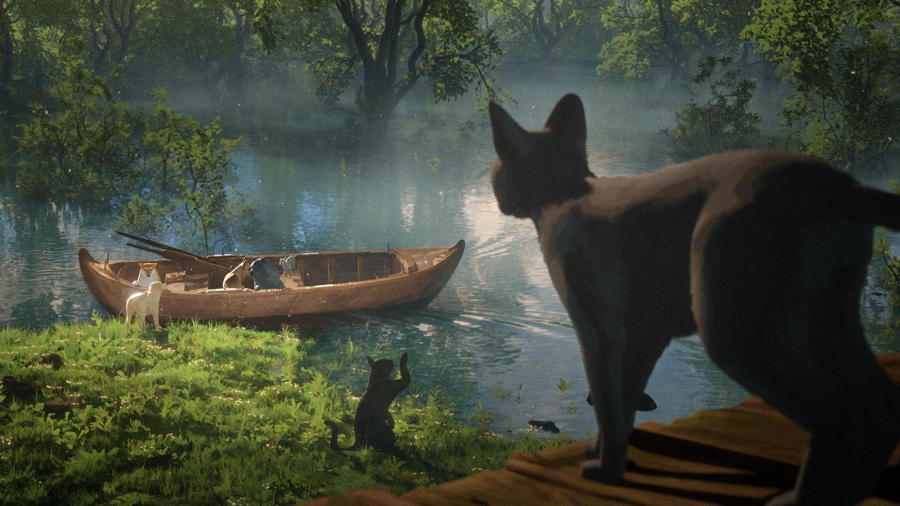
In the beginning, the cat is roaming the grassy slopes by a river and close to a wooden house once occupied by a woodcarver who has created figurines and some enormous statues of cats. When did the humans leave? Why are there no other cats around? We aren’t given any background. The narrative is kicked into life by a terrible pounding which signals a stampede of deer. This appears to be a form of folk legend and occurs again later. I tend to link Latvia with the other Baltic states, including Sweden and Finland, so deer and elk seem likely to be associated with folk tales. But a little while later the cat finds herself on a small sailboat in what appears to be somewhere in South Asia/South-East Asia. To complicate matters further, the first occupant of the sailboat is a capybara, a large rodent (the size of a pig) from South America. A ring-tailed lemur and a large long-legged bird will also join the crew. I’ve seen a suggestion that the bird is a secretary bird. This species lives on the African savannah and usually has a black cap and doesn’t often fly, hunting on the ground.The appearance and behaviour of the various creatures is sometimes inaccurate but this doesn’t really matter. What is important is that the actions make sense and seem plausible in creating a narrative.

The narrative itself is not particularly detailed or complex. It doesn’t attempt to follow the Hollywood style of a quest or ‘goal’. By the end there is simply the establishment of a group of creatures who support each other to keep alive. They comprise the capybara, the lemur, the dog and the cat. The secretary bird departs in the one seemingly magical/mystical moment in which it flies towards the sun. If you search on YouTube you can find various explanations of the ‘spiritual’ qualities of the film and the links to the myth of Noah’s Ark etc. I confess none of this occurred to me. I was heartened to find a video interview with the director who explained it simply. The cat has two great fears – a fear of water and a fear of joining a group of other animals. She manages to overcome both and the director says that in a sense it is his story about making the film. He had previously worked on his own on small projects. Now he had to make the leap to a bigger project and to work with others.
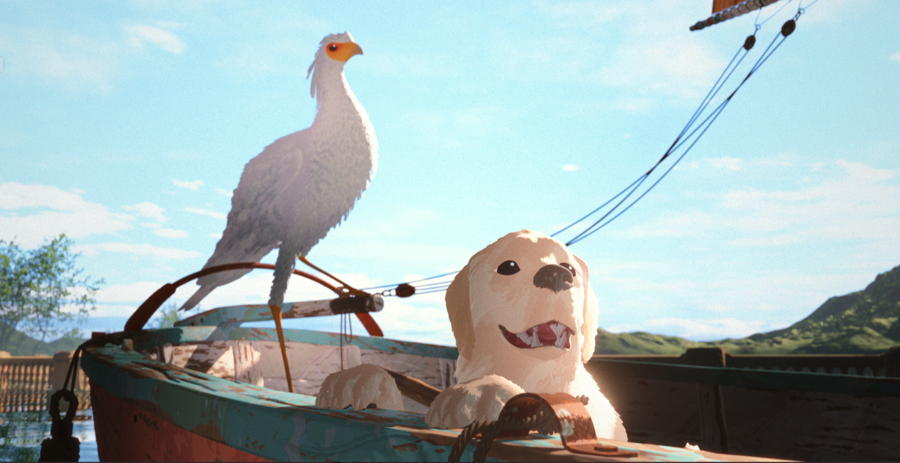
The most familiar of the creatures in the film are the dog and the cat which both display the behaviours that most of the audience will recognise. I’m thoroughly a cat person but I’ve met enough dogs to recognise common behaviours. The soundtrack of the film in terms of animal noises is amazingly good. Our cats are very vocal. I may not be able to translate the sounds into human language but I can tell what they want or how they feel. This is the real magic of the film for me – a tiny gesture, an almost imperceptible squeak or squawk. I’ve also spent many a happy moment watching a cat fascinated by a beam of light caused by a fluttering metallic object, reflected and bouncing around a room. This is caught very well on the boat in the film. There has clearly been a great deal of research by animators in the different teams in Latvia, France and Belgium, videoing their pets and recording sounds.
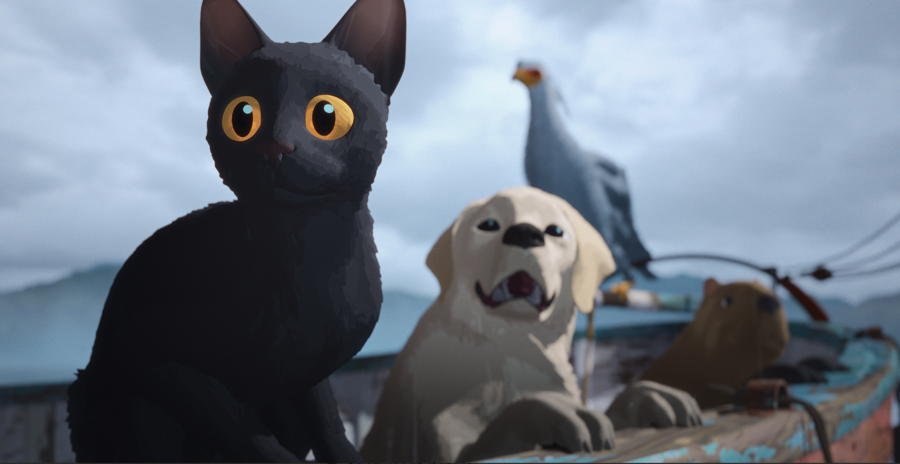
The other major question about the film concerns the technology. Like most of the reviewers I don’t really know enough about animation techniques to explain everything clearly. On a very simple level it looks like the backgrounds are painted and the animals are presented as if in live action using a free software tool called Blender which the animation teams then developed as a tool for this particular production. It enabled them to render movements quickly as they tried to build actions. The result does mean a certain roughness to the physical characteristics of the animals, e.g. in the slightly pixellated edges of some animals in close-up. The emphasis on the water of the flooding means a third ‘in between’ form of animation which I found very impressive. The film has a ‘U’ Certificate in the UK – suitable for everyone. I’m no expert on younger children but that seems right, although parents should be aware that some of the potential hazards faced by the cat are quite terrifying, including the swimming. If children are very attached to a pet they might be upset.
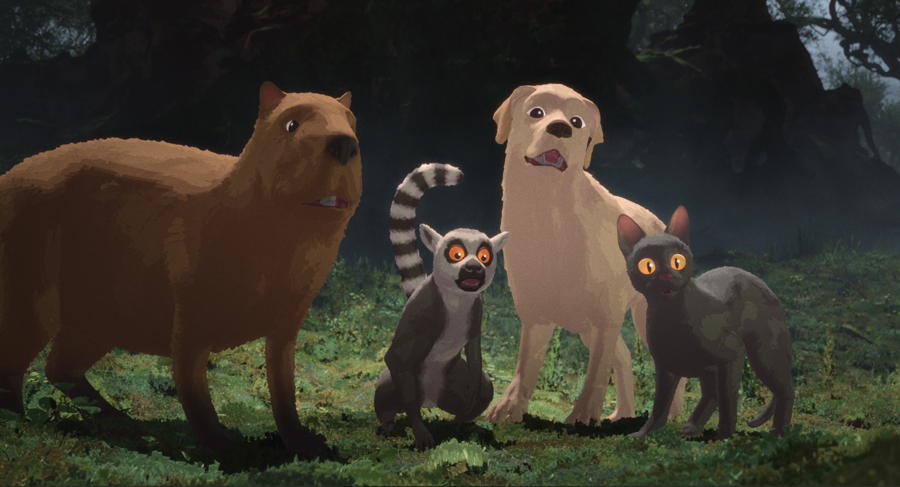
I enjoyed the film very much. I can’t compare it to Hollywood animations which I haven’t seen for many years but it stands up well to other European animations and to anime from Japan. One of its strengths is that it can be interpreted from many different angles. I think it is a potential fable about different animals working together in the context of ecological disaster. I’ve realised that the four survivors are a little like the Four Musketeers. But if someone else wants to see it as a biblical/spiritual fable that’s fine too. Flow is still in cinemas in the UK and around the world it has been a success in the context of its small budget with $27 million at the box office. Europe has been the biggest market, led by France, which like Mexico, has outperformed the US/Canada. It doesn’t seem to have opened yet in Japan. I’m intrigued by what Japanese audiences make of it, both because of the popularity of cats and anime. It seems widely available on streamers in the US and in the UK the film is distributed by Curzon. When it finishes its cinema run it will be available on streaming and then on DVD/Blu-ray.
Here’s an interview with director of Flow:
 itp Global Film
That is one movie I want to watch. An animated project with no humans and animals that actually don’t talk is a huge aversion of tropes expected for movies like this.
LikeLike
I hope you can find it to watch. It sounds like you will really enjoy it.
LikeLiked by 1 person
Sure thing. That could be good one to watch and review in the future.
LikeLike