

This beautiful and moving film is a real winner and I’m delighted that I was able to see it at the wonderful Hebden Bridge Picture House having missed its screenings in Bradford. The film is distributed by day for night in conjunction with West End Films and is currently touring smaller venues after its opening on 14th February. The film is also showing in Ireland via ACCESS>CINEMA. Screening dates for some UK cinemas are still available through the day for night website. day for night specialises in first films from Asia and Latin America and has now shifted its location from the UK to Japan. The company has a strong reputation and the films are always worth a look.
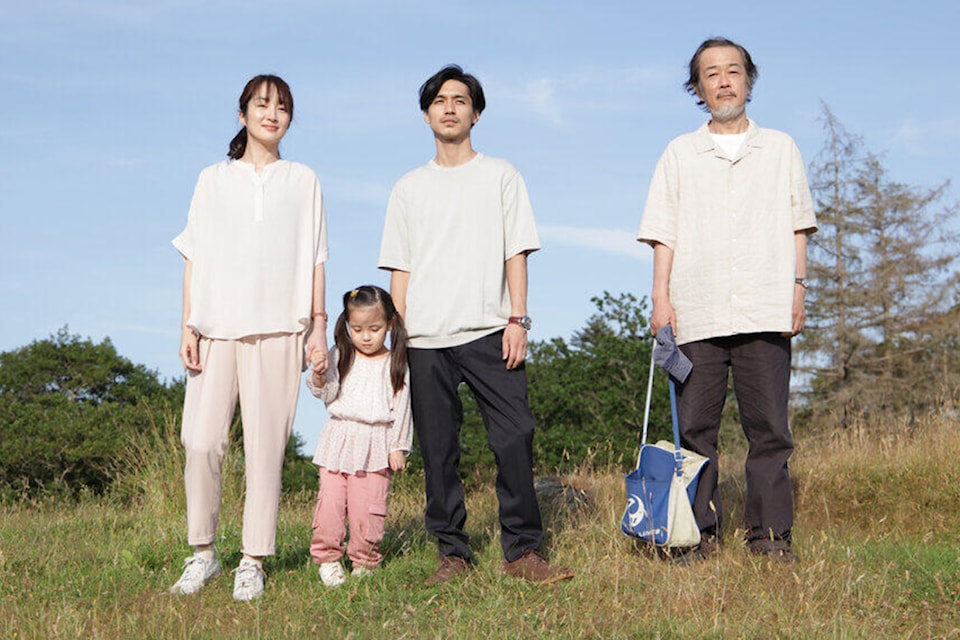
Patrick Dickinson is a British filmmaker who has lived in Japan and this story was first worked on for a short film Mr. Rabbit (US 2013). Dickinson worked on developing the narrative into a full length feature for several years while he took leading producer roles on a range of films including documentaries and series for Netflix, Amazon Prime and ZDF in Germany. The film was finally made as a UK-Japanese production, shooting in both countries. The lead role of Kenzaburo, a Japanese man in his early sixties was eventually taken by Lily Franky, the star actor associated with several of the films directed by Kore-eda Hirokazu including Shoplifters (Japan 2018), which made a big impact in the UK. Cottontail is a family melodrama of sorts and therefore not dissimilar to the films of Kore-eda. Kenzaburo is a writer who early in his career taught English in Japan and we see him as a young man meeting Akiko a prospective student in a Tokyo bar where she wants to know how to pronounce the English word ‘rabbit’. It’s a difficult word for Japanese speakers who need to learn the technique to produce the correct sound of the ‘r’. Akiko spent some of her early childhood in England. The narrative opening soon reveals that Akiko (Kimura Tae) has now died after forty years of marriage and it is the day of her funeral. Kenzaburo has to be cajoled by his son Toshi (Nishikido Ryô) to attend the formal ceremony where he is given a letter by the abbot of the temple. The letter gives the last instructions of Akiko who asks Kenzaburo to scatter her ashes on Windermere in the English Lake District.

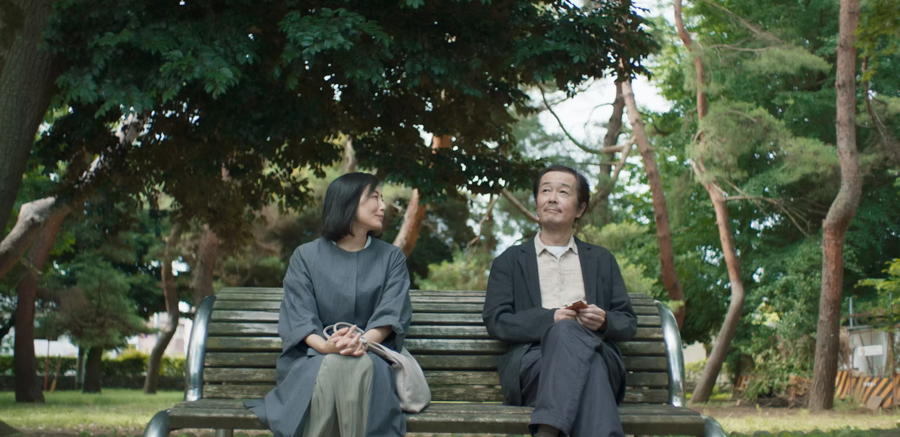
Toshi has a strained relationship with his father but eventually gets him to agree that Toshi and his wife and small daughter, Satsuki (Takanashi Rin) and Emi will accompany him to England. The only clue to the reason for Akiko’s request is a copy of The Tale of Peter Rabbit by Beatrix Potter inside which is a small photo of Akiko as a child with her parents standing on the edge of a lake. I knew nothing about Potter as a child but I did spend many holidays and day trips to the Lake District so I was intrigued to see what would happen. Certain aspects of British ‘heritage’ culture are very popular in Japan, I think. The narrative progresses at a relatively slow pace with several flashbacks neatly worked into scenes to show Akiko’s eventual decline into a form of dementia. There is no doubting the love between husband and wife, but Kenzaburo does seem to be a distant father, too often contained within the books he writes.


Once in London and with train tickets purchased, Toshi hopes to fulfil his mother’s request but his father suddenly takes off, not quite sure where he is going. Eventually he will find himself by Windermere (the name includes ‘mere’ or ‘lake’ – there is only one ‘Lake’ in the Lake District, most ‘lakes’ are titled ‘Mere’ or ‘Water’). He gets there with the help of a father-daughter pair of Yorkshire farmers, Jack and Mary played Ciaran Hinds and his daughter, Aoife. But finding the exact spot where the original photo of Akiko was taken is not easy and Kenzaburo eventually phones his son in London.


As this outline suggests, this is a fairly simple and straightforward narrative despite the flashbacks. The structure is a specific form of the road trip that involves scattering the ashes of a loved one. The ‘difference’ in this case is two-fold, the trip is about re-uniting Kenzaburo with his son, daughter-in-law and granddaughter around the memory of Akiko and also making the trip in the context of the strong parallels between certain aspects of Japanese and British culture. Viewed from the UK, Japanese culture seems on the one hand very different but really we have much in common. A relatively densely-populated island located offshore from a continental land mass and with a history of maritime power, a misguided lurch into imperialism is central to the last 150 years of each country. Tea, whisky, beer and railways and driving on the left are shared passions and many Japanese are fascinated by certain aspects of British culture. In our local town there are signposts and information in Japanese pointing to Brontë country. I was not sure if there is the same interest in Beatrix Potter but I found this report in The Japan Times, about a museum display in Japan which recreated Beatrix Potter’s house for the 150th anniversary of her birth. The report described Peter Rabbit as ‘one of the most adored bunnies in Japan’.
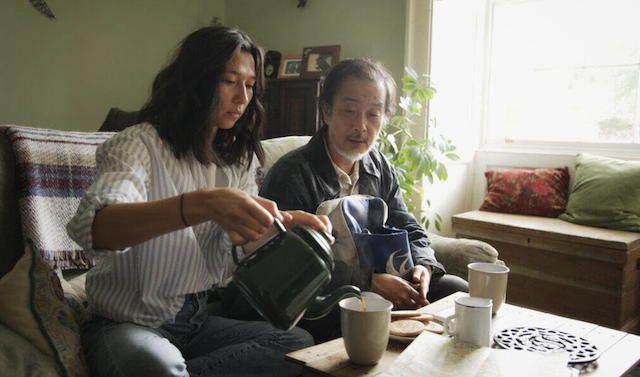
Cottontail works for several reasons. The performances, especially by Lily Franky but also the other principals, are strong and the ‘Scope photography by Mark Wolf works well in the presenting the beautiful landscapes of Northern England and the more confined settings of Tokyo. Dementia is a terrible illness in many ways and it causes grief for the sufferer and for family members. The film doesn’t shrink from that but it also focuses on the slowly repairing relationship between Kenzaburo and Toshi. The choice of the Yorkshire farm couple as a parallel works effectively. Overall, Patrick Dickinson handles this first feature very well and I recommend the film highly. In the US, the film is already available on streamers and I hope it is also picked up by them in the UK. I suspect that the film generates a positive ‘word of mouth’ from audiences. That’s what I heard in Hebden Bridge, so do look out for it.
 itp Global Film