

Having been unable to see this film on its cinema release, I was pleased to view its TV début on BBC2 and it is now available on iPlayer in the UK. I fear I have missed several of the Black British films released in the last few years and it was good to see the work of writer-director Dionne Edwards who was named as a ‘Screen International Star of Tomorrow’ in 2019 after a series of short films and well-received TV work. Pretty Red Dress is her début feature. The film was supported by both the British Film Institute and BBC Films. It’s a form of family melodrama with a strong music performance element. As in most melodramas there are also comedy moments. Travis (Natey Jones) is released from prison on parole. We don’t know why he was incarcerated. He’s met by his partner Candice (Alexandra Burke) and they are getting re-acquainted when their teenage daughter Kenisha (Temilola Olatunbosun) returns from school where later she seems to be in some form of trouble. We soon realise that all is not as it should be between Travis, his brother, his mother and her partner. But first we follow Candice whose agent has got her an audition for the main role in a West End musical based on Tina Turner’s early career. After the first audition which seems to go well the family are excited and Travis buys Candice a short red dress that they both like (and which reminds us of Tina Turner). To acquire the money to buy the dress Travis reluctantly takes a kitchen porter’s job in his brother’s bar-restaurant. The dress will become a pivotal ‘significant object’ linking together the three members of the family, each of whom find themselves facing questions in their own personal dramas which will affect their other family members, but which they are reluctant to discuss with them.

The audition is a big deal for Candice. She is currently working as a cashier for a large supermarket business but she has had a singing career with a local group for some time. With Travis in prison she has been solely responsible for Kenisha during the time that her daughter has got into fights. Kenisha is 14 and experiencing the usual adolescent struggles with friendships and her own sexual identity. Travis too is questioning his own identity. It soon becomes apparent that the red dress doesn’t only look good on Candice. Travis has free time alone in the flat during the day and he begins to experiment wearing the dress and then adding lipstick. It seems inevitable that Candice and possibly Kenisha will return home unexpectedly. How will he explain himself? I don’t want to spoil any more of the narrative. I’ll just say that I thought the resolution of the narrative works well and isn’t necessarily what might be expected.
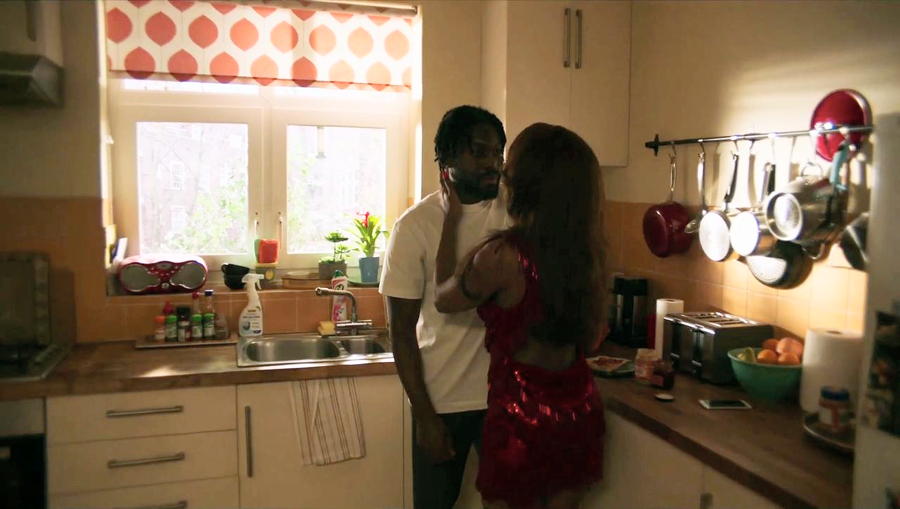
I enjoyed the film very much. As with other films I’ve seen recently I do think it is held together by the three central performances. I think the pacing may be a little slow for some audiences but with such engaging characters I didn’t find it a problem. I didn’t know any of the three leads but I see now that Natey Jones has both stage, TV and film experience going back as far as 2013. Temilola Olatunbosun, by contrast makes her first appearance in a film. I should know all about Alexandra Burke but I don’t watch reality TV or stage musicals and I am oblivious to contemporary popular music, so I’ve missed her other performances and I wasn’t aware of her celebrity status. I am now. She has a fine voice and holds her own in this film role. I feel that Dionne Edwards deserves praise for her ability to create a real family group through these performances. I’m conscious that my own understanding of Black British film is now sadly out of date. Forty years ago I was very aware of aspects of the lives of Black youths in Lambeth. I can’t claim that now but this film feels like it represents something real and I’m glad that it is a family melodrama rather than what developed as an ‘urban youth picture’ in the 2000s. There is quite a bit of music in the film and the fact that much of it is vintage Tina Turner era music was a bonus for me. I was also pleasantly surprised to hear the Shangri-Las, always a personal favourite. As well as Alexandra Burke there is some material sung by Tsemaye Bob-Egbe who also has experience of singing Tina Turner-style in West End musicals.

I’ve read most of the easily accessible reviews of the film. Overall it gets the high rating it deserves and some reviews are quite perceptive about the family relationships. Some of the minority negative reviews baffle me completely but one of the disappointing aspects is that the music is not discussed in any detail. (The review by Charlotte O’Sullivan in the Standard is an exception.) Two reviews describe aspects of the film as ‘Mowtownesque’. I think this is because the reviewers spotted a couple of framed posters for ‘Motown Revue Shows’ in Candice’s flat. That’s an interesting detail of the mise en scène but it doesn’t relate directly to the music in the film. Motown was the ‘pop’ end of Black American soul in the early 1960s. The more ‘roots’ Southern soul of Stax introduced more adult soul music in the mid 1960s but Ike and Tina Turner (with the Ikettes) pre-dated both Motown and Stax and rather than studio-driven, Tina Turner’s performances were ‘home-grown’ and fuelled by the abuse handed out by Ike Turner. At the very start of Pretty Red Dress we see a recreated Tina Turner performance of ‘You Shoulda Treated Me Right’ (a 1962 song written for Tina by Ike Turner) with Tsemaye Bob-Egbe giving a knockout performance. The film ends with Alexandra Burke singing ‘Game of Love’ a 1970 song also written by Ike Turner but with Candice singing as herself rather than emulating Tina Turner. As Charlotte O’Sullivan points out, this song might have some direct connections, albeit ironically, to the narrative of Pretty Red Dress. ‘Game of Love’ is from the same Ike and Tina Turner LP as the John Fogerty song ‘Proud Mary’ sung in the film by both Alexandra Burke and Tsemaye Bob-Egbe. Elsewhere in the film, the songs associated with Candice tend to be from the 1960s and 1970s, When the couple go to the party for Travis and his mother, the music is reggae and for Travis himself it seems to be more rap and for one of his scenes with the dress it is a modern ‘electro-soul’ track by the British-Jamaican singer Denai Moore – ‘Mirror’ written by Hugo Brijs who also scored the other other music in the film. The soundtrack can be sampled on SoundCloud.

Researching the music has got me thinking about other aspects of the film. I wish I knew more about current Black British music and also about the current discourse in London Black communities about masculinity. Travis is a very interesting character and he seems to be passive-aggressive in his relationships. His relationship with Candice certainly includes forms of role playing but I’m not sure about the language they use in reference to his love of the dress and how it makes him feel. As for the narrative overall, I think there is a struggle to try to retain a balance between the three central characters in the sense that although Kenisha’s story is less developed, those of Travis and Candice have roughly the same screentime but we know a little more about Travis and his family background while Candice and her back story are almost completely unknown. I do wonder if the script might have worked better as a two or three part TV narrative? Having said that I think Dionne Williams wanted to make a cinematic feature. I’ll certainly be interested in the next film she makes. Currently her work is on display in the TV series A Thousand Days, but this is only available via Disney+. As well as iPlayer, Pretty Red Dress is also available via a BFI Blu-ray and on various streamers in different territories. I’d love to know what US audiences made of the film, especially because it seems to me to be very London and British.
 itp Global Film