
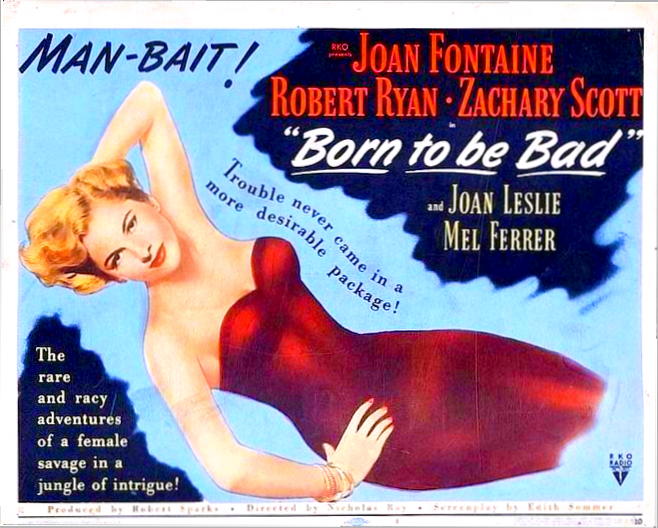
It’s a wonderfully trashy title but this Nick Ray film delivers something unexpected I think. In one sense it fulfils the promise of the title but it also teases us with other readings, not least a sense of genre confusion. Among the various reactions of audiences, reviewers and scholars at the time and subsequently we find references to melodrama, the woman’s picture, romance and film noir. Of course, it could be any of the four but also it could be a genuine hybrid in which one or two elements of each categorisation are included. A second ‘mix’ is found in the casting with some star performers playing to type and others against type. Finally, its institutional status and production background mire it in that torrid period at RKO when Howard Hughes was trying to assert his dominance and Nick Ray was struggling to make films that he thought were worthy of his artistic endeavour.

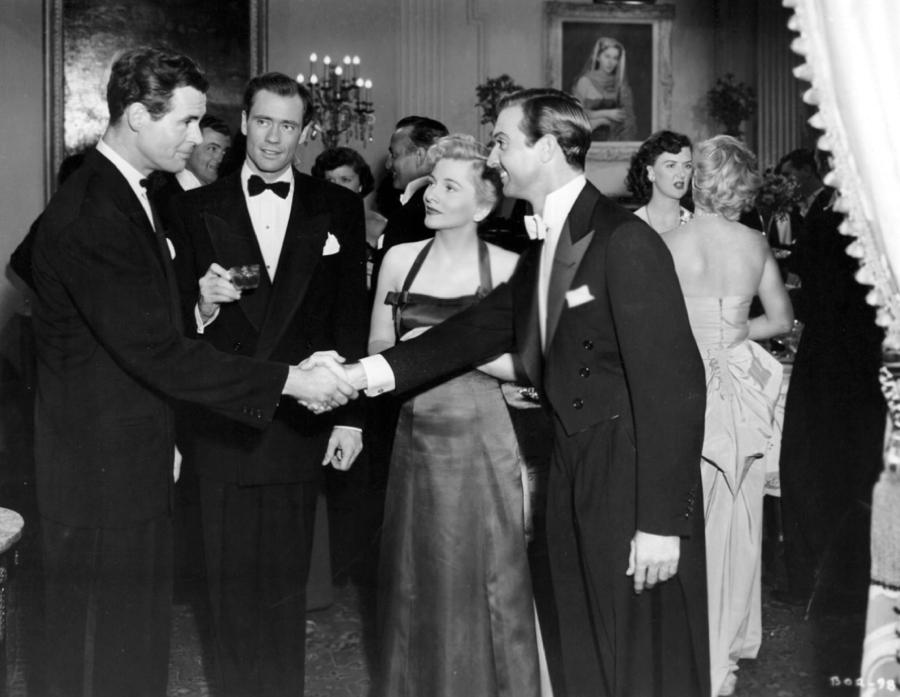
The original property is also intriguing – a novel by Anne Parrish, a writer of children’s stories and adult romances, published in 1928. This is interesting as a film adaptation at that time during ‘pre-code’ Hollywood might have developed some aspects of the story. The title of the novel was All Kneeling which was considered for the film at one point. There is a long production history which we’ll explore below. There are several versions of the film and I think the one I watched was the shortest. The central character is Christabel Caine (Joan Fontaine) who has been brought up by her Aunt Clara in the small town of ‘Santa Flora’ and arrives in San Francisco to attend Business School. Her uncle John, a book publisher, has arranged a room for her in the apartment of his secretary Donna Foster (Joan Leslie). Christabel arrives a day early (possibly deliberately) meaning Donna has little time to get to know her as she is in the midst of organising a society party in honour of the artist Gabriel (‘Gobby’) Broome (Mel Ferrer). Also at the party will be Donna’s boyfriend, the wealthy socialite Curtis Carey (Zachary Scott) and a brash writer, Nick Bradley (Robert Ryan), whose novel is being considered for publication by John Caine. We meet all these people in the delirious opening section of the film which Ray stages around the staircase and landing of Donna’s apartment, aided by Nicholas Musuraca’s camera movements.
Joan Fontaine’s Christabel at first appears to be a charming and rather fragile young woman who over the course of the narrative will prove to be the complete opposite – a scheming and ruthless woman motivated by acquisition of money and material possessions as well as the satisfaction of ‘winning’ the attention of any man she meets. I think that she’s possibly the most loathsome character I’ve met in a picture for a long time. It’s not so much what she does (which is certainly ‘bad’) but the fact that she communicates exactly the opposite set of intentions. I’m not going to spoil the plotting of what several reviewers refer to as this ‘soap opera’ but rest assured she hurts everyone in the cast apart from Gobby, who having painted her portrait will later benefit from her notoriety. Joan Fontaine was 32 when she appeared as Christabel and therefore possibly ten years too old for the part. She was a very good actor and had appeared in Letter from an Unknown Woman for Max Ophuls (her best film in my view) a year or so earlier in a role in which she aged from a teenager to a mother quite believably, but in this RKO production she is presented in a stream of designer outfits that empathise her graceful neck and shoulders as well as her fine features, but also her slim and boyish figure. Various reports suggest that RKO originally considered Barbara Bel Geddes for the role. Ironically she also starred for Max Ophuls, opposite James Mason in Caught (1948). She would have been a very different Christabel. As it is, I took against Fontaine’s Christabel from the start, partly because she is seen next to Joan Leslie’s Donna. Leslie had taken a couple of years away from acting having moved into freelance working after leaving Warner Bros. in 1946. Another irony is that Leslie had played the younger sister in The Hard Way (US 1943) in which she is built into a star by her older sister played by Ida Lupino. Born to be Bad is also compared to that other 1950 film that swept everything else aside, All About Eve, in which Anne Baxter is the seemingly innocent young actor who undermines Bette Davis.

If Joan Fontaine plays against type, the three male leads are more closely aligned with their generally recognised personae. Zachary Scott is the weak but smooth Curtis and Mel Ferrer is the elegant and amusing ‘Gobby’ who several reviewers see as suggesting a gay character. Most striking however is Robert Ryan playing the hard-nosed novelist who has been travelling in China and makes a play for Christabel while delivering some of the best lines in the film. At 6′ 4″, Ryan could be a dominating and potentially terrifying figure with a piercing look. One of my favourite actors, he was in fact the opposite of the type he often played and there are moments in his performance in this film in which the smiling open face and sparkling eyes belie his usual type. He was the supreme professional and appeared in three more pictures for Nick Ray, the best of which is On Dangerous Ground (1951).

The American Film Institute has an entry for Born to be Bad that offers a great deal of background information. It appears that RKO began to prepare a production as early as 1945 when Joan Fontaine was already pencilled in. Over the next few years several different producers and directors were considered and at one point in 1948 Gloria Grahame, a contracted RKO player, was put forward as the lead but was then vetoed by Howard Hughes, a known supporter of Fontaine. Hughes put the production on hold until 1949 when Ray was selected as director. The production always looked as if it might run foul of the Breen Office of the Production Code Administration (PCA) because of the suggestion of “implication of illicit sex which is treated without the proper compensating moral values”. It then transpired that RKO had approved a foreign version of the film that the Legion of Decency in the US heard about and put pressure on the studio to withdraw it and substitute the domestic version. This seems a weird development unless the Legion of Decency was concerned that ‘American values’ should be preserved overseas. I knew I had a Spanish release version somewhere but when I found it and compared it with the US version I’d found online, they were identical. Nevertheless, the AFI details two versions of the ending of the film which meant some re-writing and shooting (which Ray didn’t undertake). I presume that this second ending was presumably deemed to fulfil the Breen Office requirement that Christabel be seen to have been punished in some way for her immoral behaviour. I’ve read descriptions of the alternative ending but I’m not sure it meets the requirement. As it is the available print leaves Christabel’s future uncertain but the single shot of Gobby with his portrait of Christabel appears in both endings. He appears to have got it back from Curtis and he smiles as he doubles the price tag.

In the end I enjoyed Born to be Bad quite a lot, but I wish I could have seen the alternate ending. There is plenty of writing on the film and it would be fun to study the mise en scène and camerawork in more detail. I’ve come to terms with Joan Fontaine as Christabel but I would like to have seen Gloria Grahame in the role. It would have been a different picture and arguably much more disturbing for the PCA. In the clip below there is a good representation of sexual frisson between Nick and Christabel that presumably did disturb the Breen Office and below that is the original RKO trailer.
 itp Global Film