
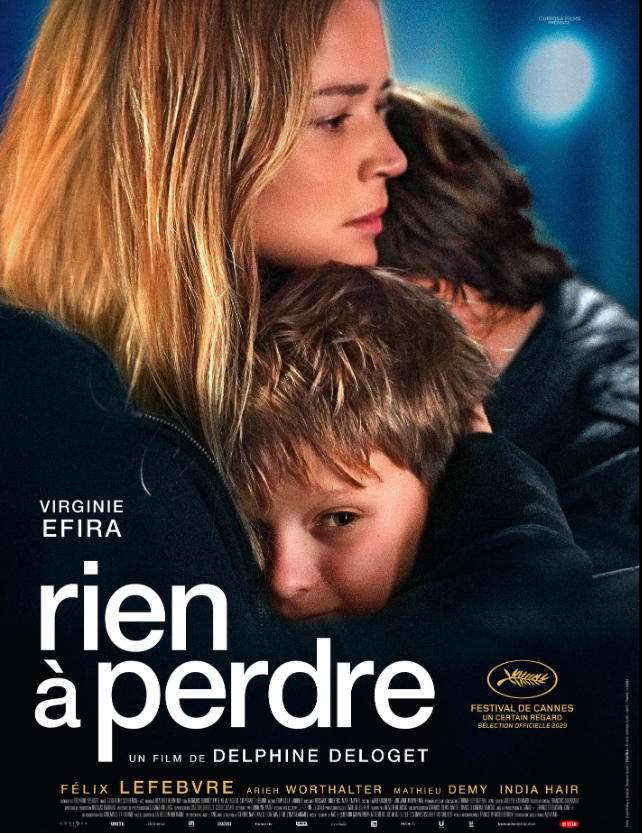
 This is the third film in this year’s festival to be a feature directorial début by a woman, but all three films are different. After about ten to fifteen minutes I had decided that this film seemed to be exploring the same dramatic conflict as Ken Loach’s 1994 film Ladybird Ladybird. The two films have the exact same theme but there are significant differences in the presentation. In both films a single mother is absent from the family home when her young child is injured in a fire and social services come and take the child away. The mother then has to fight the system to try to get her child back. The central character in both films is the mother and both films might be categorised as social realist dramas. I admire both films for both their approach and their qualities as film dramas but I found them both hard to watch because I became so involved in the story and could hardly bear to watch some sequences because I feared for the woman and her child. The difference between the two films is partly because the French director Delphine Deloget tells us in an interview that she felt that she needed a powerful and accomplished actress in the lead role because of the most difficult scenes. She therefore cast Virginie Efira as Sylvie the mother. Loach decided (as he often did) to cast a woman who was a performer but not an actor. Crissy Rock was a club singer and comedian only before Loach cast her. She won several acting awards for her performance and has since enjoyed a career on stage and television.

Ironically, Delphine Deloget has a background in documentary and believes that this background helped her in staging some scenes. This might have led her towards a Loachian ‘observational’ style, but she also felt that in parts she wanted her actors to move beyond realism/naturalism. I’m not evaluating the casting of Efira and Rock in any way. I think both performances are extraordinary. It would be interesting to compare the two films in more detail but since I haven’t seen Ladybird Ladybird for a long time I’ll focus only on the French film in this post. As usual, the French title of this film tells it like it is, literally translating as ‘Nothing to Lose’ – rather different from the anglophone ‘All to Play For’, which is in my view positively misleading in its suggestion of potential successes. Sylvie is working in a nightclub bar in Brest, the port town on the western-most tip of France in the department of Finisterre, ‘the end of the world’. One night her older teenage son Jean-Jacques (Félix Lefebre) is late getting home from an evening class and his younger brother 8 year-old Sofiane (Alexis Tonetti) sets fire to the kitchen while trying to make himself ‘frites’. Jean-Jacques improvises and rushes his brother in supermarket trolley to hospital where he is treated for burns. Sylvie has a difficult night in the bar and is then called to the hospital where Sofiane, fortunately not badly burned, is released. Later however Sylvie is visited by social services whose child protection officers take Sofiane into care. From this point on Sylvie’s life begins to fall apart.

The difficulty for the audience in this kind of drama is that there is a danger that the officers of the social services/child protection will be seen as the ‘bad guys’. They are of course, simply doing their job and following the rules. As the audience we have more knowledge. We know that Sylvie is a loving mother who will stop at nothing to protect her child and that the social workers are indeed the enemy for her if they are taking Sofiane away from her. We know too that she isn’t alone, there are plenty of friends around her – although as the problems mount up and she lashes out and some of them may withdraw. If we think about it, seen from the outside Sylvie’s family is ‘dysfunctional’. She has two brothers. Hervé (Arieh Worthalter, the star of The Goldman Case, France 2023) is the younger brother who seems to have failed to establish himself in a relationship or a job. He was absent on the night of the fire but is often available to support Sylvie. Alain (Mathieu Demy) is the older brother who has managed to hold down a job but has a history of gambling addiction. As Sylvie’s world begins to crumble around her both brothers will attempt to help her with varying degrees of success. It’s worth pointing out that the family is played by three major actor-stars with Félix Lefebre added as an upcoming younger star. The social workers, police, lawyers and other officials are by comparison fairly anonymous apart from the leading social worker Mme Henry (India Hair).
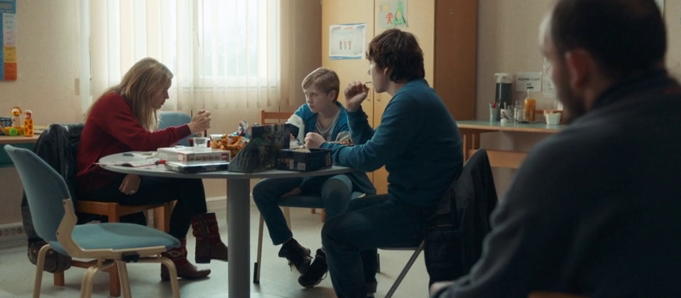
Our sympathies are inevitably with Sylvie and her sons. Virginie Efira is remarkable in her performance and riveting to watch. There is a danger that because she is such a mesmerising performer, that the narrative becomes only about her. It doesn’t – mainly because of the other strong performances and especially that of Félix Lefebre as Jean-Jacques who also has a story to tell. But what happens when Sylvie is finally driven to despair? The narrative is conventional in the sense that there is a climax and then a resolution which I think is cleverly written – the director has two co-writers, Olivier Demangel and Camille Fontaine. The film is photographed by Guillaume Schiffman but there is no music score as such with use only of diegetic music. This is an impressive features début for Delphine Deloget but so far, despite a Cannes screening and another Efira performance to savour, it doesn’t seem to have got a UK release. But it is available to stream on Apple and Amazon. I hope this isn’t going to become the norm for norm French films.
 itp Global Film