
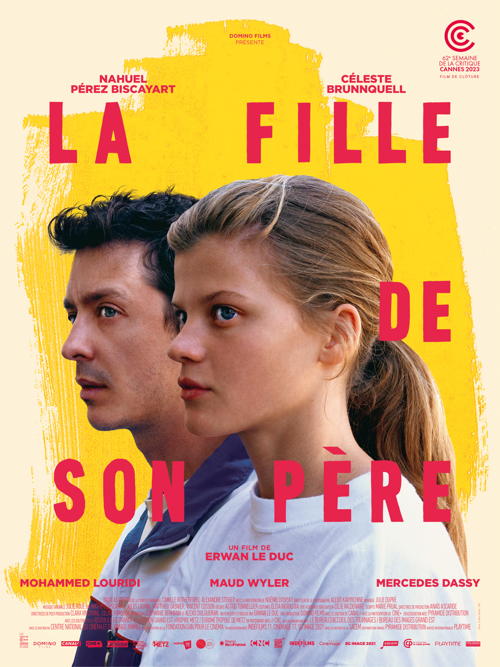
 Once again the anglophone title of a French film changes the way that audiences might approach a film: the literal translation of the French title is ‘Her father’s daughter’. For anglophone distributors the French title perhaps tells us too much? It focuses the narrative on the father’s close relationship with his daughter so I suppose you might argue that it doesn’t offer much of an enigma, whereas ‘No Love Lost’ suggests we need to look for a relationship that goes wrong, but doesn’t hint at which relationship.
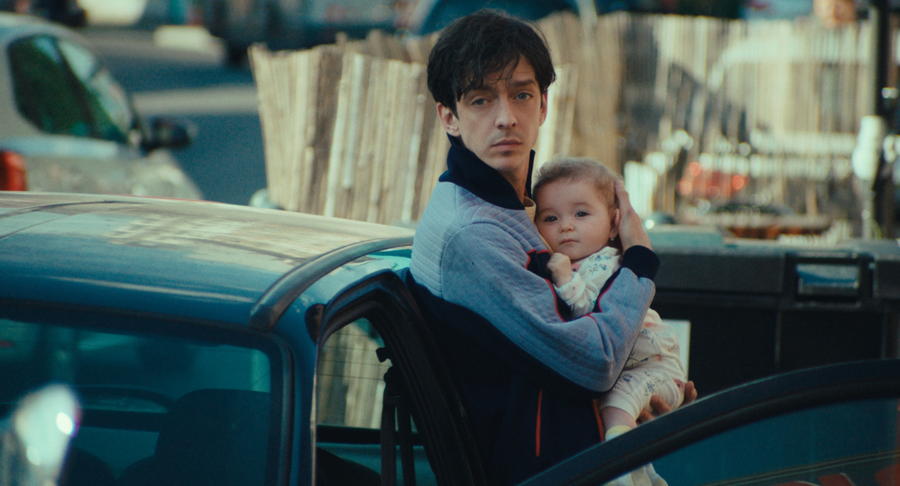
The narrative begins with our hero Étienne (Nahuel Pérez Biscayart) at a student demonstration where he is (for no discernible reason) seized by a police officer but then ‘rescued’ by a young woman and the couple run away through the streets of Paris before escaping down the Seine in a small boat with an outboard motor. This long wordless sequence ends up eventually with a small baby handed to Étienne’s parents. The young woman, Valérie (Mercedes Dassy) drives off and disappears without trace a little later leaving Étienne with his daughter Rosa. He rejects his parents’ offer to bring up Rosa and she becomes the focus of his life. His other passion is football and he becomes the coach of a small local team based at a municipal stadium (I think the credits mention the Parisian suburb of Fontenay-sous-bois). As Rosa grows up she too has a firm focus – on becoming an artist. When she is 17 and thinking of moving to an art college she decides on Metz in Moselle, close to the border with Luxembourg and Germany. In the meantime, Étienne has found a new partner, Hélène (Maud Wyler) who drives a cab (and plays the piano). Rosa has a boyfriend Youssef (Mohammed Louridi), a sensitive young poet.

Rosa’s possible move to Metz creates a certain tension as father faces separation from his daughter. But Étienne fully embraces the possibility and starts to make preparations. It’s only at this point that he spots Valérie on television in footage taken on the Portuguese coast where a giant wave is the centre of attention. What will he do? Will he tell Rosa? Here we have the enigma at last. I’ve described much of the plot but I don’t think the description gives away spoilers. Conventional narrative is not the basis of this film. It is described as a ‘comedy drama’ but that isn’t really a sufficient descriptor. It’s the second feature from writer-director Erwan Le Duc. He’s a former journalist and has quickly established himself as a filmmaker since the 2010s with both features and shorts being screened at Cannes and well received. It was only when I began to research the background to this film that I realised his first feature Perdrix (France 2019), which featured Maude Wyler, was part of My French Film Festival in 2020. It was billed as a comedy and it was certainly intriguing. I summarised it as “intelligent, entertaining and generally uplifting”.
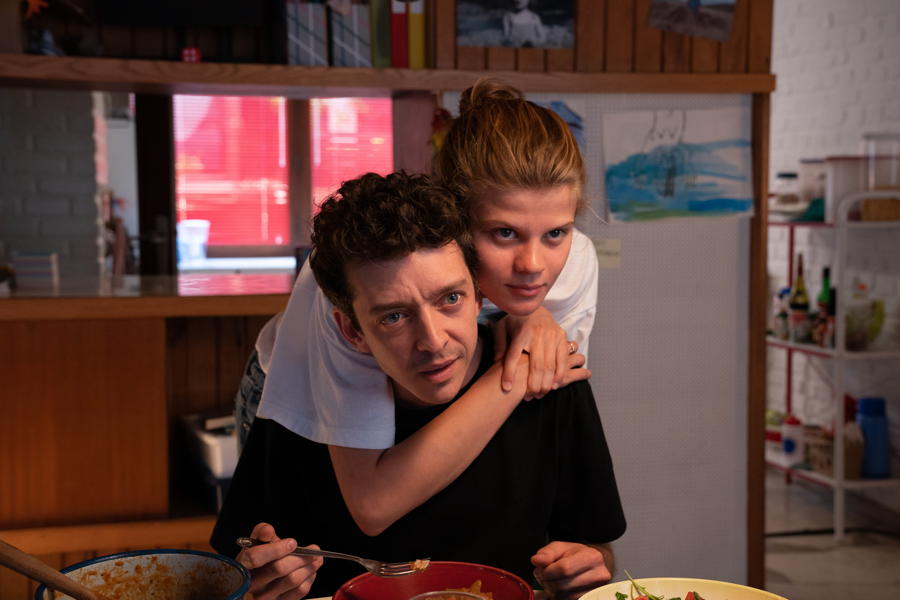
For this second film, Le Duc cast Nahuel Pérez Biscayart, the Argentinian actor probably best known for 120 BPM (France 2017) as Étienne. Biscayart is slight but wiry and flexible as an acrobat (which probably helped him in this role). Céleste is an attractive young woman with strong features and an assertive stance. Youssef is gentle and wise beyond his years. Hélène is similarly wise. Maud Wyler is actually in most of Le Duc’s films. Valérie perhaps exists mainly as an image, a potential ‘presence’. Mercedes Dassy like Mohammed Louridi was without much experience of film at the time of the shoot but she is a dancer and performer. Four out five in the cast have some form of artistic expression in the narrative. That leaves Étienne who is perhaps the most expressive of all in his own ‘performance’. I should also mention the wonderful short cameo by Noémie Lvovsky playing the local mayor and in effect Étienne’s employer.

I enjoyed all the performances and although initially unsure whether I was going to enjoy the whole film I ended up liking it very much. Le Duc is certainly an imaginative director. He’s not afraid to use fantasy sequences including a visual gag that seems to have been inserted just because it works in the scene so why not? Much of the narrative takes place in the summer – the last term of Rosa’s time at high school. It’s sunny and Rosa’s art is everywhere. Le Duc found a young woman artist at Paris Beaux-Arts art school and arranged to use her work, even commissioning some extra pieces. The many art pieces in the film have a real sense of identity. I was also impressed by both the cinematography of Alexis Kavyrchine and the music score by Julie Roué.
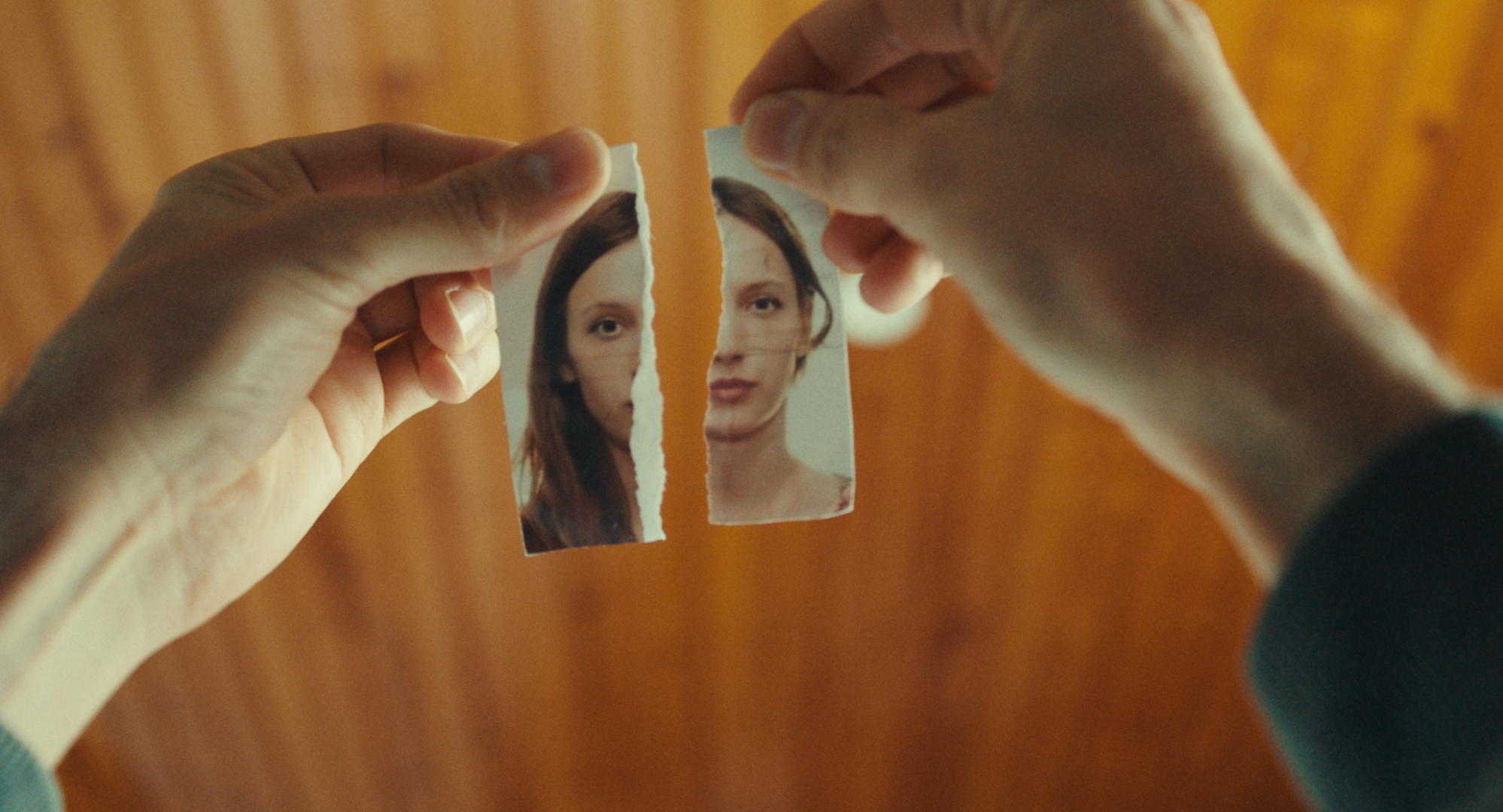
Erwan Le Duc’s first feature Perdrix did not, I think, make it into a UK release in any form and I fear the same fate might await La fille de son père because it is in some ways a difficult sell. That would be a real shame and a loss to UK distribution because I think the film has a lot to offer. If you come across it do give it a go. You might enjoy it as much as I do. Here’s the trailer but beware it gives away the enigma outcome:
 itp Global Film