

This six part crime fiction is reminiscent of Welsh serials such as Hinterland (UK 2013-2016) and Hidden (Craith, UK 2018-2022) which offered Welsh-language programming for BBC Wales and S4C, the former being produced in both Welsh and ‘mainly English’ versions. I think there is currently a similar production in Scottish Gaelic which I’ll get round to soon. Crá is a produced by Fíbín, an independent company based in Co. Galway and Zoogon a company with a Belfast presence and a head office in Co. Galway. Both companies make programming in Irish Gaelic. It was commissioned by BBC Northern Ireland and TG4, the Irish PSB for Irish language television. The production was supported by public funding agencies and other bodies in both the Irish Republic and Northern Ireland.

The key to the series origination and distribution/transmission is the location of the narrative in the far North West of Ireland in Co Donegal. The nearest large town (pop. 22,000) is Letterkenny but not much further away, over the border, is Derry (population 85,000), the second city of Northern Ireland. Cross-border issues crop up in at least two and arguably more strands in the narrative. The serial (6×45 mins) is a mix of police procedural, family melodrama and murder mystery. The inciting moment is the discovery of a body in the local bog by Garda officer Barry Roche. Only an arm is visible but eventually the body is identified as that of a woman who went missing 15 years earlier. She was Sabine, the mother of Barry’s immediate superior, Sergeant Conall Ó Súilleabháin. She was an artist married to Art Ó Suilleabháin, the owner of an abandoned modern hotel complex that overlooks the local bay. Soon, Inspector Patsy Sweeney and her two detectives, Cathal Keogh and Sorcha Conlon arrive and Conall, already presented as hot-headed and violent, is put on extended leave and told to keep out of the investigation.

The series title translates as ‘torment’ and that seems very apt given the context of Sabine’s disappearance and the tormented lives of several of the local residents. This is a close community with several conflicts bubbling below the surface. The discovery of the body will help to bring them to the surface and the presence of another ‘outsider’, Ciara-Kate, a young woman intent on making her name as a fearless podcaster on ‘true crime’ stories, will make sure that things develop quickly. In fact she does prove capable of digging up leads as well as disrupting the police procedural.

The central character is Conall. His difficult relationship with his father as well as two women, one close to his own age, one younger, becomes the central focus. The failure of the hotel after Sabine’s murder was a blow for the community but it still remains important in the melodrama because of the ‘goings on’ in the period before its closure. It also represents a symbol of what has gone wrong in the village. At least one character is directly linked to the ‘troubles’ over the border so there are plenty of narrative enigmas to pursue. As in the other series set in remote regions, the landscapes and the isolation of the community are important elements. We get plenty of long shots of cars travelling on roads that might see just a handful of vehicles an hour and at one point of crisis a special detachment of Garda is summoned from Sligo. After a few minutes we realise that they are still at least 30 minutes away from getting to an emergency.
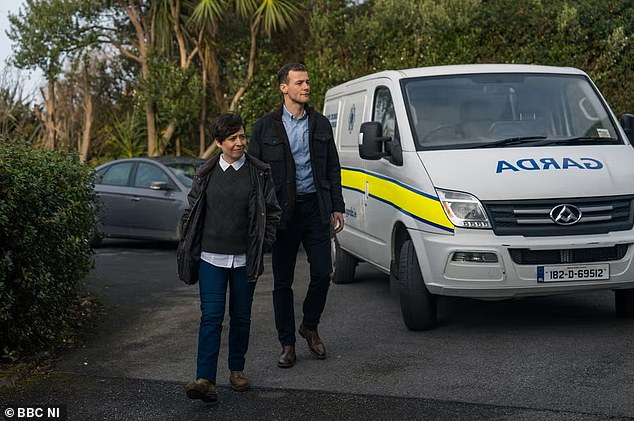
The whole narrative is presented in Irish Gaelic with subtitles. I recognised at least a couple of the actors, including Dónall Ó Héalai who plays Conall and was the lead in Arracht (Ireland 2019) a Gaelic language film set during the famine and renamed Monster for the international market. I also recognised Roisin Murphy as Annemarie but I needed to look her up to discover she had been an important player in What Richard Did (Ireland 2012). The characters and to a certain extent the landscapes are familiar to me but the language isn’t. The subtitles are fine but some of the references defeated me. I was puzzled for a while by ‘ICE’ until I discovered it’s the UK agency for Immigration Compliance and Enforcement – does its Irish equivalent use the same acronym?

The film was written by Richie Conroy and Doireann Ní Chorragáin and directed by Philip Doherty. It was photographed in ‘Scope by Richard Kendrick who manages to capture the atmosphere and the feel of the landscape and the community very well. There are several music pieces on the soundtrack and I think these can be found on Spotify. The serial’s strength is not so much its story as such – many of the narrative elements are familiar from other TV crime fiction productions. Some of the central ideas such as Ciara-Kate’s podcast are very much ‘of the moment’. More important is the impact of the setting, both the landscape and the small community. The Garda decide on a re-enactment shown on local TV but within the small community, everyone knows something about every other person’s business so the impact is quite different than it might be in an anonymous city. I enjoyed the serial very much. I thought all the performances were good and the writing provides some touches of humour which leaven the ‘torment’ effectively. There is also a brief dream fantasy moment. I think the serial finishes its run on BBC4 this week, having shown on BBC Northern Ireland towards the end of 2024. It is currently on BBC iPlayer. I hope we get other similar serials from this part of the world.
 itp Global Film