
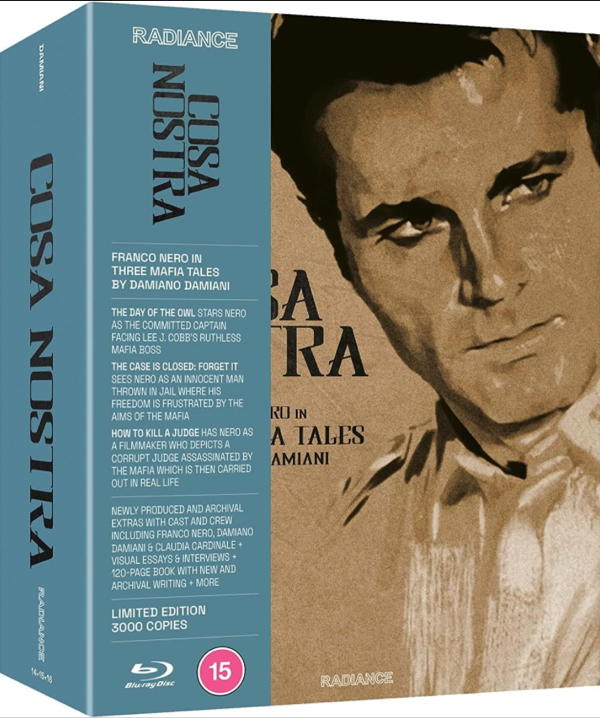
The Day of the Owl (a.k.a. Mafia) is available in a handsome Blu-ray presentation by Radiance released in September 2023. Radiance is a UK Physical media imprint similar in some ways to Powerhouse/Indicator but focusing much more on films from the genre cinemas of Europe and East Asia. The company releases films in the best possible quality prints. It doesn’t release on DVD. Blu-rays are released in North America as well as the UK. I have only watched rented copies of Radiance discs so I can’t comment on print materials issued with some discs. The Day of the Owl is one of three Damiano Damiani mafia films collected together in the Radiance box-set. Check out the ‘shopfront’ site here.
I don’t think The Day of the Owl was ever released in UK cinemas so this is a welcome chance to see a significant Italian genre film by a feted director (and based on a successful novel). I found it an intriguing and enjoyable watch prompting several important talking points. The director is Damiano Damiani (1922-2013). He was known as both a scriptwriter and a director. This was the third of his films that I’ve watched following The Witch in Love (La strega in amore 1966) and A Bullet for the General (El Chuncho, quien sabe? 1966). This period of Italian cinema and Damiani’s films in particular represent a time when genre pictures were moving towards ‘arthouse’ and sometimes ‘political’ issues. The Day of the Owl is adapted from the novel by Leonardo Sciascia (1921-1978). He was born in Sicily and he also wrote the original novel for the film Illustrious Corpses (Italy 1976) directed by Francesco Rosi. Both novels cover crime in Sicily. Sciascia was a celebrated writer and his novel, The Day of the Owl, published in 1961 brought Mafia activities to wider attention, as well as making connections to political corruption. The film changes some aspect of the original narrative but overall carries the same message. What is surprising, given later crime narratives, is that there is less ‘action’ than might be expected and more attention given to ideas about masculinity and the control exerted by the local boss.

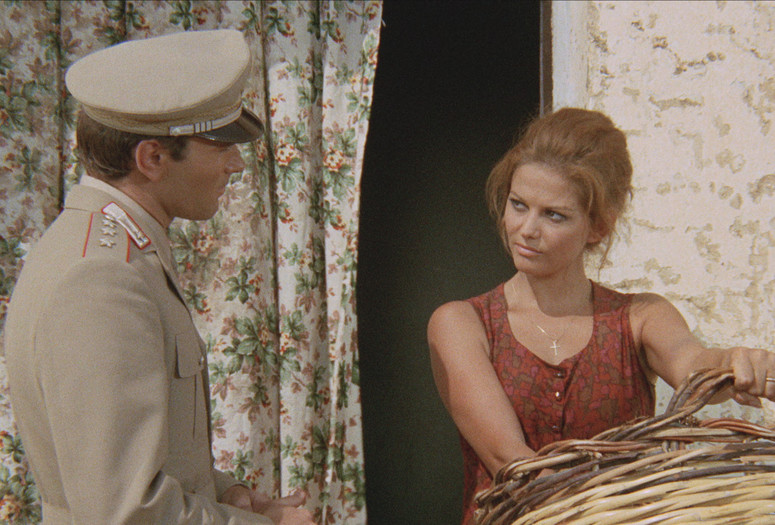
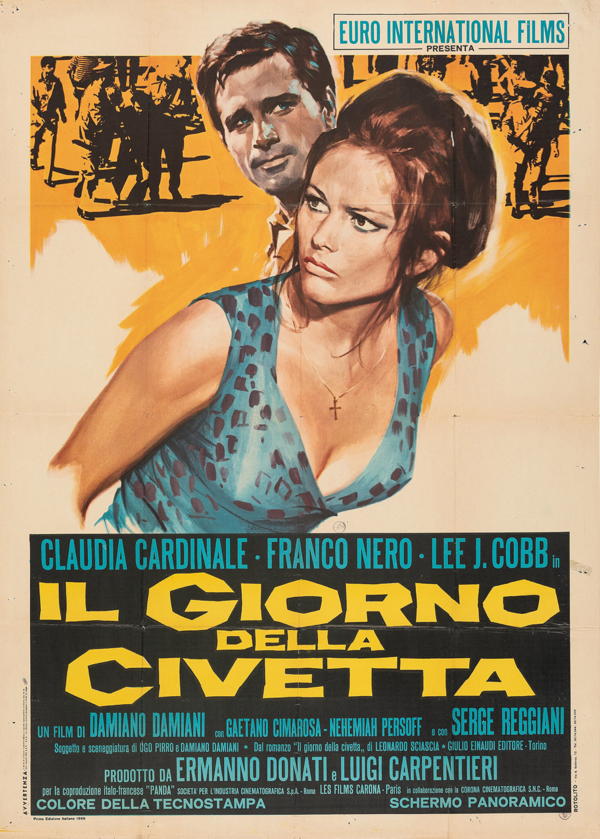
The characters are to some extent familiar and the narrative ‘disruption’ before the narrative proper begins is the arrival in a small Sicilian town of a new Captain for the local carabinieri. A transfer from the North, Capt. Bellodi is played by the handsome and charismatic Franco Nero, who was 26 at the time and whose father was actually a carabinieri officer. Nero went on to become one of the most important actors across international productions, especially in Europe. The actual ‘inciting incident’ is the assassination of a truck driver early in the morning on a country road outside a small town. We soon realise that the local Mafia boss played by the Hollywood actor Lee J. Cobb effectively runs the town and is the most likely suspect to have organised the shooting. The narrative enigma involves two questions – who actually pulled the trigger and why was the man shot? This is a film about men and masculinity but the star, as the poster makes clear, is Claudia Cardinale who had come to international attention in Sergio Leone’s Once Upon a Time in the West (1967). In this Mafia film she plays the wife of a man who has ‘disappeared’, perhaps heading to Palermo for work. The couple live on a hill above the bend in the road where the shooting took place and we see him briefly just before the shooting – could he have beeen a witness? She also may have seen the incident and she is clearly involved in some way, so Bellodi will have the chance to meet her and interrogate her. Cardinale’s role is expanded from the novel to give her more prominence. Although her role is important it doesn’t have the supreme importance suggested by her domination of the publicity materials.

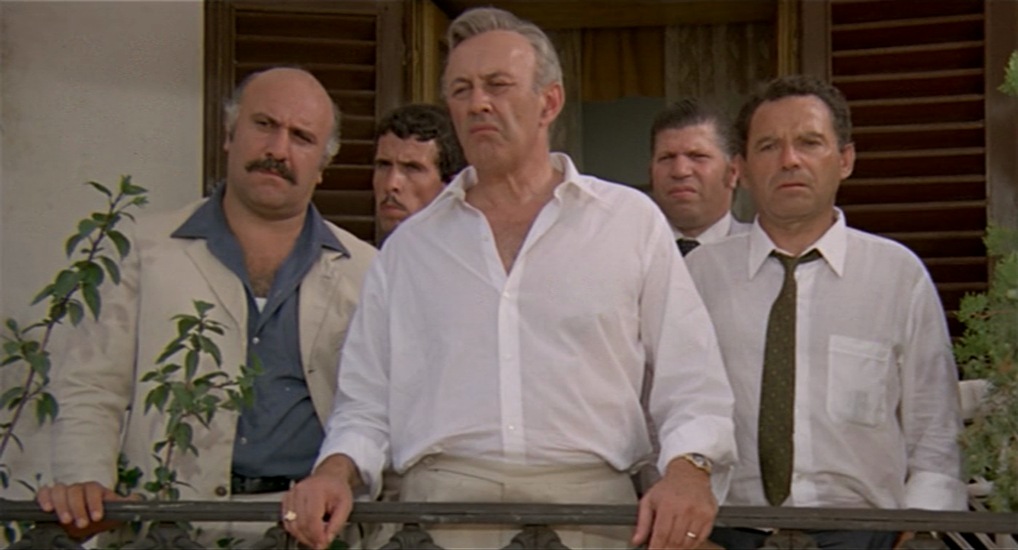
Much as in some of Leone’s films, there is an operatic dimension to the film with the police station on a rise on one side of the town, allowing Bellodi to view the activity at the house of Lee J. Cobb’s Don Mariano across the town square. The centre of the town becomes something like a theatre stage with the carabinieri offices on one side and Don Mariano’s house on the other. Don Mariano conveniently spends much of his time on his balcony where he ‘receives’ the men of the town, easily visible through Bellodi’s binoculars. The truck driver was a small-time supplier of concrete for local construction who seemingly refused to ‘play the game’ of following the orders of the criminals behind the construction business in the town. Don Mariano seems able to influence public works contracts so that they are all shared between his associates. Bellodi realises that the only way he will solve the case is to trick Mariano’s men into making confessions. But what he doesn’t realise is that none of the confessions will stand up in court since nobody, not even those who are uninvolved in the Mafia operations will testify in court. The omerta, the code of silence and code of honour and conduct which operates in Sicily and Southern Italy, generally protects the Mafia. Bellodi is from Parma and is an ‘outsider’. Don Mariano is safe within the system. He himself divides men into five categories: “men, half-men, ‘manlings’, arse-lickers, and quackers”. This neatly describes many of the male characters in the town. The Don recognises Bellodi is a ‘man’, but he can afford to do this since he knows he can’t lose.
The more I think about this film, the more I’m reminded of Inspector Montalbano, the Italian TV crime series based on the novels of Andrea Camilleri, also shot in Sicily. The TV series is ‘lighter’ and perhaps more comic in tone than The Day of the Owl, but there are strong links, not least in the use of music and the camerawork that catches the glorious light of Sicily. The main difference is that Montalbano is the head of a ‘town/city police’ force, whereas the carabinieri are, like the French gendarmerie, a national, military force with responsibilities that cover small towns as well as national concerns. The TV series also discovered that it didn’t hurt to have one or two very beautiful women in each episode. For The Day of the Owl, the music was composed by Giovanni Fusco (whose work adorns L’avventura (Antonioni 1960) and Hiroshima mon amour (Resnais 1959). The camerawork was under the similarly prestigious control of Tonino Delli Colli who at this stage worked for Pasolini and Leone. The film is presented in 1.85:1 rather than ‘Scope but still creates a sense of landscape contrasted with big close-ups for the many dialogue sequences.

The cast is very strong. As well as Lee J. Cobb, the overseas cast includes the American Nehemiah Persoff and Serge Reggiani, born in Northern Italy but raised in France and a star actor of French cinema. Whereas in the UK, North American actors retained their native identity in films of the 1950s and 1960s, the Italian film industry at this time dubbed all of the cast, especially in a case like this where they need to come across as specifically Sicilian (except for Franco Nero). The dubbing is very good and the performances are excellent. Cobb and Persoff had worked together on On the Waterfront (US 1954). Overall, I thought this was a very impressive production and it is well served by this Blu-ray presentation. I realise that I don’t really know what the title signifies and I’m slightly puzzled by why the shooter uses a shotgun, which I have read was the usual weapon for assassinations in Sicily at this time. Any clarification of these questions would be appreciated.
 itp Global Film