
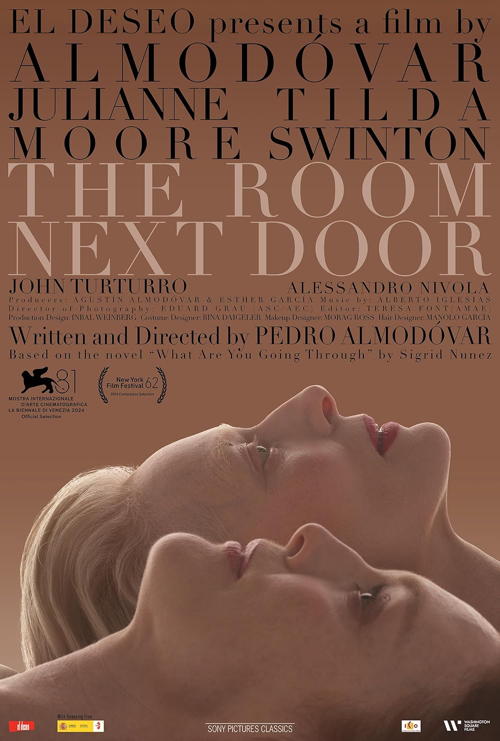
The latest Pedro Almodóvar film finally reached Bradford last weekend and what an intriguing film it is. An English language film made by a Spanish producer mainly in North America with two leads, one American and one Scottish, and a mix of supporting players. I confess I was wary despite being an Almodóvar fan since I first saw Women on the Edge of a Nervous Breakdown back in 1988, following which I searched out all the earlier films and subsequently each new release. I’ve never disliked one of the films yet, although I have liked some more than others. My slight apprehension was because this is his first English language film, but also because while admiring Tilda Swinton’s obvious mastery of performance, I’m not really a fan. I have no problems with Julianne Moore, the other lead. In the event, the film proved less problematic than I feared but still a little weird. The reception has also been mixed. It won the Best Picture ‘Golden Lion’ at Venice and most professional critics (but not all) praised the film as did many non-professional critics but some of the usual ‘awards’ audience members clearly couldn’t take it at all.

The narrative is about the thin line between suicide and choosing how to die with dignity when terminally ill. But it’s not about ‘assisted dying’ as such. It’s an adaptation of a story by the American author Sigrid Nunez. The novel What Are You Going Through? (2020) appears to have several narrative threads all concerned with friendship, death, dying and grief. Almodóvar appears to have taken one distinct strand as his central narrative, but also worked in parts of some of the other strands. Martha (Tilda Swinton) and Ingrid (Julianne Moore) were once close friends, working together as young journalists on magazines but later their careers diverged when Martha became a war correspondent and Ingrid moved to write books rather than magazine pieces. At a signing for her latest book Ingrid meets another old friend who tells her about Martha’s cancer diagnosis and a shocked Ingrid decides to visit Martha in hospital.
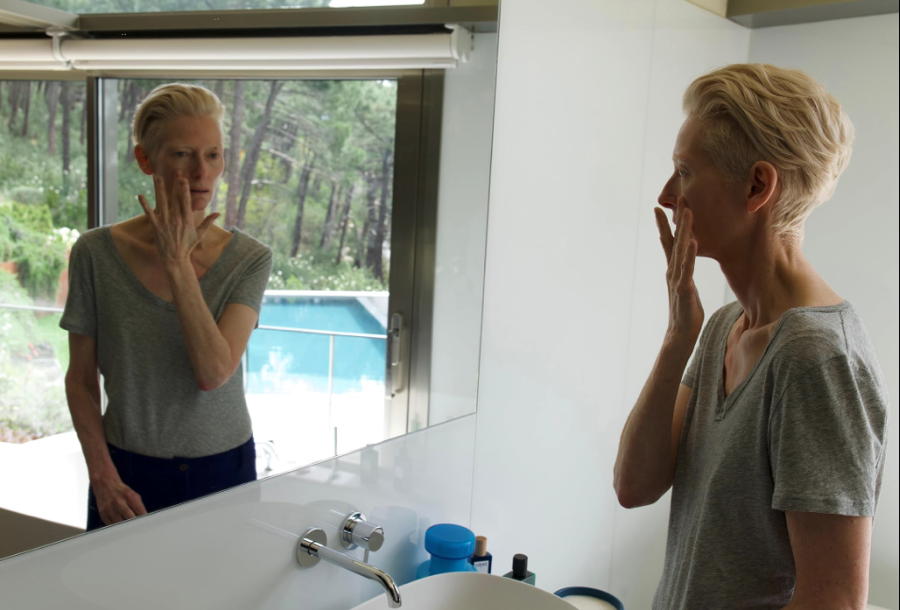
This is an Almodóvar film and so every sequence is exquisitely dressed – both the settings and the costumes with carefully selected colours and textures as well as ‘significant objects’ like books and paintings. Almodóvar’s team, here comprising Eduard Grau as DoP, Inbal Weinberg as production designer, Gabriel Liste as art director and Bina Daigeler as costume designer, work beautifully together to create a distinctive Almodóvarist mise en scène. It is underpinned as we expect by a score written by Alberto Iglesias. Almodóvar’s concerns with colour and design extend to every one of the main locations in the narrative in either New York City or in Madrid (where presumably it was more convenient for Almodóvar and his crew). There is one key location which is meant to be in up-state New York, but according to IMDb appears to be in New Jersey. Some reviewers have suggested that Almodóvar is attempting to match the kinds of flamboyant mise en scène composed within a CinemaScope frame and created in Hollywood for directors like Vincente Minnelli for musicals or melodramas from the 1950s and 1960s – and I agree with this to some extent.


It’s difficult to discuss how the narrative plays out without serving up too many spoilers but I’ll try. Martha has stage 3 cervical cancer and she has volunteered to take part in a series of experimental treatments but when one of the treatments fails to have any impact she decides that she’s had enough and that she doesn’t have anything else to live for. But there are things she wants to talk about and there are various questions about how to die. She asks Ingrid to be present in her last few days which will be spent in a striking modernist house in the country. Will Ingrid agree? What are the issues for her? In some parts of North America (i.e. in parts of Canada and the United States) assisted dying is now legal, but in Martha’s case, the local police officer is a devout Catholic with strong views. Because of this, Ingrid needs to know a decent lawyer. This will be possible because of the presence of Damian, an ex of both women played by John Turturro, a man who seems to have some good ideas about contemporary society but isn’t very good at selling them. I think I read that Almodóvar has referred to this new film as being related to Pain and Glory (2019) in which Antonio Banderas is the film director starting to think about the end of his career and his life. I wish now that I had re-watched that film before seeing the new one. Reading my blog post of the earlier film they do indeed seem to be more closely related than I initially thought. In the most obvious move, Almodóvar includes a couple of flashback sequences in the new film that match the use of flashbacks in the earlier film in structural terms. In this second film, however, the prospect of life ending soon for the central character is much more pressing and the flashbacks seem much more ambiguous.

I didn’t read the interview by Maria Delgado with Pedro Almodóvar in the November 2024 issue of Sight and Sound before I saw the film – or perhaps I did and then forgot about the details. The interview does in a sense ‘spoil’ the various allusions to books and films, writers and performances that are so central to the film’s meanings but the richness of the mise en scène means that I didn’t have time to think about them as I watched the film. I’m not going to go into all of them but the most obvious allusion comes in the naming of the two characters as Martha and Ingrid. Martha is the name of Elizabeth Taylor’s character in Whose Afraid of Virginia Woolf?, the film adaptation of Edward Albee’s stage play. Ingrid chooses a book about Taylor and Richard Burton, titled Erotic Vagrancy, as reading material to take to the country retreat. Virgina Woolf is present in other ways including via Ingrid’s latest book about Dora Carrington, a Bloomsbury Group member with Woolf and later known as a painter who took her own life aged 38. ‘Ingrid’ suggests ‘Bergman’ and Martha and Ingrid watch Rossellini’s Viaggio in Italia (Italy 1954) in which Ingrid Bergman is hit hard emotionally by the sense of the sudden death of the people of Pompeii as she tours the ruins. My advice is to watch The Room Next Door first and to read the interview by Delgado soon afterwards. Then you can enjoy spotting the allusions yourself during the screening and discovering those you’ve missed while reading the interview and digesting Almodóvar’s reasoning behind his choices. Reflecting now on what he says, I can see the logic of all those decisions and I’m reminded of that sense of Almodóvar making films about men and then films about women and the latter are concerned with memories of being with his mother and watching classic female-centred melodramas. I think Julianne Moore here becomes something like Joan Crawford in Mildred Pierce (US 1945) when she is in the police station at the end of the film.

What conclusions can I draw about this latest film by Pedro Almodóvar? None of my fears were realised. Pedro handles the English language just fine. Tilda Swinton is very good and I was riveted throughout by the performances and the mise en scène. Pedro at 75 is as accomplished as he ever was. I want to watch the film again, partly because I didn’t ‘feel’ the level of political commentary which Delgado and Almodóvar himself feel is present in the film. Perhaps I am just relieved to have the beauty of the filmic image momentarily blotting out the horrors of contemporary conflicts. But I am also aware that this film is perhaps less accessible than many of Almodóvar’s other films in the sense that it can come across as a triumph of ‘style’ over ‘content’. The narrative is built around dialogue and big close-ups facilitating a display of emotions. There is a small number of other characters and the two flashbacks but I’m not sure how much they add. There is enough going on between the two leads for me. If you love cinema this is one of the best films of the year presented by one of the great masters of the art of cinema working with some of the best performers and other creatives and it cries out to be explored and discussed.
 itp Global Film