
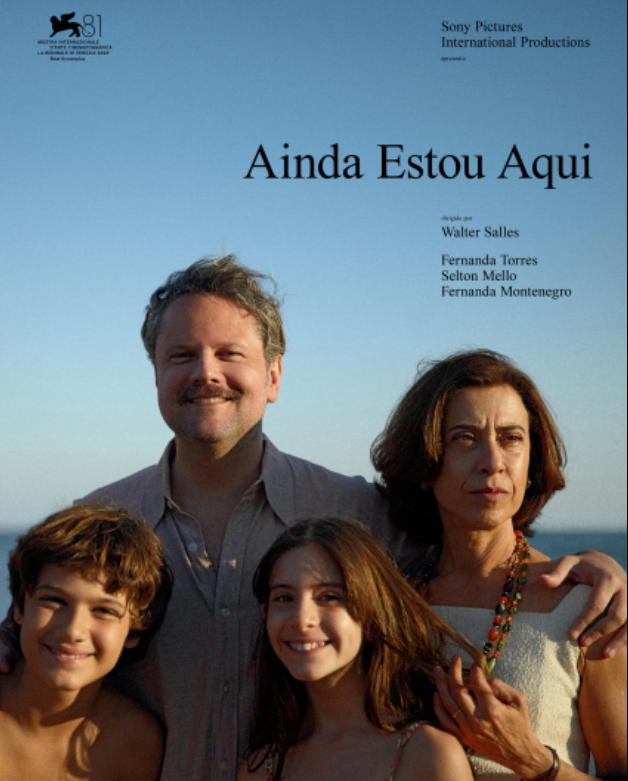
First seen at the Venice Film Festival in September, this film had several more high profile festival screenings before its Brazilian release earlier this month. In the UK it was screened first at the London Film Festival and I saw it at the Leeds Film Festival. It is a political thriller and a family melodrama that tells a story that has been told before but needs to be told again so we never forget – and that demand comes up in a dialogue exchange towards the end of the film. It is based on a true story adapted from the memoir of one of the characters seen in the film. The ‘difference’ here is the focus of the story is the family of someone who is ‘disappeared’ and it is told from the beginning through the perspective of the matriarch of the family, who herself was initially incarcerated and interrogated.

The film starts in late 1970 and Eunice Paiva (Fernanda Torres) is swimming in the sea off Rio de Janeiro. Her five children, one boy and four girls, the oldest of whom is around 18, are on the beach playing volleyball or lounging/playing games. Back home just a few streets away, her husband Rubens (Selton Mello) is working on an architectural project for a new home in the hills above the city and the family’s maid Zezé is in the kitchen. We soon realise that this is a warm loving family and that friends can pop in anytime. It’s a fairly typical middle-class family at leisure but that night the oldest daughter Vera is stopped at a roadblock with her friends coming back from a film screening (of Antonioni’s Blow Up). The security forces are searching for ‘terrorists’ who have kidnapped a foreign ambassador. This might be a form of ‘narrative warning’ but for a while life goes on as normal (or as normal as possible under a military dictatorship). Then one night, the knock on the door comes and Rubens is taken away, followed a little later by Eunice and the second oldest girl. I won’t spoil the central part of the narrative but we know that the dictatorship will end and that Eunice and all her children will survive after several gruelling days in solitary confinement and a long interrogation. But Rubens will ‘disappear’ despite evidence that he has been seen in the military compound.
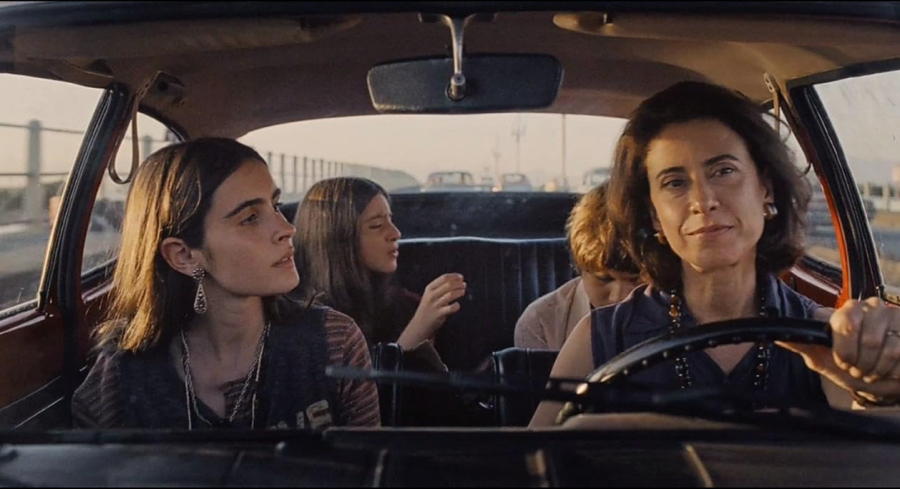
Rubens was once a congressman representing the Brazilian Labour Party (banned in 1965) but he had friends and colleagues who were considered ‘communists’ by the military and they won’t stop interrogation and torture until they get him to divulge names. Only one member of the family escapes the immediate consequences of the arrests. Vera is in London staying with friends of her parents. The military dictatorship in Brazil controlled the country from 1965 to 1985. It wasn’t the first dictatorship in the country but since the late 1980s there have been regular elections for new governments (though not without protests). In this story, once Eunice has taken her family to São Paulo, the film narrative leaps forward to 1996 and then finally to 2014 when Eunice (now played by her mother, Fernanda Montenegro) is 84.

The director of the film is Walter Salles, perhaps best known in the UK for Central Station (Brazil 1998) and The Motorcycle Diaries (UK-France-US-Argentina 2004). He has also made films in English in the US including Dark Water (2005) and On the Road (2012), neither of which were particularly well-received (but I enjoyed Dark Water, his J-horror remake). Since then he has made few features and nothing with an international impact apart from a 2014 documentary on the Chinese auteur Jia Zhang-ke. This film is a big return to the international arthouse circuit, winning prizes at Venice and several other festivals. Salles, now in his late 60s, also appears to have known the Paiva family in Rio and been one of those visitors in the 1960s. The script is by Murilo Hauser and Heitor Lorega adapted from the memoir by Marcelo Rubens Paiva, the young boy in the family in 1970. The cinematography by Adrian Teijido is very effective. He shot on 35mm and included archive material and Super 8mm footage shot in the story by Vera Paiva. Whether this was ‘real’ footage or shot alongside the 35mm in the present, I couldn’t tell – but it works. I enjoyed several of the songs on the soundtrack and the score by Warren Ellis.

Ultimately, the film depends on its performances, especially by Fernanda Torres. A star and celebrity figure in Brazil, Torres is phenomenal. She is a mother and a wife and later a political activist and convincing in all of her roles. The appearance of her mother playing Eunice at 90 is very moving and I was also impressed by the actors playing the young children in 1970. One of the most affecting passages comes when Eunice is released from captivity and arrives back at the family home desperate for a shower. I think it’s Eliana (Luiza Kosovski) who would also have been held by the military but released earlier, who watches her mother through the open bathroom doorway. It’s difficult to fully describe how Torres conveys the intense emotions she is feeling as Eunice. Fear, anger, determination, love and many other emotions are skilfully communicated with the slightest facial and body movements. The family feels ‘normal’ in its relationships and its petty squabbles. Eunice tries to protect the younger children from knowing too much about what is happening and the older children take on responsibility. Friends help and life appears to go on but this makes the reality even more heartbreaking.

The ‘disappeared’ are missed in several Latin American countries and especially in Argentina and Chile as well as Brazil. Who was it who first hit on the idea of disappearing political opponents by flying them out to sea and dropping their bodies in the ocean? The same devices seem to be shared by the juntas in each country and there is a terrible irony in one line of dialogue when we learn that Brazilian political exiles in 1970 might have gone to Chile where Salvador Allende has been elected as a a socialist president. He would be overthrown by a military coup backed by the CIA in 1973. We are still learning about the horrors committed by right-wing extremists throughout Latin America, not just in the 1970s but through long periods. As Trump returns to the White House in a world that that still includes Modi in India, Orban in Hungary, Putin in Russia and Netanyahu in Israel among many dangerous leaders, I’m Still Here is both a warning and a clear statement of survival against the odds. The film is scheduled for a UK release from Altitude in the New Year. Don’t miss it if it screens near you. Highly recommended.
 itp Global Film