

This tough but absorbing film explores issues about both social class conflict and suspicion of ‘foreigners’, people like those known in Yorkshire and elsewhere as ‘incomers’. It is based on a true story. Antoine (Denis Menochét) and Olga (Marina Foïs) are a French couple in their fifties who have bought a small farm with some abandoned houses high in the hill country of Galicia (though the film was actually shot just over the border in León). When the film begins they have been there for a year or so but already there is an inkling of the animosity towards them from their nearest neighbours, two brothers still living with their widowed mother on a farm with a few cattle. The hostility is evident in exchanges in the small tavern in the village where the men play dominos. The couple are not isolated, however, since they have made friends with an older shepherd on the hills and with another couple, who help with their attempts to begin a market garden business and also to renovate the abandoned houses.
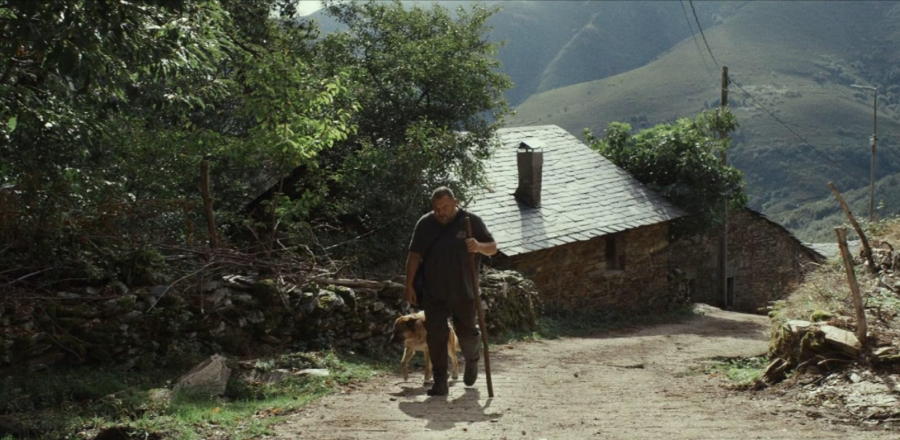
The director is Rodrigo Sorogoyen whose 2018 political thriller El reino (re-titled The Candidate in the UK) impressed me greatly at a Leeds Film Festival screening. This new film is scripted, as was the 2018 film, by Sorogoyen and his regular writing partner Isabel Peña. It’s just as good but different in several ways from the earlier film and unlike that film it is available in the UK for the next 11 months, free on iPlayer. The clearest difference is in the pacing. The earlier film was frenetic but in As bestas the pace is measured, building to a climax but then returning to a similarly slow-paced coda. It’s a long film (130 minutes on TV) but I never found my attention wandering. In fact sometimes I wanted to turn away, fearing what might happen.

Sorogoyen deliberately holds back information to the viewer and releases it only slowly. In this way we can’t at first be sure what exactly causes the resentment of the neighbours Xan and Lorenzo. Xan (Luis Zahera, a local actor from A Coruña) is the older brother, the one who baits Antoine while Lorenzo (Diego Anido) appears to have some form of learning difficulty and rarely speaks. It isn’t clear whether this is the result of something that happened in his childhood. The mother is mainly silent but protective of her sons. The locals speak Galician and Spanish and Antoine has had to learn sufficient Galician to understand them. Gradually we will discover that the main bone of contention is the possibility that the farmers in the region could benefit from payments from wind farms located on their land but agreements are required between developers and a majority of local landowners. Antoine and Olga have arrived with different ideas about how to use the land and some form of conflict is inevitable.

The relationship between Antoine and Olga is at the centre of the narrative. Again we learn about it only slowly. It’s Antoine who is the focus of the intimidation by Xan and to some extent the couple are divided about how they should respond. Later in the narrative, Olga becomes more central. The couple also have a daughter in her twenties who lives in France with her small son and she will visit Galicia later in the narrative. The couple are ‘different’ in the village not just in terms of language and culture but also because of education and the fact that they have travelled. We get the impression that Xan and Lorenzo have rarely left the village. It would be all too easy to focus solely on Antoine and Olga and to treat Xan and Loren as archetypal poor farmers equipped only with brute force and ignorance. But Sorogoyen’s and Peña’s script goes well beyond that and in the Press Notes Sorogoyen offer this:
What I find interesting about justice is that it is not indisputable. It is relative. Depending on the point of view we adopt to tell a story, we can have a certain conception of what is fair or, conversely, have a radically different vision of it.

I don’t want to say more about the plotting, but instead try to relate the ideas in the film to wider issues. I haven’t visited Galicia but I would very much like to. I think it’s true to say that Galicia has been mostly represented on film, and perhaps in literature, in stories related to its long coastline. It is in some ways the most remote part of Spain and its people are distinctive and often looking outwards. Since the 19th century migration, especially to South America and to Cuba has been a major factor in the relatively slow growth of the region and the lower standard of living than in the more industrialised parts of Spain. The obverse of the history of migration (shared with other Celtic countries such as the West of Ireland) is the relatively low figures for immigration. Most of the immigrants who have arrived tend to be Portuguese or Spanish speakers from elsewhere in Spain or Latin America. All this makes the French couple in As bestas unusual and more ‘other’. What this means in terms of the narrative is that a certain degree of initial hostility might be expected. The casting of Denis Menochét is interesting since in some other roles he has been seen as a quite menacing figure (i.e. in films like Custody (France 2017)). However, in Only the Animals (France-Germany 2019) he plays a farmer in the Central Massif in France, a lonely figure seemingly suffering in a broken marriage. I did wonder if his bulk had increased for As bestas? One important factor is that he is not ‘armed’ in a region where many of the farmers have rifles for hunting (and protection because of wolves?).

While the story of As bestas is about a situation specific to Galicia, it also has links to a national phenomenon in Spanish agriculture. Compared to other major economies in Europe – Germany, the UK, France or Italy – Spain has a larger agricultural sector as a proportion of GDP. Part of the agricultural sector is focused on crops for export but there is also a large number of small, ‘family farms’. This saw the movement back to the family farm by some of the workers made redundant during the recession following the 2008 economic crash. This in turn saw the expansion of the so-called ‘grey economy’ with rural families finding other forms of employment income. But it has also seen a crisis for small farmers facing increasing difficulties in maintaining traditional farming methods. A number of recent films deal with these problems. The 2023 Spanish nomination for the International Film category at the Oscars, Alcarràs, deals with a family tenant farmers in Catalonia threatened by a landowner who wants to use the land for solar panel energy production.

This film is a thriller that incorporates complex character studies. The acting performances are all very good and the cinematography by Alejandro de Pablo in ‘Scope does a good job of representing the landscape of the hill country and the local weather, temperate and unusual for Spain. The film’s title is visualised through a post-credits sequence at the start of the narrative in which three men select one horse from a wild herd and wrestle it to the ground in slow motion. This is a ritual performed in the Pontevedra province of South Western Galiciahas in which the men, known as aloitadores attempt to control the horse and then cut its mane. It doesn’t appear to have a direct relevance to the story that follows except in a metaphorical sense. Wild Galician horses are representative of a local native species and they do appear a couple of times. But I’m not sure if ‘the beasts’ are meant to be either Antoine or the brothers or the horses/cattle.

This is a terrific film. I recommend it highly. As well as being on iPlayer it is also available on Apple and Amazon plus, in the UK, Curzon and Sky.
 itp Global Film
The Candidate was good; I’ll pursue this on your strong recommendation, thanks!
LikeLike
This film first came to my attention because of its sweep at the Goyas and I was intrigued by the use of Ménochet. I hadn’t been massively taken with Sorogoyen’s earlier films – I don’t mind The Candidate (where Zahera is again a standout, as a very different character), but I actively disliked May God Save Us (2016). I think that The Beasts is a massive step up in his filmmaking, and interesting that it germinated for quite a long time (other projects coming to fruition sooner) – I’ve read an interview with him where he said that the delays meant that when it eventually went ahead, he was ready on a technical level to make it. I watched it on the BFI Player last year; given that it hasn’t received a physical media release in the UK (and the French release only subtitles the Castilian and Galician, while the Spanish edition only subtitles the French and Galician), it’s good to have it on somewhere like iPlayer with English subtitles! The central four cast members are all superb.
Galicia has a rich cinematic tradition, especially in shorts, documentaries, and experimental filmmaking. My favourite is Lois Patiño’s essay film Costa da morte / Coast of Death, which I saw at the Bradford International Film Festival in 2014. If you’re interested, the site Novo Cinema Galego – http://novocinemagalego.info – is an archive that collects the details of films that are part of what is known as ‘New Galician Cinema’ and what has been written about them. The site is a mixture of Galician and Castilian Spanish, but if you can read a bit of the latter, most of it is comprehensible. For the most part, very different to this film, but a multi-faceted way of seeing the region and its culture(s).
LikeLike
Thanks Rebecca. It’s strange that a distributor like New Wave or Curzon has not picked up these films and released in the UK on both cinema screens and DVD/Blu-ray. Signature seems to show them on very limited cinema releases and then sends them straight to streamers. I have seen other Galician films and read a couple of novels I think, but they were all set mainly on the coast. Like you have seen Spanish films mostly at festivals which are now difficult for me to visit. I will look at the Galician archive. It might help me remember some of the films I’ve seen.
LikeLiked by 1 person
There doesn’t seem to be much rhyme or reason these days to what manages to get a release on physical media, although Spanish cinema is particularly poorly served in the UK (although to be fair, the release of Spanish films on physical media in Spain is also haphazard at best). But, yes, New Wave or Curzon would seem like a good fit for this one.
LikeLiked by 1 person
I was impressed with the film. Regarding the pre-title sequence, I rather thought this was a parallel between the wild horses and the two brothers. At one point the older brother mentions that the younger suffers from an injury affecting his mental state. I thought this is the event depicted in the pre-title sequence.
LikeLike
That is a possibility but there are three men in the pre-title sequence and they seem to be contemporary figures. I noted the line about how Lorenzo had been a beautiful child but I’m inclined to think that the opening is meant to be metaphorical in terms of a distinct local culture and the harshness of traditional farming life which the incomers are simply not prepared for. I don’t think we get an explanation of what happened to Lorenzo but I guess he could have been kicked by a horse or cow. On the other hand, Titan the dog runs towards the brothers as if he knows they are friendly and won’t harm him.
LikeLike
Titan is not a reliable character, Antoine comments that he is not very good as a guard dog. And when Olga searches for evidence of Antoine’s remains Titan is not a lot of help. I did not see him with a credit at the end; there is a credit for a dog trainer. I wondered how experienced a performer he was on film?
LikeLike