
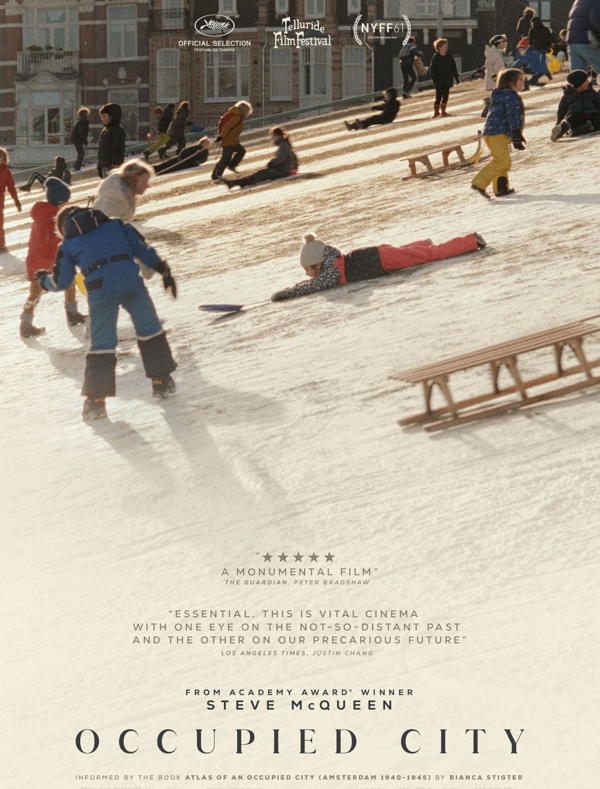
This 260 minute film by Steve McQueen draws its inspiration and its wealth of research material from the book written by his partner Bianca Stigter about the German Occupation of Amsterdam between May 1940 and May 1945. It raises a wide range of questions, not least of which is exactly how to describe its form. I’m tempted to agree with some of the reviewers who suggest that the film is more closely linked to the kinds of art installation pieces created by McQueen in his earlier art practice period rather than with the narrative fictions or more structured documentaries that the filmmaker has produced more recently.
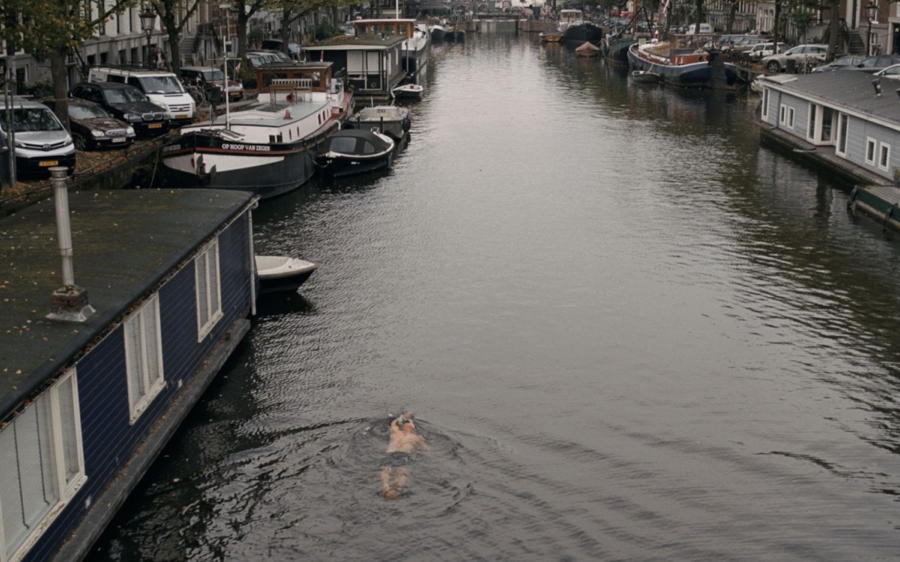
There is no discernible structure to the film which seems to select its sequences more or less randomly. There may be a some sort of geographical logic to the journey around the city but we don’t see any maps or diagrams that might help us locate where we are. But in each sequence the offscreen voice of Melanie Hyams tells us the exact address of the street/house and offers us details about the people who lived there and what happened to them or how the building was used by the German Occupation authorities. Hyams enunciates in beautifully delivered English and also Dutch for proper names. There is a Dutch voiceover in the Netherlands version. Scenes in streets or inside buildings were shot during the COVID epidemic when sometimes streets might be almost deserted and at other times thronged with crowds.
Amsterdam had a large population of Jewish people in 1940 (suggestions are of 80, 000 or more). Some of them escaped to the UK or other countries in the few days in which the German forces invaded the country in May 1940. The vast majority, however, were identified by the occupying forces and the collaborators in the Dutch Fascist party (NSB). Some were removed to labour camps others were sent later to concentration camps and only 5,000 returned after 1945. Many of the addresses refer to the homes or meeting places of the Dutch Resistance groups and again there is a litany of the resistance members who were arrested, imprisoned and sometimes executed. I’m not sure why, but the most ominous choice of a place of execution was the ‘dunes’ where the bodies were then deposited in mass graves.

I confess that the length of the film is a problem for me. I’m not against all long films but I do need to be aware of why the length is required. I think this may be the longest film I’ve attempted to watch and without a clear reason as to why it is so long I struggled after the 90 minute mark, knowing I was not yet halfway through. My problem is that though I am by no means an expert on the Dutch experience of occupation, I have seen enough Dutch, British and other films dealing with this period in the Netherlands to be aware of most of salient points. It strikes me that the Netherlands was arguably the largest country that the Nazis occupied fully. Poland remained disputed by the Soviet Union in 1939 and from 1944 it was the site of fierce battles with the Red Army. France was only partially occupied after June 1940 with a puppet regime in Vichy controlling the South. The Netherlands borders Germany and it had a large Jewish population as well as a local Nazi Party. It was therefore likely that the Nazis planned the occupation in great detail and determined to exploit their control as much as possible. This certainly comes across in the film, but I wonder how many examples of persecution and exploitation we need to have described in order to get the point. I’m not saying that there shouldn’t be archives of material covering every aspect of occupation, rather that the aims of the filmmaker should be clear and the use of individual incidents should be considered and decisions made about how many are needed in the film. Alternatively if McQueen wants to use them all, why not make two or three films or a TV series?

As the film progressed – I watched it over several late night screenings – I did begin to recognise its value and I certainly don’t want to be negative about it. By covering so much, McQueen makes us aware just how comprehensive and thorough the Nazi research turned out to be. There don’t appear to have been any aspects of Dutch life that the Nazis didn’t think about and plan to deal with. One aspect of the Occupation that does come across forcefully is that the country was divided about the Occupation. In some of the countries occupied by the Nazis, there was organised resistance but also a general acceptance that life must go on and it might be sensible not to aggravate the occupiers to avoid reprisals. In the Netherlands there were clearly Nazi sympathisers as well as the NSB (which Wikipedia suggests had 100,000 members during the Occupation). But there was also widespread support for resistance and many reprisals by the Nazi authorities. McQueen includes some comments about the Allied bombing raids. Apparently an early American bombing raid in daylight failed to hit the Fokker aircraft factory in Amsterdam in bad weather and many civilians were killed. The RAF then attacked the factory at night successfully. The Dutch resistance later requested the RAF to bomb a residential area in which there were many buildings used by the Nazis. The raid was successful but some sixty Dutch civilians were killed. Even so, the general feeling was that the attack bolstered Dutch morale. The toughest period for the Dutch was the Winter of 1944-5, the so-called ‘Hunger Winter’ when many people starved because food was scarce for a variety of reasons including the failure of the Allied advance in Operation Market Garden, the harsh weather and German policies.

Two of the aspects of Occupied City that struck me forcibly were the cinematography and the presumably deliberate choices to include a range of protests and demonstrations in Amsterdam in 2021-22 which seemed to comment on or engage with the stories about Occupation. The cinematography by Lennert Hillege offers a wide range of imagery, both interiors and exteriors. One shot through the trees looking down on a slope covered in snow with lots of people milling about reminded me of the painting ‘The Hunters in the Snow’ by Pieter Breughel the Elder (1565). I realise now that there isn’t much resemblance except the fact that the snow scene does depict people skating and playing a form of ice hockey, both of which also feature in the Breughel painting. But the sequence is really there to show a park (named after a Jewish city planner) which was the subject for snowy landscapes painted by a pair of Dutch Jewish artists. The park was used later as one of the ’round-up’ locations for Jews, like the artists, who were sent to Auschwitz and other camps. It was also re-named after an anti-semitic philosopher. This sequence has a particularly mournful musical accompaniment. I didn’t notice the music by Oliver Coates so much in other sequences but I did notice that sometimes scenes were only accompanied by ambient sound beneath the narration or diegetic music performances. In the last hour or so I noticed the music more with a concertina played on screen and the drums and general excitement of protesters.

The images of present-day protests are one of the contentious choices made by McQueen. Early on in the film we see a pair of aircraft flying banners displaying ‘resistance’ to aspects of the COVID lockdown. Later we see various movements by police with riot shields and body armour, accompanied by water cannon and drones for surveillance. This is quite a worrying linkage. But other protests, including a positive demonstration about remembering two and a half centuries of slavery in Dutch colonies in the Caribbean seemed to be more promising and the big demonstrations about the ‘climate crisis’ were lively and encouraging with many younger activists. There are several instances in the film of commemoration of historical events including the rather downplayed appearances of the Dutch Royals, a welcome sign after the unnecessary pomp and circumstance of recent British Royal occasions. I was also pleased to see pro-Palestinian and anti-racist demonstrations – being against anti-semitism but also pro Palestinian freedom from illegal Occupation is a perfectly logical position to take. The final sequences include a rehearsal of a young teenager’s coming of age ceremony in a synagogue which gives hope for the future, but here again I noted that less is sometimes more. A track along a Holocaust memorial in which the thousands of names of Jewish families who lost family members in the camps are simply listed on tall plinths, white on a black background says a lot in a few minutes.
I think my final thoughts about the film are that it was a very worthwhile project to undertake and it may reach an audience that wouldn’t necessarily read the book by Bianca Stigter. But I think this film works like an avant garde project, through repetition, rhythm and an underlying appeal to ideas about the cityscape and the lives lived now referring back to some of the lives lost. My personal preference would be a shorter film in which the material was packaged for a more direct communication of the history of the Occupation, the sacrifice and the struggle, perhaps using intertitles and on screen diagrams/maps.. But that’s just my feeling. If you get the chance to see this, do experience it for yourself and make up your own mind about what you think. The print I watched on MUBI ran ‘only’ 251 minutes – a TV speed-up presumably? It is also available to rent or to buy on Amazon, Apple and Sky in the UK and Film 4 is listed as a funding partner so presumably it will appear on the channel at some point? A24 is an American distributor and partner.
 itp Global Film