

We have already blogged about this film with a shortish post by Nick back in 2015. I don’t disagree with his piece but I approached the film rather differently and so I wanted to post a second take. There are a number of key points about the film which make it stand out in Éric Rohmer’s work – I remember its release and that it generated a fair amount of interest (winning the Golden Lion at Venice) but I really wasn’t prepared for what I found. The casting of Marie Rivière is an important element. She is one of the most frequent collaborators with Rohmer appearing in nine of his films between 1978 and 2007. In this one she plays the lead and Rohmer unusually allows her to improvise and play scenes ‘for real’. She has an advantage in that it seems that in some scenes she is working with members of her own family and in fact there appear to be quite a large number of non-professional actors in the cast. This gives the film an open easy feel, though it does mean there isn’t much of a narrative drive until the latter stages.
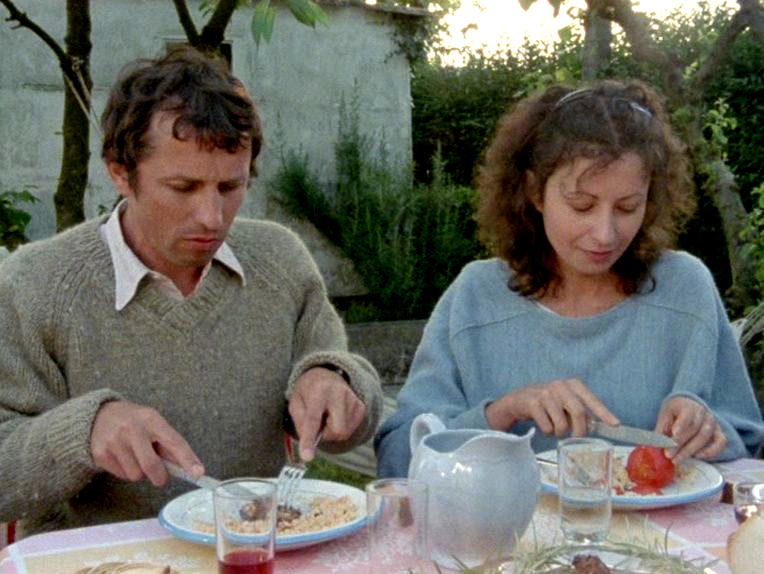
The plot is fairly simple. Delphine (Marie Rivière) is looking forward to a summer holiday when the guy she is booked to go with drops out. She now has to find a new travelling companion at short notice. The narrative depends on the French obsession, especially among the Parisian middle-classes, to get away for a long break of at least two weeks in July/August. Delphine is determined to have her holiday and she makes attempts to take up offers and suggestions from friends and family. She tries joining a form of family holiday in Cherbourg but doesn’t feel comfortable and returns to Paris before a similarly abortive trip to the Alps. Finally, back in Paris she meets she meets an old friend whose brother-in-law has a Summer apartment in Biarritz. Delphine catches a train and spends a few days exploring the beaches.


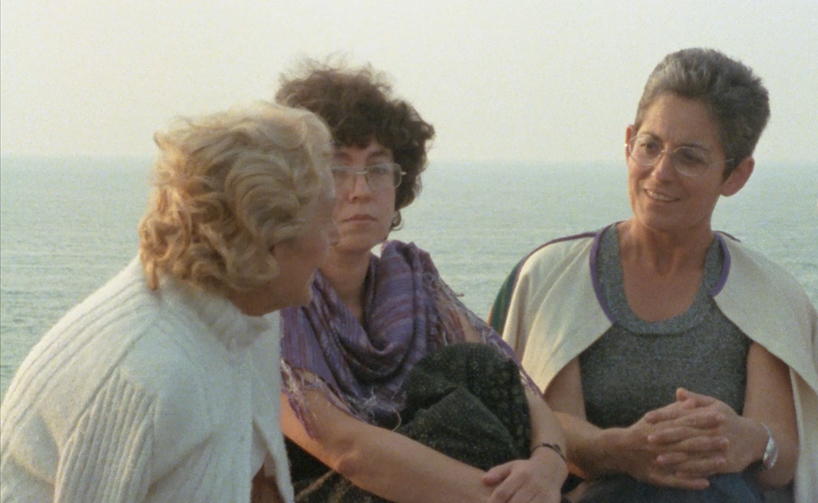
Two incidents then finally propel Delphine towards a significant change in her outlook. In the first she finds herself eavesdropping on the conversation of a group of older holidaymakers who seem to be having a discussion about a novel, Jules Verne’s Le rayon vert (1882). This is an unusual Verne story in which the possibility of romance rather takes over from the usual adventure narrative and science fiction under-pinning. In it a young woman is being pressurised to marry an older scientist but when she learns about the phenomenon of the ‘green ray’, which if seen at around the moment of sunset on a distant horizon enables the viewer to see into their own ‘heart’ and the hearts of others, she determines to search for a sighting. Delphine is very taken by this idea. Her own reading on holiday appears to be Dostoevsky’s The Idiot so it’s perhaps not surprising that she recognises the need for a change! The second incident is when Delphine meets another young woman on her own, a ‘liberated’ young Swedish woman with a very different outlook. The two get on very well and this leads to a number of other meetings and the eventual climax of the narrative – which will of course include a sighting of the ‘green ray’. But I won’t spoil the lead up to that point.

The success of the film depends very much on the performance of Marie Rivière. As a potential romantic lead she is an attractive young woman but she carries both a sense of a lack of confidence in herself but also a determination to do what she wants rather than what others think she should do. I’ve also written about her performances in The Aviator’s Wife (France 1981) and An Autumn Tale (France 1998). I enjoyed her performance in Le rayon vert and identified with the way she was feeling. I particularly enjoyed her improvisation in the quite long lunch table conversation about her vegetarianism which she handles gracefully and with some assertion in the face of general ignorance. Fortunately vegetarianism is accepted more easily in France these days I think. And so it should be since the quality of fruit and vegetables in shops and in markets is so high.
In his original posting in 2015 Nick discussed the film in terms of the ‘Bechdel test’ and suggests that this film might pass the test because it focuses on a young woman’s desires and the way she interacts with her female friends and relatives. The #Me Too campaign had not begun as such in 2015 but in retrospect we might ask questions about an older male filmmaker who consistently made films featuring younger women. I don’t know anything that might suggest this was an issue with Rohmer and on the contrary I should point out that on this film, as well as working with Marie Riviere on the script, other Rohmer collaborators here are producer Margaret Ménégoz, cinematographer Sophie Maintigneux and editor María Luisa García. This film is deservedly one of the most popular of Rohmer’s prolific output in the second half of his career. Definitely recommended if you haven’t seen it, it is widely available on streamers and I watched the Arrow Blu-ray.
 itp Global Film