

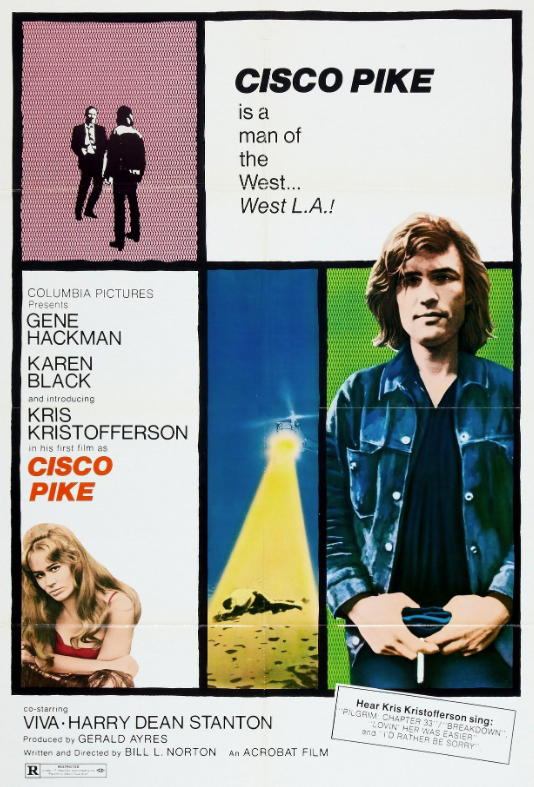
The death of Kris Kristofferson aged 88 will no doubt generate a fair few column inches in both the mainstream and more specialised press for someone known as both a singer-songwriter and a Hollywood star actor. I’d like to add my two pennyworth since I followed his career for around forty years or so. I can’t quite remember which came first for me. I suspect that that I bought the album ‘The Silver-Tongued Devil and I’ first in 1971 and then went to see Cisco Pike in Summer 1972. I remember that cinema visit quite clearly, if not the film so much. Cisco Pike formed the lower half of a double bill at the Odeon Northfields in West Ealing. God only knows who put the double bill together since the top half was Elizabeth Taylor and Michael Caine in Zee and Co., (in the US it was known as X, Y and Zee) written by Edna O’Brien but directed by Brian Hutton. What did Hutton know about the foibles of the British middle classes? The Odeon bookers were having a laugh as Kristofferson in his first starring role plays a musician down on his luck and forced to go back to selling dope to his friends to keep himself afloat in Venice Beach. Gene Hackman plays a cop who intends to use the former dealer Cisco to shift a large consignment of top quality grass he has acquired in dubious circumstances. The rest of the cast includes Karen Black, Viva, Harry Dean Stanton, Roscoe Lee Brown, Joy Bang and Doug Sahm (of the Sir Douglas Quintet). These two contrasting films targeted very different audiences and the setting further enhanced the surrealism of the experience. The Odeon Northfields was a 1,500 seat small ‘atmospheric’ theatre opened in 1932 and acquired by Odeon in 1936. It had a Spanish-themed auditorium with a fiesta feel but in 1972 it was about to change. I just remember the red drapes covering the walls and ceiling which made it feel more intimate.
Kristofferson had made his first appearance on film in Dennis Hopper’s The Last Movie in a small role alongside other friends of the director such as Michelle Phillips (ex The Mamas and the Papas) and film director Sam Fuller. Kristofferson contributed some music during the shoot. The film was shot in 1970 and Kristofferson had already started work on Cisco Pike before it came out in 1971. Cisco Pike also took time to be released and some of the key songs from the album are used in the film. The films of this period exploring the ‘counter culture’ of the music and drugs scene were all indebted to Easy Rider (US 1969) directed by Hopper and starring Hopper and Peter Fonda for Columbia. That film had cost around $500,000 and had made money around the world as well as seeing a tie-in album of songs used in the film which became a major soundtrack hit. The other studios were forced to look for similar projects but most of the finished productions fared poorly since studio executives didn’t understand the culture and what would work for the youth audience. And of course this was primarily a culture that embraced a West Coast viewpoint but extended to university campuses and some African-American communities – but it wasn’t by any means part of the mainstream. That’s why it was ‘counter’.
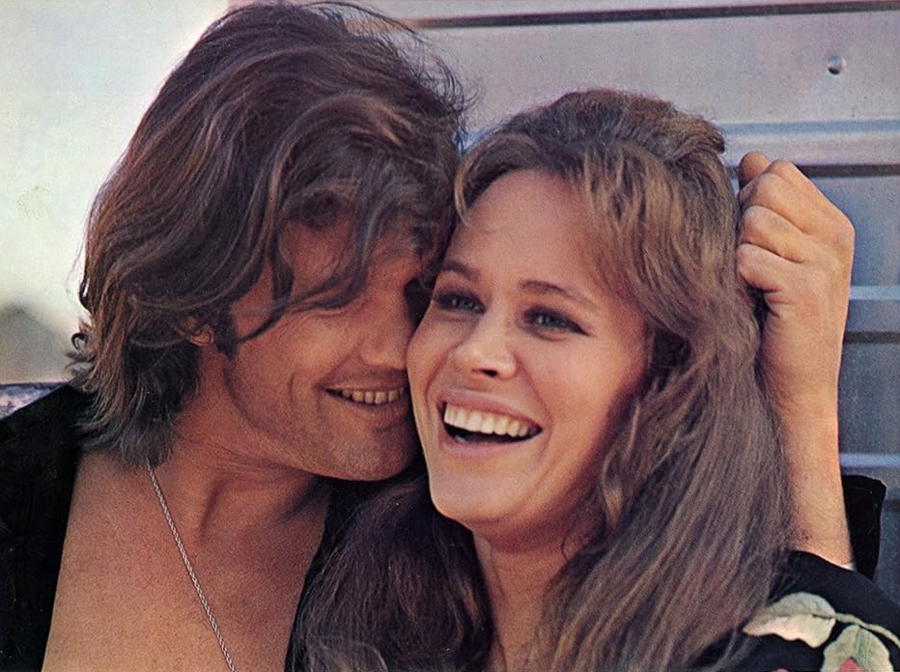
Cisco Pike should have worked. Gene Hackman was top-billed and he was ‘hot’ after the success of The French Connection (1971) for which he would win the Best Actor Oscar and second-billed Karen Black had been in both Easy Rider and Five Easy Pieces (1971), the Bob Rafaelson film which led the more considered arthouse run of counter culture films at this point. Kristofferson was ‘introduced’ by Columbia on this picture and his was certainly the central character in the film. Perhaps it’s worth filling in some details of Kristofferson’s experience at this point. He was both more ‘authentic’ than most of the actors who played counter culture heroes and especially those who played musicians. He was also older. He came from a military family and he excelled at school and college in Southern California, being awarded a Rhodes Scholarship to Oxford. In the UK he continued his college rugby and was awarded a blue for boxing. He had already had essays published in US magazines and he started writing songs, recording some for the UK music impresario Larry Parnes under a pseudonym. In 1960 he joined the US Army and trained as a helicopter pilot based in Germany until 1965 when he turned down a teaching post at West Point and went to Nashville to hawk his songs around the record producers. Several of his songs became country hits for other artists before he made his first album in 1970. Here was a guy who worked as a janitor and flew choppers out to the oil rigs in the Gulf. Kristofferson had a real back story and at 34, despite a lack of formal training he was ready to be a star.
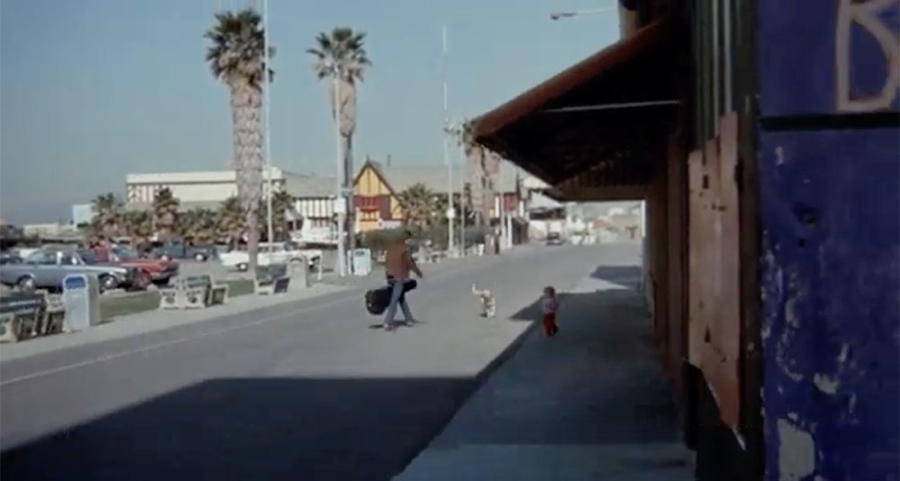
Looking at Cisco Pike again after more than fifty years, there were a few surprises for me. Recognising the sexism of the period but putting it aside for now, two things stand out. One is the presentation of Venice Beach and locations such as the studios, the Troubadour music venue and Sunset Boulevard. It seems like a realist and rather downbeat presentation of a Los Angeles that was not so familiar in mainstream Hollywood in the 1960s. The cinematographer Vilis Lapenieks had previously worked mostly on TV but also on some small scale features and at least one title I recognise: If It’s Tuesday This Must Be Belgium (1969). That was a comedy about a group of Americans touring Europe and had a truly stellar cast. Bill Norton wrote and directed Cisco Pike. He was just 27 and this was his first feature after studying at UCLA’s film school. You do wonder about Columbia’s decision to finance his film and how he managed to attract a great cast. For a first feature he does pretty well. It isn’t a tight narrative throughout but he manages the reflective parts well and there are some good lines in the script. Some reviews refer to a melancholic picture and that seems a good call. It certainly isn’t ‘feelgood’. Nobody is redeemed and the hero doesn’t ride off on a white horse (even ironically). Norton went on to be a prolific director in television. The second stand out from my re-viewing is simply Kristofferson’s presentation. He looks lean and ‘fit’ in both meanings of the word. He is also able to be laid-back and alert and angry and his drawl is a distinguishing feature. Of course he is in some ways playing himself, but I think you can see what attracted audiences, some of whom wouldn’t know him as a singer-songwriter.

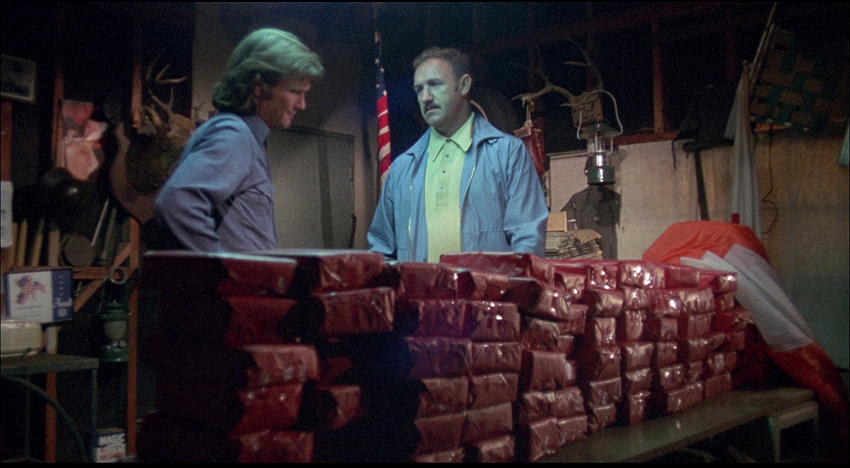
The plot as such has Cisco deciding to give up dealing and trying his songwriting again much to the relief of his partner Sue (Karen Black). But this is blown off course when the corrupt cop played by Hackman in effect blackmails him into selling a massive amount of grass over a weekend. This of course doesn’t work out straightforwardly, offering Norton the chance to show some action around the streets of Venice Beach. A familiar device introduces Harry Dean Stanton as an old music buddy who hasn’t given up his heroin addiction and serves as a warning to Cisco. The procedure of dealing allows a nice montage of meetings accompanied by Kristofferson’s ‘Pilgrim’ song (see below) and meetings with several familiar faces. But still, the movie failed at the box office. The more conservative critics panned it but some were impressed. I think I would agree with Monthly Film Bulletin‘s reviewer Brenda Davies in May 1972 who praises Kristofferson and argues that the film’s weak link is Hackman’s performance. As she points out Hackman tries hard to create the cop as a character but the naturalism of Kristofferson’s performance shows up the Hackman character as not really credible. My feeling at the time, as already a Kristofferson fan, was that I enjoyed the film and I wasn’t aware then of its ‘failure’ in America. It joins several other films from the 1970s including Dog Soldiers (Who’ll Stop the Rain, 1978) by Karel Reisz, Cutter’s Way (1981) by Ivan Passer, Charley Varrick (1973) by Don Siegel etc. and various other titles that slowly picked up followers even though some didn’t even get a videotape release. These were ‘adult’ films that told you something about the state of America under Nixon and then Carter before Reagan arrived (Cutter’s Way was a 1976 novel adaptation). Some of these became ‘cult films’ and finally achieved a Blu-ray release. This was the happy outcome for Cisco Pike, now available from Powerhouse/Indicator.
The lack of success of the film in Hollywood didn’t stop Kristofferson from getting big parts. In 1973 he was Billy the Kid with James Coburn as Pat Garrett in his first of three films for Sam Peckinpah with only a relatively small part in Bring Me the Head of Alfredo Garcia in 1974 and the lead in Convoy with Ali McGraw in 1978. (Bill Norton wrote Convoy.) In between he made Alice Doesn’t Live Here Anymore (1974) with Ellen Burstyn for Martin Scorsese and the second remake of A Star is Born (1975) with Barbra Streisand and Semi-Tough (1978) with Jill Clayburgh and Burt Reynolds for Michael Ritchie (with Kristofferson using his knowledge of American football). These were his 1970s films that I saw – there were a couple more I didn’t see. In 1980 he was the lead in Cimino’s Heaven’s Gate opposite Christopher Walken and Isabelle Huppert. I’ve loved every version of this film I’ve seen and Kristofferson must be one of the few American Hollywood actors to have been a student at Oxford and to play a character with that schooling on screen. Finally, I enjoyed Rollover from Alan J. Pakula with Kristofferson playing opposite Jane Fonda. After that Kristofferson began to suffer from the contamination caused by the industry backlash against Heaven’s Gate and the good parts dried up. There was nothing of note until he played a small but key role for John Sayles in Lone Star (1996) and then two further small roles for Sayles in Limbo (1999) and Silver City (2004) and then acted as the narrator (voice only) in Todd Haynes’ I’m Not There (2007). IMDb lists 118 acting credits for Kristofferson but I think I saw the best of them. From 1981 I considered him primarily as a singer and I was mainly interested in his hook-ups with the other ‘Outlaw’ country stars and the formation of The Highwaymen in the mid-1980s with Willie Nelson, Johnny Cash and Waylon Jennings. When I heard about his death, as well as watching Cisco Pike, I watched the opening half hour of Pat Garrett and Billy the Kid and then several YouTube videos of Kristofferson singing with the men and women who were his idols in the 1960s and became his friends. I think he’s best remembered as a great songwriter, a supporter of good causes and someone who successfully married country rock and an acting career at a time when music looked like becoming bigger than the movies. He’ll be sorely missed but we have an archive of performances and songs to cherish.
This montage offers an early music video idea – he made a few music vids I think.
 itp Global Film
I didn’t see Cisco Pike at the time of release and only recently attempted a viewing on Talking Pictures and found it so resolutely downbeat it was unwatchable for me on the small screen. I did see Cutter’s Way at the time of release (at the Tower in Leeds if memory serves) and found that very watchable with a grizzled John Heard, and a young Jeff Bridges playing ‘Bone’. I seem to remember it was based on a novel : ‘Cutter and Bone’. My own first experience of Kristofferson on screen, unless I saw ‘Pat Garrett and Billy the Kid’ first (which is likely), would be his pairing with the then hot darling of UK arts cinema, Sarah Miles, in ‘The Sailor Who Fell From Grace With The Sea’ which was certainly an oddity. I enjoyed it at the time but not sure it would stand up to current scrutiny.
Nowadays, for a genre audience, Kristofferson may be best remembered as Whistler, the sidekick of vampire-slayer Blade, who mercifully died in either the second or third of the trilogy.
LikeLike
Don’t think i have seen Cisco Pyke though I remember seeing Cutter’s Way with Jim Cook. We might even have used on the evening class at some point. Highpoint of this post though was being reminded about the Northfields Odeon where I saw films in the 60s and 70s. A great cinema, though, rather cold and neglected! I saw El Cid there and I think I took my young sister then aged 10 to see Star Wars there. She deployed a laser weapon all the way home!
LikeLike