

Image from Ernst Lubitsch’s Three Women
This major silent festival held in the town of Pordenone in North Italy this year runs from October 5th until October 13th. Over eight fairly intensive days of viewing guests will be able to see and enjoy a wide variety of films and pictures from the earliest days of cinema. As has been the case for several years now the majority of the titles will be screened from digital transfers from either original nitrate prints or copies of these. A small proportion of titles will be screened from safety print copies of the original nitrates. Like many others I miss the particular characteristics of 35mm prints and the luminosity of nitrate prints, but there are quite a few promising titles on photo-chemical film; and many of the digital transfer also feature restoration aspects and can, when well done, looked very good. All the titles in the programme enjoy live musical accompaniment from the very skilled and experienced troupe of musicians performing at the Festival.
The main features on the opening and closing nights always enjoy full orchestral accompaniment. This year is a good one for fans of the Western: on the opening night we have John Ford’s very fine 3 Bad Men (1926) with Timothy Brock conducting the Orchestra da Camera di Pordenone in his own score. And on the closing night we have The Winning of Barbara Worth (1926), adapted by Frances Marion form the classic novel and directed by Henry King. This has an accompaniment by Neil Brand and performed by the Orchestra da Camera di Pordenone.

Vilma Bánky, Ronald Colman
Weekdays commence with digital transfers from the Library of Congress paper print collection of the first year of output from D. W. Griffith, working at the Bioscope Studio. These were shown, mainly in 16mm copies, in the complete retrospective of Griffith’s films at earlier Giornate. Given their age and travails the quality of those prints varied considerably. It will be interesting to see how they look in digital versions.
Days will end with a variation on one of the great pleasures when the Festival was held in the Old Verdi cinema; ‘Goodnight Silents’. These were relatively short programmes of early films, many hand-painted or stencilled coloured; happy viewing before bedtime. In recent years the last screening has been feature length titles. Now after a main feature there will be a programmes of early short films and some evening longer titles. This eats into the night-time but I also enjoy these varied programmes of titles, in terms of genre and territory.
The rest of the programme is a series of selected titles high-lighting national cinemas, star performers, and particular places or themes. A set that I am really looking forward to are the four titles featuring Anna May Wong. She was a star whose career rarely received the parts her talent deserved, though she was in some fine films: Pavement Butterfly ( DIE LIEBE EINES ARMEN MENSCHENKINDES, 1929) I am advised is really good. Happily in 2022 she was commemorated on a U.S. Quarter Dollar.

DE/GB 1928
Latin America offers the chance to see a variety of features from this continent; something that is a rare opportunity. The selections will include surviving extracts, documentaries, newsreels, short dramas, features and even home movies. These will be from a number of the archives and countries with early cinema industries. Argentina, Brazil, Chile, Colombia, Cuba, Ecuador, Mexico, Peru, Paraguay and Uruguay.
And there is also a programme of films from Uzbekistan, mainly from the period when it was a Soviet Republic of the USSR,. Two of the feature films in the programme will be accompanied by Uzbek musicians with traditional instruments, while there will be an exhibition of posters and photographs. And the Island of Sicily will provide a selection of early films from that distinctive Italian region.
Other parts of the week will focus on Early Cinema: Ethnographic films: the work of Joris Ivens and of the designer Ben Carré. The Canon Revisited will include Sorok Pervyi / The Forty-First USSR 1926) directed by Yakov Protazanov; also Blade af Satans Bog /Leaves from Satan’s Book (Denmark 1920) directed by Carl Dreyer. Rediscoveries includes a title by Britain’s prolific film-maker Maurice Elvey, made in the USA, Folly of Vanity1924), co-directed with Henry Ottto. And we will enjoy a title with the Czech actress Anny Ondra, famed for her appearance in two Hitchcock films, The Manxman and Blackmail. In 1928 Ondra was the protagonist in Saxophon-Susi, a German comedy about a young woman entering show business.
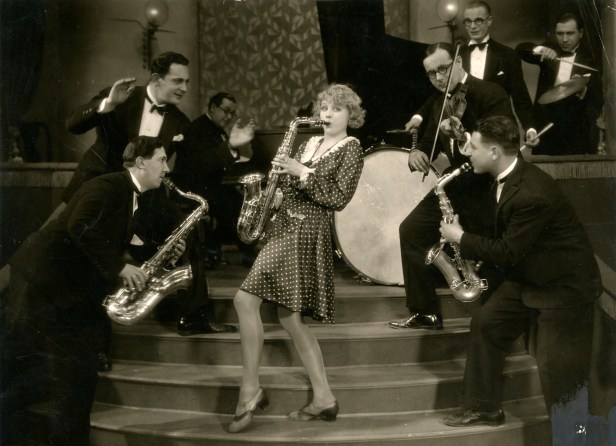
Anny Ondra
Whilst a special event is a screening of one of the orientalist silent dramas, La Sultane de L’amour / The Sultaness of Love (France 1919); a French writer’s version of a story from The Arabian Nights. And among the comedies there is Harold Lloyd in his 1924 role as Girl Shy. And as displayed in the Festival poster the 1924 Three Women / is a return to the great comedy of Ernst Lubitsch with a formidable trio of actresses: Pauline Frederick, May McAvoy and Marie Prevost.
There is one item for which I do not have anticipation; The of Land of Promise (1924) which is a piece of Zionist propaganda for the colonial settlement in Palestine. An earlier festival also featured a block of films from the Zionist settlers under the provocative title of ‘Israel before Israel’ [1995]. This might be more acceptable if we also were able to enjoy some examples of Arab silent cinema. There are certainly Egyptian late silents which have been waiting restoration for years. And there were silent films made by indigenous Palestinians in the 1930s, likewise still waiting to be seen.
There are many other early treasures screening. And there will be special lectures: book launches and a Film Fair with both new and vintage books, videos and posters. So it will be a rich, demanding but rewarding week.
 itp Global Film
sounds amazing. Do you have time to eat?!
LikeLike
Getting proper meals and enough sleep is one of the challenges at the Festival.
The best way is to selectively miss some screenings. This year that is more difficult because there is so much in the programme that I am unfamiliar with. The guide for this is the detailed and excellent Catalogue; hopefully it will be available when we enrol on Saturday.
LikeLike