

(NO SPOILERS if you haven’t watched all six episodes yet.)
For the last few years, the BBC has looked to schedule a suspense thriller serial for this time of year. Vigil (UK 2021) was set aboard a nuclear submarine of that name which reports the suspicious death of a crew member. Because the vessel is still in UK waters a local police investigator is airlifted to the submarine. As the plot develops there is a fear that another submarine could be nearby, meanwhile action by protestors near the nuclear submarine base is seen as weakening security. In Vigil 2 (2023) a weapons display at an army base goes wrong and drones kill soldiers and some visitors. The same police detective as in the first Vigil, DCI Amy Silva (Suranne Jones) is sent to a foreign airbase in the Middle East where the RAF are training local armed forces to use the weapons that have gone wrong in Scotland. Nightsleeper shares several generic elements with the two earlier serials but it is made by a different company, Euston Films – the brand for some very successful TV programmes for the former Thames TV in the UK in the 1970s and 80s and now part of the global company Fremantle. There are no significant personnel shared with the earlier serials.
Nightsleeper offers a riff on the popular genre thriller idea of a familiar mode of transport that is taken over by either a criminal gang, a foreign agent or even a plague of zombies. All that matters really is that a vehicle carrying passengers is literally ‘unstoppable’. That was indeed the title of the 2010 Denzel Washington film featuring a runaway freight train. The Runaway Train back in 1985 (from a script by Kurosawa Akira) was a similar idea with two convicts on a driverless train in Alaska. Speed (1994) transferred the idea to a bus with a bomb on board that will explode if the bus stops. These and similar narratives set up the genre elements. As well as suspense the best of these films offer a chance to explore the hopes and fears of a group of characters trapped in a unique environment and forced into daring stunts. The new idea in Nightsleeper is that the UK’s newish ‘digital railway’ is vulnerable to a cyber attack. All the signals and the points on the system are controlled within a closed system. If an outsider gains control over the system, it becomes in effect a giant model railway with a controller who can move trains anywhere as they please.
The island of ‘Great Britain’ is not very large and the longest passenger train service (i.e. without the need to change trains) is from London to Inverness. There are currently sleeper services to Inverness, Aberdeen, Fort William, Glasgow and Edinburgh, but there are just two trains each night (not Saturday) which split/join at Edinburgh and Glasgow together for the separate services. The UK rail network was the world’s first and running it in the 21st century is a complicated business. Only the main lines from London to Edinburgh/Glasgow are electrified, diesel power operates on the other lines further North. The sleepers are run by Caledonian Sleeper owned by the Scottish government.
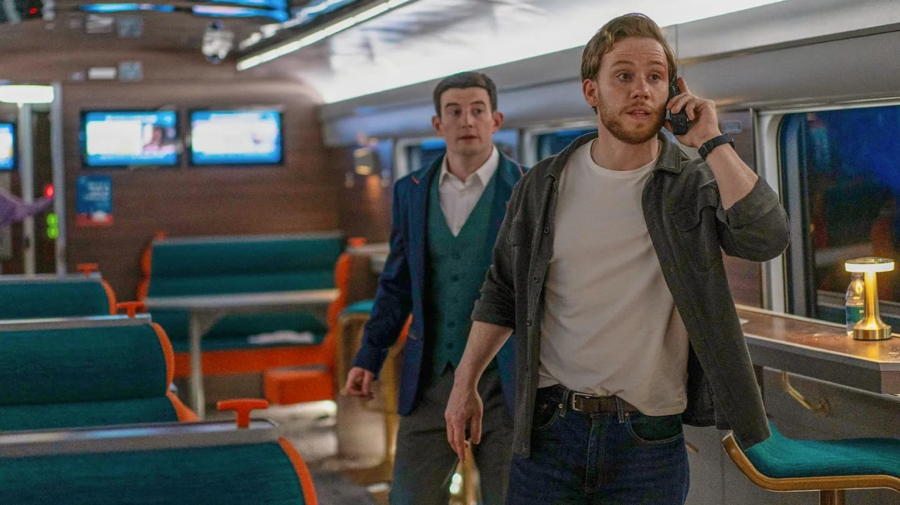
The TV serial assumes a smaller train, i.e. with less carriages, running just between Glasgow and London using a mocked-up power car in the livery of a fictitious company ‘Heart of Britain’ but the sleeper carriages themselves seem more authentic. The basic premise of the narrative is that someone breaches the train security and attaches a device in the train ‘office’ which takes control of the internal systems of the train. At the same time, a cyber attack takes over control of the entire digital train network. With one or more of the train staff ‘tapped up’ to cause the train to be evacuated at its first stop, it is then possible to move the empty train away from the station and head towards London acting as a form of guided weapon which could crash into a major station. Those responsible can then demand a payout to prevent a catastrophe. But the train isn’t fully evacuated at its first emergency stop Motherwell and around a dozen passengers are left on board. At this point the train becomes driverless and moves forward on command by an external agency.
The consensus among critics appears to be that the show failed to deliver all of its promises across its six episodes. The audience comments and reactions I have read seem to be split fairly evenly and I haven’t yet seen the ratings for the show. My overall feeling is that the central idea should perhaps have been written to complete its run in fewer episodes but that most of the cliffhangers do work. I watched the whole series over two (late) nights and I did find it compelling viewing – but I have to agree that the ending had lost its power by the time it did arrive, even if it was a perfectly acceptable idea as an ending. Otherwise I’m not sure a lot of the criticism is justified. The dozen characters who remain on board the driverless train when it leaves Motherwell comprise a motley crew, each whom has a story which across the six episodes emerge from interactions within the group. The leader of the group is Joe Roag (Joe Cole) an ex-Met Police detective. I only know Cole from the ITV serial of The Ipcress File in which I thought he was excellent. In Nightsleeper he plays the role with a visible degree of hesitation at seemingly key moments. I did find this a little odd but perhaps it is appropriate for the character in relation to his back story. Joe’s central activity depends on the phone contact he has with Abby Aysgarth (Alexandra Roach) at the National Cyber Security Centre. This exchange develops in the context of confusion in both the train and at the London central offices of Cyber Security, where Abby is not secure in her role leading the attempt to find the source of the cyber attack. (It was good to hear a clear Welsh voice giving Joe instructions.) This is a third narrative strand after the ‘thriller’ and the almost soap-like melodrama of the stories of the twelve hostages. In fact this third strand could even be split in two as it involves intrigue within the cyber security team, but also a kind of mystery narrative about how the ‘hackjack’ has been carried out and what the final outcome of the journey might be. Four fairly distinct genre narratives males quite a heady brew.
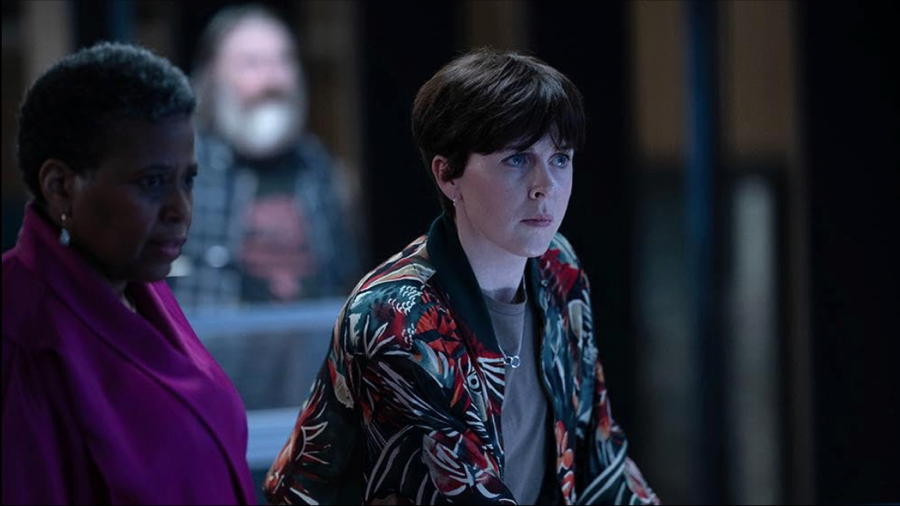
An important issue is just how plausible is the whole scenario and how do the writers Nick Leather and Laura Grace approach a runaway train narrative? Many critics just see the serial as absurd and I agree that there are small incidents that any regular rail user will recognise are not remotely accurate, stretching credulity. On the other hand, the overall idea of the digital railway being controlled from a single point is not that far from reality, although I think at the moment it is more a regional thing. Signalboxes don’t exist any more and long stretches of track are controlled from one point. I think the serial has more problems showing cyber security at work. People sat at large computer terminals as myriad lines of code flash across the screen is not good film or television. We have no real idea what or how they are doing things. Finally there is a whole dimension missing. Where are the politicians and advisers (minders?)? This is a six hour narrative with a narrative time line representing more like seven or eight hours as the train is re-routed. Surely a COBRA meeting or equivalent would be set up? This is a flawed serial but an entertaining enough ride and we perhaps need more stories about control of public services by self-managed computer systems and the dangers they pose. I seem to remember incidents in which hospitals and banks have been ‘cyber attacked’ recently. What if control of the the national power grid was under attack?
 itp Global Film