
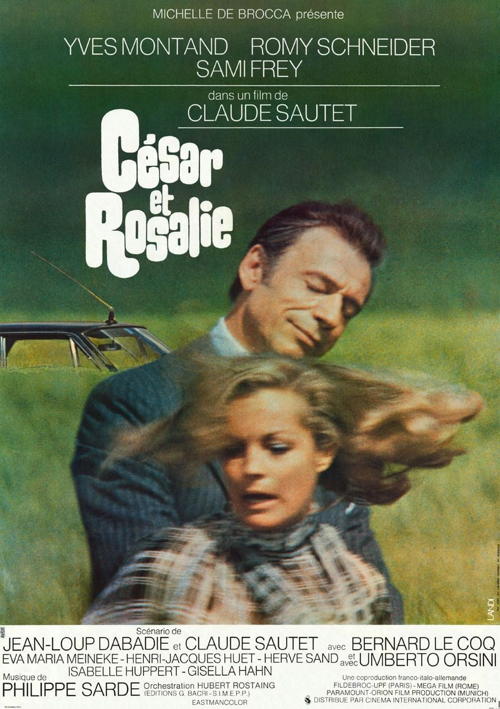
I’m working on a project to study how romance comedy-dramas might have worked differently in French cinema compared to the approach in British and American cinema. César et Rosalie was a significant hit in France with its trio of stars and direction by Claude Sautet, a writer and director who had a long career from the early 1950s up to 1995 but who worked on relatively few titles as writer or director (or both).

The story is a twist on the familiar trio of characters – in this case a woman Rosalie (Romy Schneider) and the two men who attempt to keep her with them, César (Yves Montand) and David (Sami Frey). David was Rosalie’s first love but then he left for America when she married Antoine, whom she later divorced. At the beginning of the narrative David returns to France to discover that Rosalie is living with César but her small daughter is with Rosalie’s mother and the rest of her family. David attempts to win Rosalie back and César responds by trying to keep her. What does Rosalie want? That’s the basis of the comedy-drama.

César is a ‘self-made man’, a scrap metal merchant buying and selling on a large scale whatever he can find which includes the railway steam locomotives being phased out by SNCF. He’s brash and wealthy but a little sensitive about his lack of academic and cultural knowledge – and he’s a little defensive in formal situations. David is more shy and reserved but quietly determined and he is a ‘creative’, working as a designer for bandes dessinées (what are commonly known as ‘comic books’ or ‘graphic novels’ outside France).

I watched the film on DVD and the main ‘extra’ was a series of interviews with some of the production personnel including producer Michelle de Broca and editor Jacqueline Thiédot. De Broca states firmly that it is meant to be a comedy. Susan Hayward in French National Cinema (Routledge 1993) describes it as a “bitter-sweet comedy” and offers the film as an example of the trend for “the unmasking of the mentalities of the new bourgeoisie”. I take this to be a reference to César in particular as played by Yves Montand. And indeed Montand is the source of the comedy in the film via his performance qualities. He seems quite willing to send himself up and to indulge his own sense of fun. He is also quite boisterous and at times violent when his temper gets the better of him. This in turn is heightened by the calmness under pressure of Romy Schneider as Rosalie and Sami Frey as David. Schneider is very beautiful and, though dressed by Yves St Laurent, looks rather different than most of the other leading French actresses of the period.

This is a fast-moving film, especially in the opening section around the wedding of Rosalie’s mother with César and David meeting for the first time and indulging in a childish game of bravado that is nonetheless exciting and amusing at the same time in a car chase. Much of this section depends on the slick editing of Jean Boffety’s cinematography by Jacqueline Thiédot. My overall feeling about the film is that it is a cleverly made entertainment with strong performances. What is interesting is that the three leads come from such different backgrounds and have had rather different careers in film, although all three shared an ability to move across a range of film projects from mainstream commercial to arthouse. Schneider and Montand were also international stars appearing for Hollywood directors in ‘international’ films. Schneider started in films very young as a 15 year-old so although she was actually younger than Frey, she seems to belong more to Montand’s generation of stars. Romy Schneider died young at only 43 in 1982. She was considered one of the most beautiful actors of her generation and widely celebrated for her acting skills. One other facet of the film is the appearance of the young Isabelle Huppert as Marite, Rosalie’s younger sister. She doesn’t have a big role but she stands out in the supporting cast.

As far as the idea of ‘romance-comedy-drama’, Sautet’s approach has two interesting features. The triangular relationship does not resolve into a conventional pairing but is left ‘open’, but also the relationship between César and David eventually switches from ‘rivals’ to something approaching mutual appreciation and quite close feelings so some commentators see this as an example of the import of the Hollywood ‘buddy movie’ into the French mainstream. I think, however, that there are earlier examples of the older-younger male bonding relationship in European cinemas. I enjoyed César et Rosalie very much and for me it works in terms of romance, comedy and drama. I wasn’t surprised to watch an intelligently realised film because I’d also enjoyed Claude Sautet’s 1960 polar, Classe tous risques with Lino Ventura and Jean-Paul Belmondo. It’s a shame that Sautet, an accomplished writer, didn’t direct more of his own scripts. César et Rosalie is available on Region 2 DVD – I rented from Cinema Paradiso in the UK – but does not seem to be available on UK or US streamers. Here’s a US trailer:
 itp Global Film