

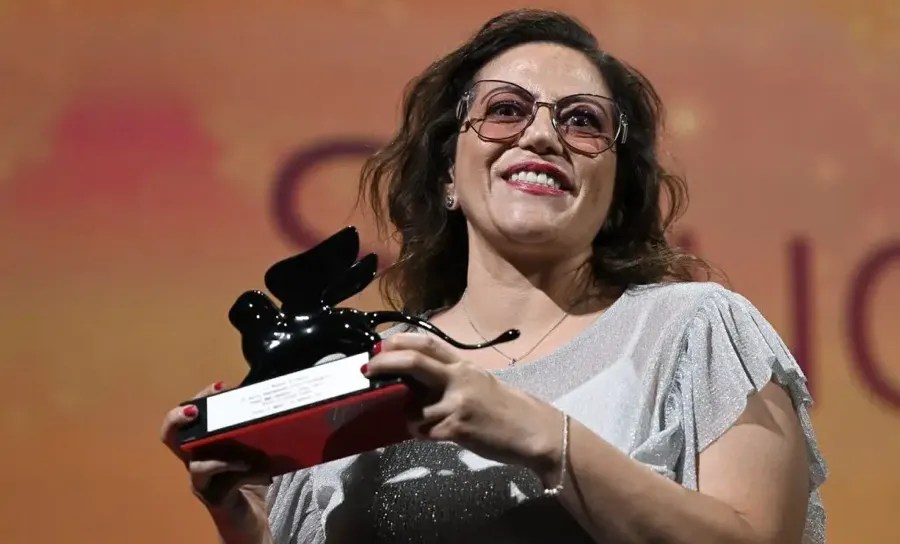
The writer-director Soudade Kaadan was born in France in 1979 and is now based in London. She made Nezouh with funding and support from four countries and seemingly shot in a fifth, Turkey. This is, in effect, a film made by members of the Syrian diaspora in other parts of the Arab world and in Europe. Kaadan’s starting point was to offer something different in the representation of Syrians affected by the conflict in their country:
At the time I started writing Nezouh, there was a certain expectation as to how a Syrian film should look – it was mostly informative, with a first-degree narrative to explain and simplify the complexity of a Syrian war for a white Western audience. Most of the refugee films about Syria were either trying to present us as victims or heroes, in a black and white narrative. But of course, we are neither one nor the other, like any human being. In all my films, I wanted the audience to feel that Syrian refugees were their equals. (from the Press Notes for the film.)
She succeeds in doing this by fashioning a metaphorical narrative which includes elements of what might be called ‘magical realism’ – she uses that term in the Press Notes. The film uses Arabic dialogue and although the precise location is not mentioned (or I didn’t notice it) there is a general assumption that it is Damascus, but it could be anywhere in Syria (except the coastal strip). She suggests that there are three phases in the narrative: the first is brief and dark in a family home before an attack blows holes in the concrete walls and roof spaces. The second phase then lets in light through the bomb-holes and the three family members, mother Hala (Kinda Alloush), father Mutaz (Samer al Masri) and young teenage daughter Zeina (Hala Zein), react to their new living conditions. This is the longest phase and perhaps it needs to be split into two parts as the daughter begins to spend time on the flat roof, drawn out by Amer (Nizar Alani), a teenage boy, perhaps a few years older, who lives across the way. The world looks different through the bomb-holes and Zeina and her parents react to their new sense of the fear but also the opportunity that is opened up. Should they try to stay in the apartment and risk being killed by the city’s besiegers or leave and hope to find a better life elsewhere? The third phase will then be set on the streets when circumstances push them to decide.
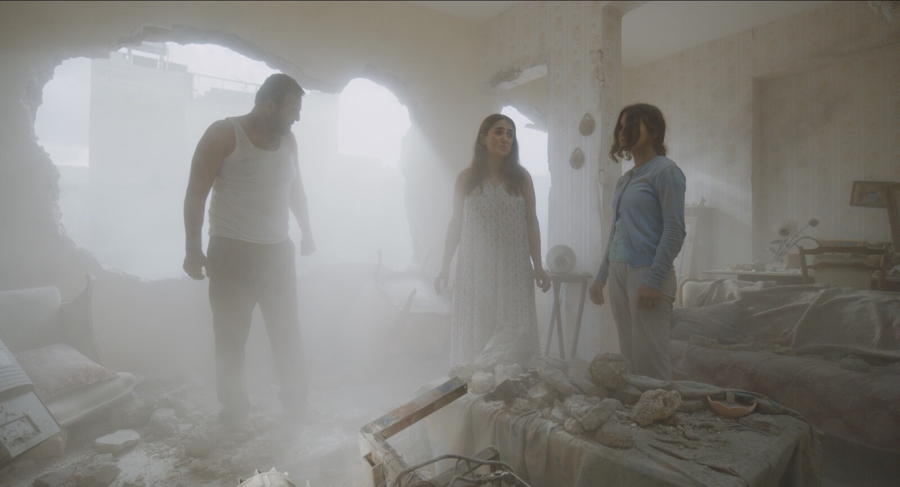
The father is conservative and patriarchal. He sees himself as the breadwinner/protector of the household. He believes it is his responsibility to marry off his daughters (the older ones left some time earlier, married and with children). In the circumstances he suggests that Zeina should marry a soldier. Hala is outraged and we learn that she was very young when she got married and she envisages a much more extended adolescence for Zeina and a chance for her to choose her own path. Zeina begins to see the world quite differently when she gets out onto the roof and especially when she meets Amer. There are several fantasy/’magic’ moments in the film. I’ll just point to one idea – the metaphor for the sea as a form of escape. Zeina wants to go to the coast so that she can fish in the sea. Amer finds her a fishing rod in an abandoned house. (But he also tells her girls can’t become ‘fisherwomen’.) When she looks out through a bomb-hole at the sky, she imagines that the blue sky is the sea and skims a pebble across the imaginary waves, so we see the ripples and hear the pebble fall beneath the waves. Hala on the other hand has a more dangerous wish to get to the sea and take a boat to escape to another country. When she tries to emulate Zeina in skimming a pebble it doesn’t seem to work as well.
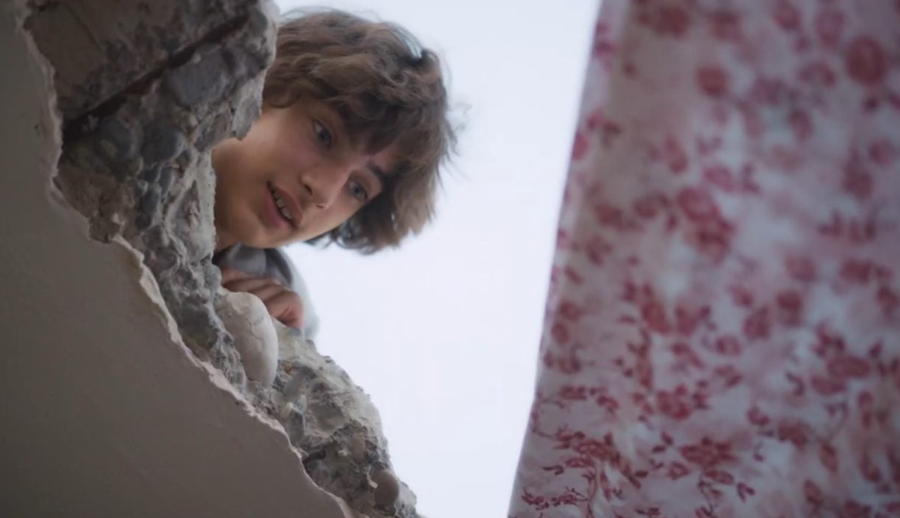
The narrative is built around Zeina and her relationships with the other three characters. She is at an important point in her life, at the beginning of puberty (though her father doesn’t know yet). The tone of the film is caught between her optimism and her fear. She loves her father but still needs him/wants him to be there, as does her mother. If the film has flaws they might be associated with Amer’s access to every kind of media technology. He explains where it all comes from but this could be another ‘magical element’. The actors perform very well – of the four leads, Hala Zein is the only one without previous film credits but she carries the central role with confidence. There is a good use of songs at moments in the narrative and the whole experience of the aftermath of the explosions and damage to the apartment is expertly caught by the photography of Hélène Louvart (surely the busiest woman in filmmaking, especially on films with a woman as director) and also Burak Kanbir. The film is presented in ‘Scope at 2.35:1.
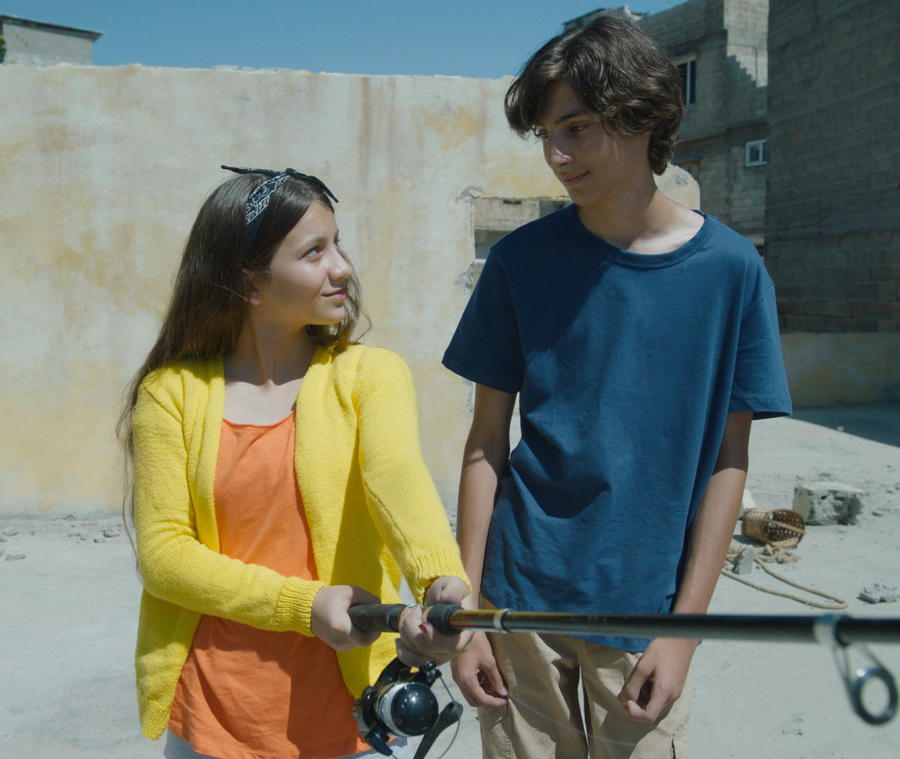
The title ‘Nezouh’ means ‘displacement’ and I think that Soudade Kaadan succeeds in offering us a sense of what this means in the context of the war in Syria. These are ‘real people’ as distinct from the refugees we see in the context of news reports in the Western media. They are frightened, but proud, with hopes as well as fears and as the film’s creator suggests they are more complex beings than we might imagine. I watched the film as a rental on BFI Player. It was briefly in UK cinemas in May this year and is now also streaming on Apple, Amazon, Sky and Rakuten in the UK as a rental. I found the film moving and enjoyable as well as communicating something different about the impact of war in Syria.
 itp Global Film
Thanks for writing about this, it’s so hard to make a film on Syria, and so hard to find films like this, I’ll seek this out based on what you say.
LikeLiked by 1 person