

I’ve been researching various French directors for a project about how they might have influenced a young director in the 2020s. Jean-Paul Rappeneau (born 1932) began as a writer contributing to film scripts such as that for Zazie dans le metro (1960), directed by Louis Malle. He has only made eight features but he directed several films which featured major stars and won César Awards in France. His best-known film internationally was probably Cyrano de Bergerac (1992) with Gérard Depardieu. I discovered that I had just one of his films in my collection presumably bought for its star Juliette Binoche.

Le hussard sur le toit was a hugely popular novel written by Jean Giono (1895-1970) and published in 1951. The novelist lead an eventful life, serving in the Great War but later becoming a novelist and a pacifist. Persecuted by the French authorities as a Nazi sympathiser because he refused to fight, he was never charged and after 1945 began to write historical novels. Le hussard sur le toit was one of four novels in a series. In it he uses some elements of his family’s history (his father was from Piedmont) and locates it in the Alps he knew so well.. The story is set during the cholera pandemic of 1832 in Europe which ravaged through the south of France. Angelo Pardi (Olivier Martinez) is a young man whose Italian mother has bought him the rank of colonel in the Italian army, but although Angelo is a skilled horseman and soldier he has never been to Italy. Now he must go to join the insurrectionists fighting against the Austrian occupiers of Northern Italy following the Congress of Vienna in 1815. Angelo’s father had moved to the South of France during the Napoleonic wars. Now Angelo must travel to Italy as Austrian agents in France are already looking for him. I’m not sure how accurate the film’s script is re the history, but that’s not the main concern of what is a romance-adventure narrative.
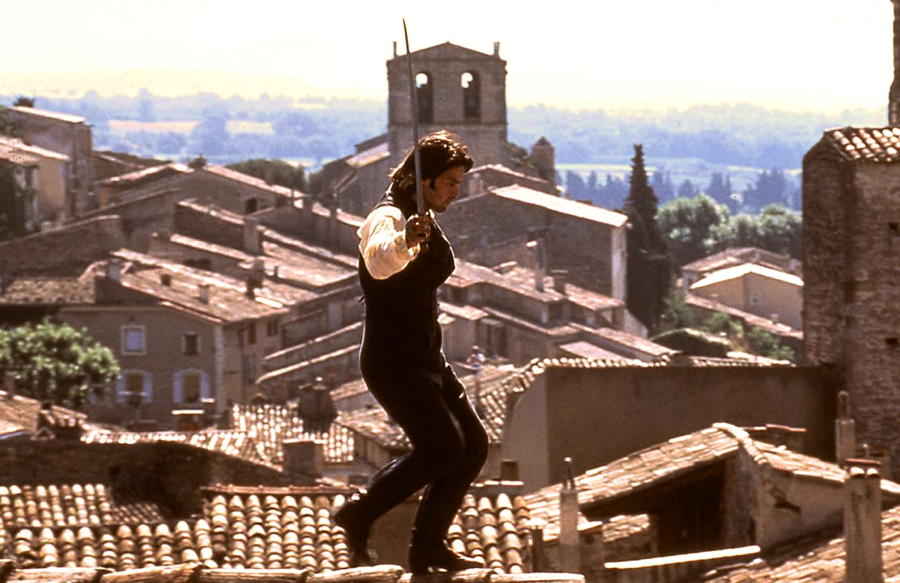
Angelo escapes from Aix-en-Provence just as the Austrians find him but cholera has already begun to sweep through the region. He won’t get far before he discovers towns full of the dead and dying and attempts by French troops to enforce quarantine – although at this point nobody knows how cholera spreads and all kinds of myths flourish. The film’s title comes from the moment when, to escape quarantine, Angelo runs across the roofs of a town before rain forces him to to drop through a sky-light and discover a noblewoman sheltering in her aunt’s house. This is Pauline de Théus (Juliette Binoche). There is an immediate rapport between the two. Angelo has been brought up as a ‘gentleman’ with a strict moral code. Pauline is the wife of an older man she believes is in their chateau in Manosque, high in the Alps. For most of the rest of the narrative the couple will be together with Angelo trying to get to Italy but also willing to be diverted because he must protect Pauline. Rappeneau was concerned to show the beauty of Provence so the journey seemingly leaps from one setting to another in landscapes and townscapes far apart. But everywhere there are many dead and dying and hostility towards travellers. Early on Angelo learns from a country doctor (François Cluzet) the only practical way to save a person who has been infected. Both Angelo and Pauline will have to fight their way out of difficult situations amidst the glorious scenery before they can reach Manosque.

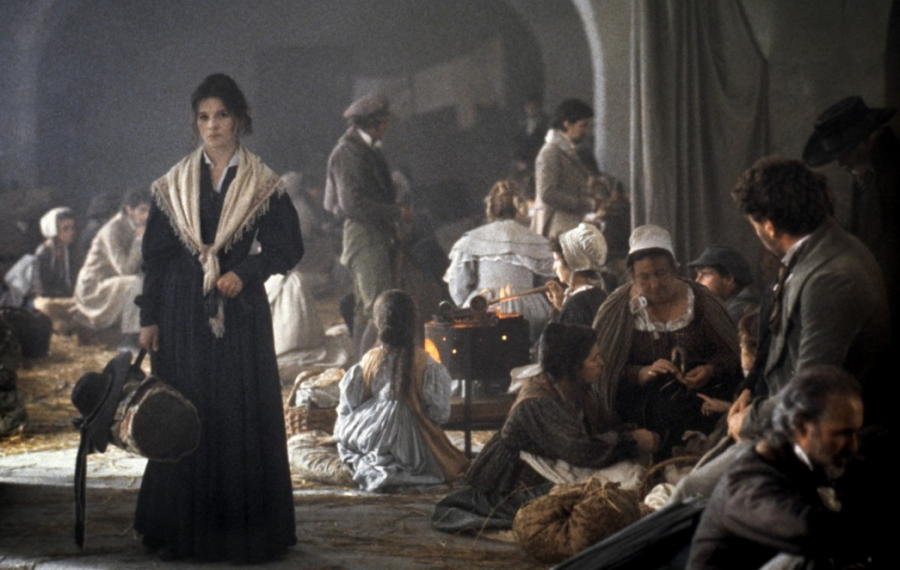
This is a true ‘romance’ in both the original medieval sense of a ‘knightly tale of chivalry’ and the more modern sense of a love story. But the code says, at least to Angelo that it must remain an unrequited love. His first concern must be his saddlebags full of money for the rebels in Milan. The casting of the film is very important. Juliette Binoche, at the height of her early career is very beautiful but also headstrong, playful and teasing of the younger Olivier Martinez who is suitably dashing, athletic and also a little naive (but well versed in survival skills). In fact Martinez is only a couple of years younger at most but both players act their ages as set out in the script. This was a genuine romance epic, running at 140 minutes in ‘Scope and with a cast of many extras and a strong supporting cast. There are many extensive crowd scenes, all shot on location and contrasting with the more closely-framed scenes between the two leads. But the lasting images are often of two figures on horseback in very long shot framed in the mountain country of the French Alps.

This was No 10 in the French Box Office for 1995 with 2.4 million admissions but unfortunately also the most expensive film of the year, meaning a loss in the domestic market. It was popular in overseas territories but probably not sufficiently so to make money overall. In a book focusing on La Reine Margot (France 1994), Julianne Pidduck links it to Le hussard sur le toit, arguing the ‘lukewarm’ response to both these ‘heritage films’ “perhaps signalled and exhaustion or disenchantment with formula of epic cinema as ‘national media event'”. She sees this style of ‘super-production’ associated with the Mitterand presidency which ended in 1995. ‘Heritage cinema’ was seen in both France and the UK as possibly appealing to nostalgia and national pride. I’m not sure about this. Jean Giono’s story celebrates rebellion and passion but its patriotism is for an Italian future or a Provencal localism.
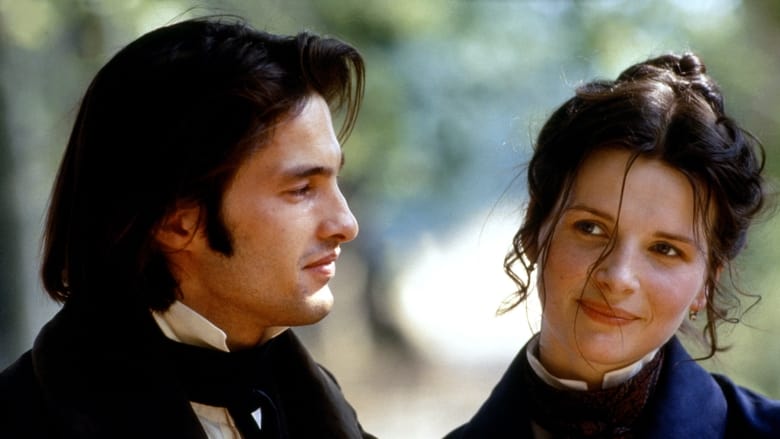
I enjoyed the film very much, though it would have been better on the big screen. It didn’t seem too long. The performances work for me and the cinematography by Thierry Arbogast is thrilling. As a certain kind of genre film, I feel it links to the Western in both America and Europe and also to both South Asian and East Asian cinema where romance and adventure in the mountains is celebrated. I’m not sure what a young filmmaker might learn from watching this film today but I hope they would recognise that Rappeneau creates a real romance through dialogue, action and the presentation of genuine emotion between the two central characters. The film isn’t available on streaming services but there are reasonable quality prints free online (with English subs). There is at least one DVD with English subs. Blu-rays exist but not with English subs.
 itp Global Film