
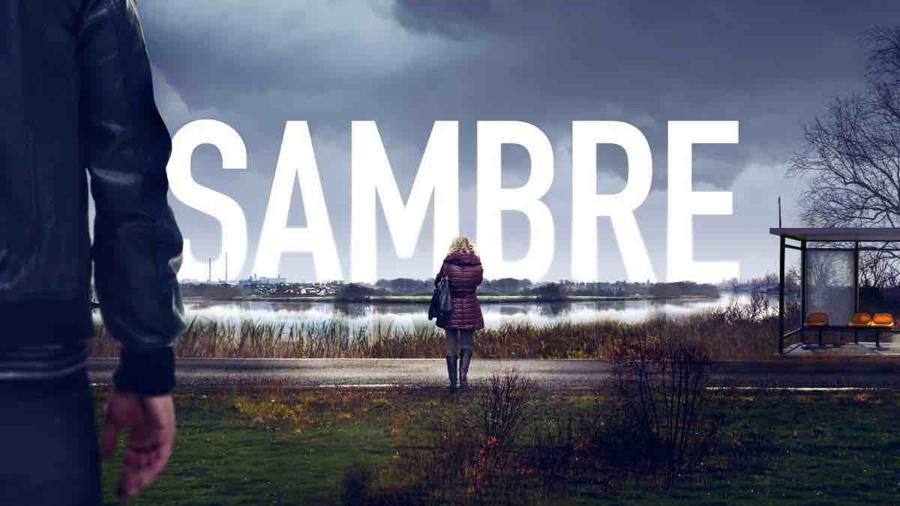
The Sambre River runs (canalised) through North-Eastern France to join the Meuse in Belgium at Namur. It runs through what was the French-Belgian coal basin and the site of heavy industry. The TV serial Sambre (6 x 60 minute episodes) is a fictionalised narrative detailing the activities of a serial rapist and the flawed procedures of the police and judiciary over thirty years from 1988 until the perpetrator is put on trial in 2022. The script is based upon the ‘true crime’ book Sambre, radioscopie d’un fait divers by Alice Géraud. It was adapted by Géraud and Marc Herpoux and acquired by BBC4 in the UK. The first two episodes were broadcast on 31st August and all six episodes became available on iPlayer at this point.

The structure of the serial is to offer a chronological account from the different perspective of characters involved in each period. Four characters re-appear at different points and the actors cope well with having to age thirty years. One of those is Alix Poisson as Christine, the first victim who we see in each episode as she lives through the thirty plus years of bringing up her daughter. She features at the centre of first episode when she is attacked near a bridge over the river outside Aulnoye in France. Julien Frison as a young gendarme, Jean-Pierre Blanchot, is also featured throughout the serial and in some ways becomes the representative of police attitudes, although it is the police culture that is being critiqued rather than the individual. The second episode moves forward to 1993 and features a young female investigating judge trying to get the police investigation moving. The third episode presents the work of a local mayor to protect her female constituents as attacks continue and episode four moves the focus to a Belgian university researcher asked to explore a Canadian geographic profiling system which might suggest the home or workplace of the rapist in 2007. The fifth episode features a ‘cold case’ investigator from the Regional Crime Squad in Lille in 2011 and the final episode wraps the story. I don’t think that outlining the structure in detail is any kind of spoiler. This is not a ‘whodunit’. Instead it is a narrative presentation of the process of finally stopping the rapes which serves as a commentary on the society and culture of the region in a general sense as well as the impact of the rapes on the lives of the individuals caught up in the events.

I’ve never seen anything quite like this serial before, although there have been several ‘reconstructions’ of national tragedies in the UK, sometimes presented in fictionalised forms. I have generally missed those programmes (which is not meant as a criticism of them) but there are a couple of feature films which I thought about while watching Sambre. One is Memories of Murder (South Korea 2003) by Bong Joon-Ho about a serial killer from the 1980s whose activities terrorised the local community as the local police forces initially failed to investigate effectively. The other is the more recent French film The Night of the 12th (France-Belgium 2022) which deals with a seemingly unsolvable crime in the Auvergne-Rhône-Alpes region investigated by a crime squad from Grenoble. That film offers an explicit critique of male failures in procedures for investigating attacks on women. Sambre delivers a critique which is more implicit in its presentation of procedural issues. Four episodes are headed by women and they are seen to be hindered by assumptions about female behaviour. But it is a complex narrative and in at least one case it is a woman’s analysis that confuses the search for the rapist.

The central feature of Sambre is its location in North-East France/South-West Belgium. The attacks on women are first the responsibility of the gendarmerie in the small towns of the region to investigate. Later they will involve local police over the border in Belgium and the ‘geographical profiling’ is carried out by a researcher based at the university in Charleroi. This is the economically distressed region of France and of Belgium, much like the ‘rust belt’ of the US or the former mining and steel districts of the UK. It’s never explicitly stated but is there a sense that the region suffers from neglect by national services? The case is finally brought to a conclusion by the more expert/experienced regional cold case squad. Several of the actors are recognisable from other French TV exports but the ‘star’ of the film for me is Olivier Gourmet who plays the cold case investigator. Gourmet is Belgian and closely associated with the films of the Dardenne Brothers all made a little further down the Meuse valley around Seraing and Liège. The serial was filmed mainly in Nancy and Metz to the East of the Sambre and partly in Belgium according to IMDb but it certainly looks like the North East France I have visited – it has the feel of authenticity.

The serial is directed by Jean-Xavier de Lestrade who is also listed as a ‘co-creator’. Lestrade has previously been known as a highly successful documentarist and that must have helped in his grasp of how to present all the procedures: he also deserves praise for his handling of emotional scenes with the actors who give impressive performances. Apart from the occasional drone shots, the film is mainly set in interiors except for the locations of the attacks which take place early in the morning or sometimes in the evening. The most notable feature of what is a 6 hour plus narrative (most episodes are actually slightly longer than an hour) is that the narrative is allowed to breathe with scenes often staying on close-ups or medium close-ups of the faces of the key players for much longer than the norm when the characters are not speaking. The result is that we really get to see the long term impact of these unsolved crimes and the stress and anxiety they create for both the attack victims and some of the investigators. We begin to wonder exactly what it is like to live with the experience of a sexual assault.

The serial has been prepared for export to Anglophone countries by anglicising the title to ‘Samber‘. I think this is a little sad if we can’t be assumed to be able to pronounce a single word in French. Fortunately, BBC4 hasn’t adopted the made-up name and titles the serial Sambre – Anatomy of a Crime. The programme details on IMDb seem wrong on some counts and I don’t think the aspect ratio is ’16:9′. It looks more like 1.85:1 on my computer screen (see the trailer below). I think there is some quite interesting use of diegetic music which isn’t covered on IMDb and would require considerable time studying the on screen credits to fully log. Recorded music is particularly important in episode 2 with the investigating judge playing music on her headphones and in her flat. I think this is an excellent television long-form narrative. It is an expensive show by the standards of French and Belgian TV costing around €9 million for the six episodes. It has been rewarded with high viewing figures of 4 million per broadcast episode and the highest streaming figures for France Televisions. I hope the BBC4 offer of the episodes on iPlayer for the next 12 months attracts similar views. I’m going to describe it as a ‘procedural crime melodrama’ forming an important critique of policing and judicial procedures. Despite the sense of violence around the attacks, very little is actually shown. This is a careful and well thought out presentation that tells a gripping story without sensationalism. Highly recommended.
 itp Global Film