

Abandoned is a Universal B picture (defined by its 79 minute running time) included in the ‘Universal Noir Vol 1′ box-set. I’m not sure about the film noir tag. There are elements shared with films noirs but overall it doesn’t feel like a noir. One of those elements is the pairing of Denis O’Keefe as a form of hero and Raymond Barr as a form of villain. They were previously paired in Anthony Mann’s Raw Deal (1948), one of the celebrated noirs and O’Keefe also appeared in Mann’s T-Men (1947) which shares some other different elements with Abandoned.

O’Keefe plays Mark Sitko, the crime reporter on a city paper. The city is unnamed but features Los Angeles locations. Sitko is making a night-time call at City Hall sniffing for stories and comes across Paula Considine (Gale Storm), a young woman reporting her sister missing. Sitko begins to quiz her and asks her if she’s visited the morgue. It’s perhaps a cruel question but it makes sense. Sitko then spots a figure hiding in the shadows – a dubious private detective, Kerric (Raymond Burr). He seems to be tailing Paula. Sitko knows Kerric and soon he’s exposed as working for Paula’s father. Paula and her sister didn’t get on with their father so she’s wary of Kerric. The sister had been pregnant but there are no records of her baby being born in the local hospital. The sister is in the morgue as a suspected suicide from carbon monoxide poisoning – but without a baby. Sitko smells a rat and takes the case to the DA’s office where he meets Chief Macrae (Jeff Chandler). But Sitko and Paula have been tailed by Kerric. Getting to the truth will be difficult.

The original script by Irwin Gielgud and William Bowers is directed by Joseph Newman and photographed by William Daniels. The photography is very good, the direction competent but the story is carried by the principals. The opening and closing sequences are presented in true film noir style, other wise the film is a mix of genre repertoires. First it could be described as a ‘sensational’ ‘torn from the headlines story’ with a newspaper man lead. This is intriguing in itself as Sitko is slightly creepy himself – he’s clearly interested in Paula and lets her know it, despite the fact she has just learned of her sister’s death. On the other hand he is quite heroic, in the way he sets out on the investigation and accepts her assistance. There is also a sense of comedy in the way she treats his advances. O’Keefe, the son of vaudevillians had some experience as a light comedy actor in his earlier career. Gail Storm was perhaps a surprise choice for the part of Paula. She had a background in pictures for the ‘Poverty Row’ studio Monogram in various genres, including films in which she sang – she would have a singing career alongside TV success in the 1950s. Her previous two pictures were B Westerns for small independents. I’m not sure how she got into this Universal production, but she does fine.

The ‘sensation’ is a baby snatching racket, a social problem which caused the PCA (Production Code Administration) problems. The Code wasn’t keen on showing unmarried mothers and certainly not on the idea of identifying the fathers of children born out of wedlock. There is a commentary on the Blu-ray with Barry Forshaw and Kim Newman and they raise the point that by not worrying about who the father might be, the script risks implying that the woman’s father is the possible culprit – an even worse suggestion for the PCA. This ‘social problem’ angle made me think of some of Ida Lupino’s films. Her first directorial work for her own company was on Not Wanted (1949) about a young woman who becomes pregnant but loses her boyfriend to his music career and then suffers psychologically when she gives up the baby for adoption. Lupino’s other films include Never Fear (1949) about the impact of polio on a young couple, Outrage (1950) about the rape of a young woman and The Bigamist (1953). These films each have a realist aesthetic and location shooting around Los Angeles. Such ‘social problem’ narratives were relatively unusual in studio pictures and as here they tended to be inserted into crime thrillers. Abandoned does feature a ‘real’ Salvation Army Hostel for unmarried mothers-to-be.
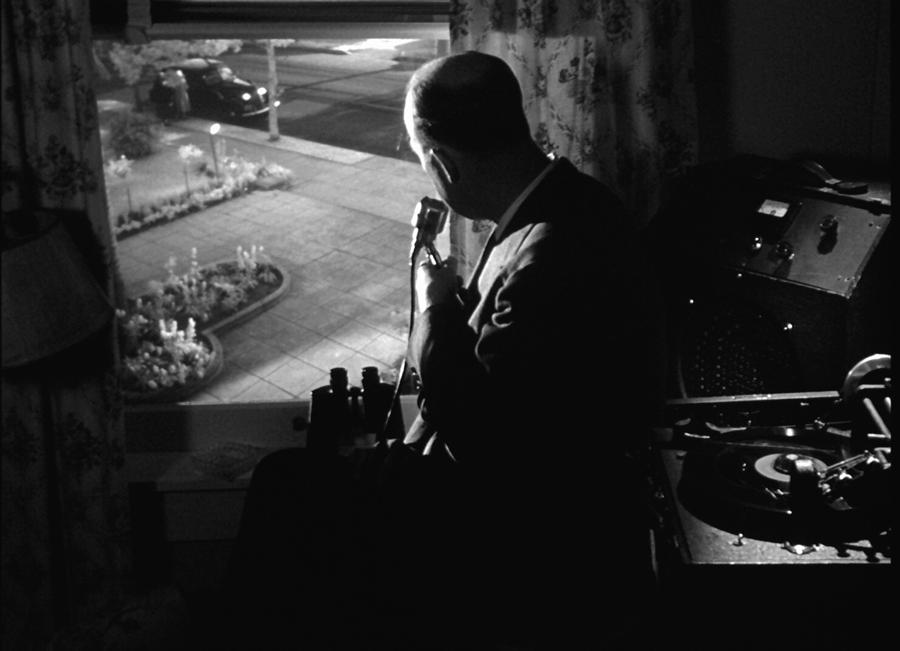
A third genre repertoire can be identified in the ‘Law enforcement procedural films’, a cycle of films from 1947 to 1949, perhaps starting with Anthony Mann’s T-Men (1947) and Border Incident (1949) about Treasury men and Border Patrol officers respectively. Perhaps the biggest hit of the cycle was Jules Dassin’s The Naked City (1948) a police procedural in New York. Such films often featured a voiceover narration filling in the details of procedures. Abandoned adopts this strategy, especially in the extended sequence detailing the entrapment of the ‘baby snatchers’ using an audio recording device in a house across the street from a meeting with a microphone in the bushes. But this isn’t the climax – actually capturing the guilty parties is a complex process.

The final section is exciting and the dénouement in the shadows is certainly worthy of the film noir tag. Overall this is a superior B picture and Dennis O’Keefe is very good as the lead. Raymond Burr was already well-known as a heavy but here he has a more nuanced role than usual. He does appear to have a smidgen of remorse while trying to save his own skin. Marjorie Rambeau, an ex-Broadway star and Hollywood character actor since the 1920s is an unusual gangleader as the formidable ‘grand dame’, Mrs Donner and Mike Mazurki (Moose Malloy of Farewell My Lovely (1944)) is a more recognisable heavy. I must try and finish the boxset now. So far it has been well worth watching.
 itp Global Film