
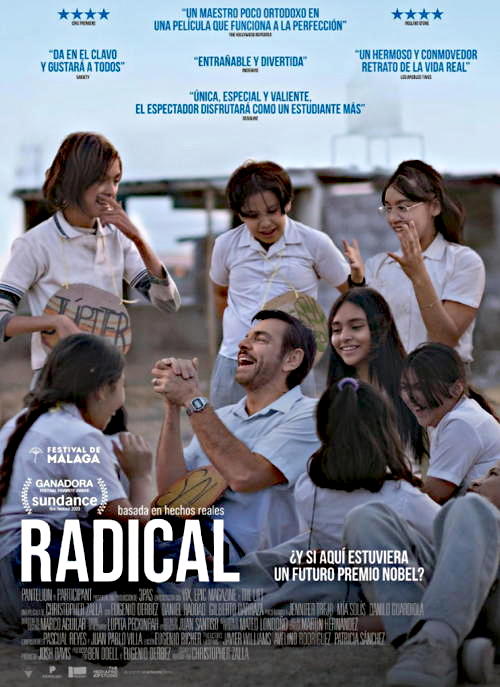
Cinema has returned to the National Media Museum in Bradford with screenings in the Cubby Broccoli Cinema even if the the rest of the Museum building is still undergoing a re-vamp. Even better news is the scheduled re-opening of the main Pictureville screen in the old library theatre building which has been closed because of an investigation into the RAAC concrete in the building. The screen is due to re-open on August 31st. In the meantime I found my way into Cubby via the Emergency exit in the car park to see Radical. I wasn’t the only one to negotiate all the mayhem of the road changes in the city centre. I think there were possibly four others. I’m glad I caught this film. In some ways a familiar story, the setting and the treatment of the characters in this narrative ‘based on real events’ make it stand out.
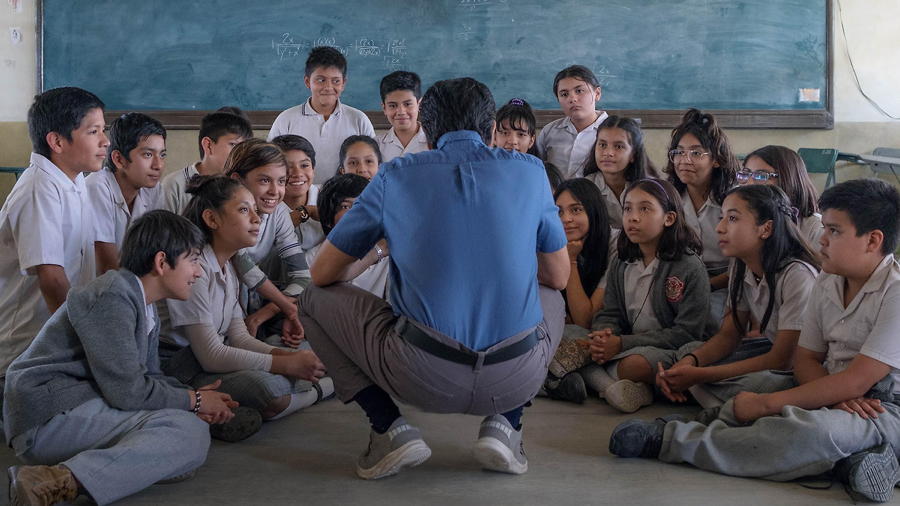
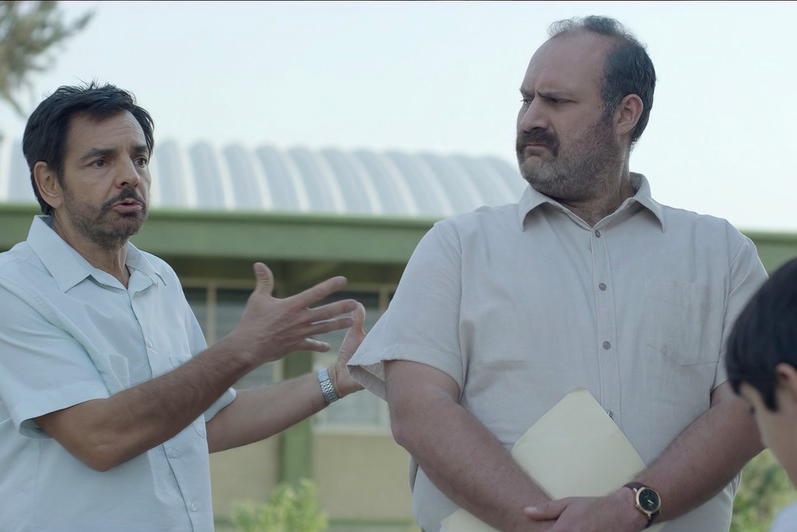
Sergio (Eugenio Derbez) is a relief teacher taken on by principal Chucho (Daniel Haddad) of an elementary school on the outskirts of the Mexican border city of Matamoros. Sergio is assigned to a class of 12 year-olds. The school has the worst record in the state (possibly the nation?) in the National Tests for Grade 6 and Sergio is the only ‘volunteer’ to take on the role and he has some revolutionary new ideas. He’s not a young man anymore but he is much more radical in his approach than anyone else in the school. He starts off by moving the furniture and breaking up the formal rows of desks. At first the students are very sceptical but Sergio eventually begins to win them over. He asks them to think about problems rather than teaching them how to pass the test, but it certainly isn’t plain sailing. There are lots of problems in the school and in the local community, not least the drugs gangs that operate in the border region. Mysteriously the school hasn’t got any computers, even though Sergio agreed to take the job because he had seen a news report suggesting the school had been given funding for a computer lab. The film narrative develops not just on the basis of Sergio and his students in the classroom but also on four sets of relationships that extend outside the school. Sergio builds a friendship with Chucho which at first seemed unlikely. He also has a closer relationship with three individual students. None of these relationships is in any way ‘dangerous’ though there is a scene in which he seems to be stroking a girl’s arm and back to encourage her when she is speaking to an education official which would cause horror in a UK context, I think. Some of Sergio’s actions also have unexpected consequences, one resulting in shocking violence. Could he have foreseen this?
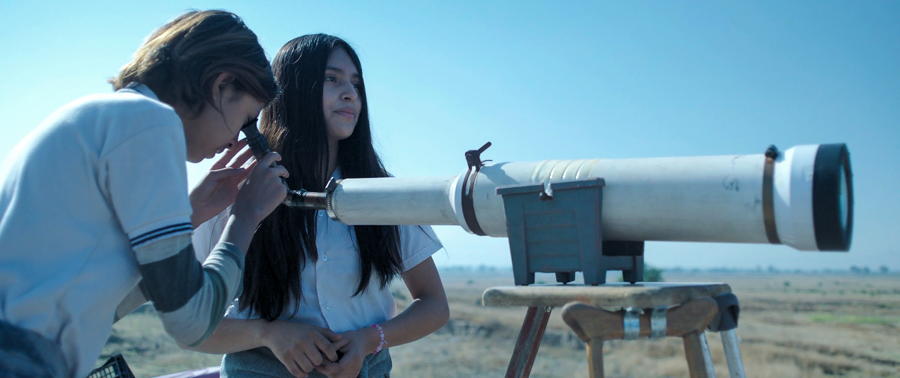
Paloma is a beautiful young woman well into puberty but she is shunned by some of the other students because she is the daughter of a man who collects scrap metal and lives next to the town rubbish heap. But Paloma has many hidden talents and some remarkable ambitions. Lupe meanwhile has an enquiring mind and Sergio’s comment that she might become a philosopher fires her imagination. But she has a difficult background as well in a family with many younger siblings and therefore pressure on her as the oldest child to help her mother. Finally, Chico is seemingly an orphan living by the beach who Sergio identifies as ‘the class clown’ but his life too is difficult because his older brother is grooming him to become part of a drugs gang.

It’s not difficult to see how with all these elements, this could become quite a manipulative story in terms of the audience response with the prospect of triumphs and disasters in equal measure. Several critics recognise this after the film’s success at Sundance in 2023. Leslie Felperin, writing in the Guardian sums up the critics’ position very well:
The expression ‘feelgood’ is usually just an indicator of cheerful and positive content, but don’t forget it also works as an imperative. As in, you better feel good about this movie or its admirers will get very cross and maybe call you names . . . [Radical] is a film that a certain constituency of viewers is going to love so passionately that woe betide any who might suggest that it is profoundly manipulative and unabashedly sentimental. The Guardian 6th August 2024.
I understand this and to some extent I agree with it. Felperin does qualify her statement by identifying that the film is very well made with terrific performances all round. But she does fall into the trap of quoting The Dead Poet’s Society (US 1989), abetted by the sub-editor who quotes that film as the header for the review. It’s not really a helpful comparison. I do admit that the film is closer to a popular Hollywood comedy-drama (apart from being subtitled) than to an arthouse film but in one important sense it is more like the several similar films from across Europe, Africa and Asia featuring teachers and students. The film doesn’t shy from quite difficult questions about the corruption in local education provision as well as the drugs problem. It ends with a set of statistics about Sergio’s success with his students and in particular with one of them that seem almost fantastical as a real life story. But that’s what it is, being based on a story written by Joshua Davis that appeared in Wired magazine in 2013.
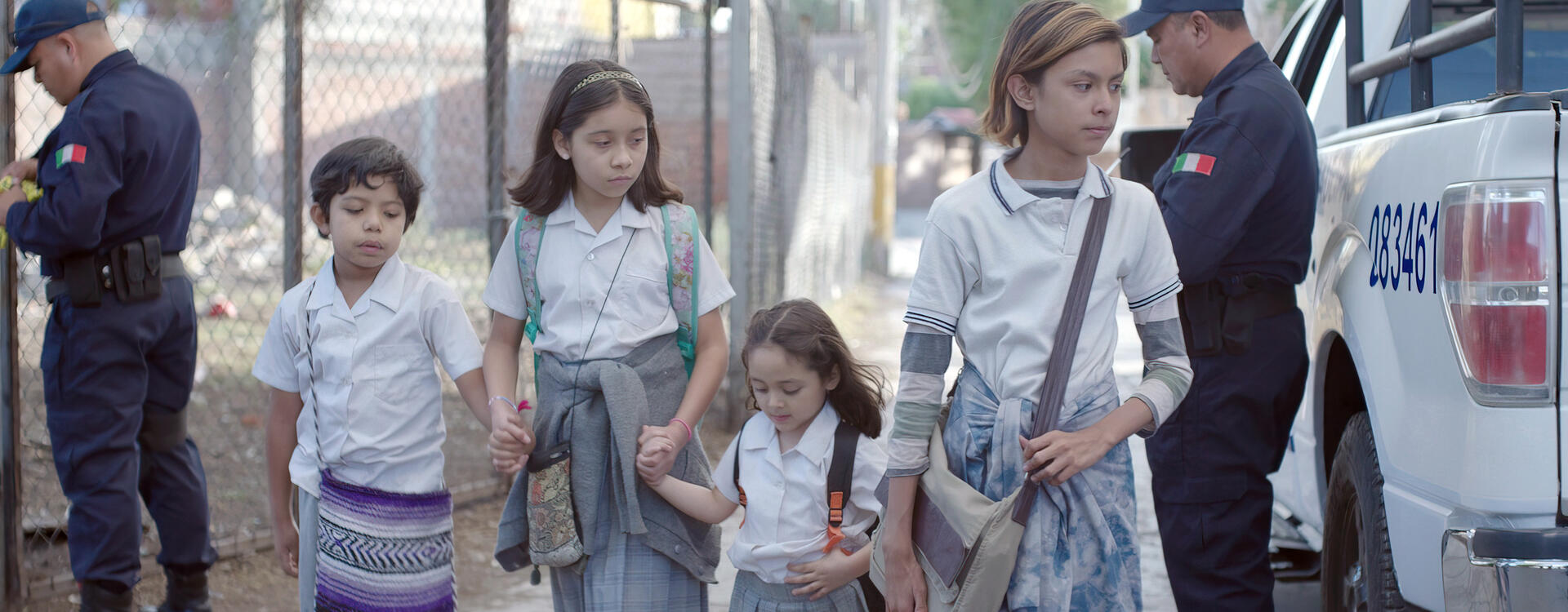
I confess that I was one of the film’s easily manipulated audience members. I was once a teacher in the 1970s faced with similar (but older) students and I thought myself to be ‘radical’. I adopted many of the same pedadagogic strategies as Sergio. Some of them worked. It was a struggle but when they worked it was very satisfying. Watching the film I was in tears of joy after only a short time and I stayed that way, although I was soon also fearful of what might happen because Sergio sets in train a number of challenges to the order of a local community run by people who aren’t really that interested in improving the lives of kids from poor families. There is definitely something else going on in this ‘comedy drama’. Education policies in many countries have seemingly supported neo-liberalism in many countries since the 1980s. Teaching children to think for themselves is a dangerous game. But this is a mainstream film and in ideological terms it ‘recuperates’ the disruption at the end of the narrative by focusing on the student who might become the ‘next Steve Jobs’, playing down the collective enterprise of all the students rather than the individuals who rise to the top. I think the film should be used to start a discussion of what learning is really for. Matamoros as a border town is the location of manufacturing businesses which use cheap local labour to serve export of goods to the US. That is evident in the opening scenes but gets rather lost in the story.

The film was shot in 2.35:1 by DoP Mateo Londono. It looks very good. There is also good use of music alongside the performances of the young actors playing the students and the two main adult characters. Whatever else, you won’t be bored and the 127 minutes flashes by.

Here is the Sundance trailer which helped the film get North American distribution. It does reveal quite a lot of the plotting so avoid if you don’t want to see spoiler hints. The film is still in some UK cinemas but not yet on streamers.
 itp Global Film