

The Farewell is another film I discovered buried in All4’s streaming offer, but I think it has now disappeared. It was a big success in the US and is easily found on Apple and Amazon. It is a ‘lightly fictionalised’ autobiographical film by Lulu Wang in the form of a traditional Chinese family melodrama married to a Chinese diaspora drama. It is described in many reviews as a comedy-drama.Wang herself was born in China but moved with her parents to the US aged 6. The narrative is based on the idea of the ‘good lie’ as adopted by the Wang family. Billi (Awkwafina) is a young Chinese-American writer in New York who has just received a rejection of her application for a scholarship when she hears that her paternal grandmother, her ‘Nai Nai’ (Zhao Shu-zhen) in Changchun (one of the largest cities in North East China), has been diagnosed with terminal cancer. Billi’s parents have decided to travel to China to see her but to follow family tradition and not to tell her about the diagnosis. Along with Billi’s uncle in Japan, they have used a forthcoming wedding of Billi’s cousin as the excuse for a family get-together in Changchun. Billi is shocked by the idea and her parents say she should stay in New York because they are afraid she will tell her Nai Nai the truth. But Billi somehow finds the fare and makes the trip herself. The main part of the narrative is then the preparations for and the celebration of the wedding banquet.

The film was a success at Sundance and then distributed by A24, the new US distributor which was on a streak with well-regarded independent films at this time. The film was a success at the box office in North America with $17.7 million and a further $5.4 million elsewhere. This is a healthy figure for a film mainly in Mandarin and subtitled. Results in Europe were solid but the biggest overseas market was in Australia with over $1 million. Ironically the release in China was poorly handled with suggestions that audiences had already seen digital copies from elsewhere by the time it was released. There are many reviews of the film and I don’t want to repeat all of the main points so I’ll focus on some wider questions. The film was released in the US a year after the massive commercial success of Crazy Rich Asians (US-China 2018), a glitzy romantic comedy which delivered an international box office of well over $200 million (and in which Awkwafina had a significant role). When Lulu Wang was looking for finance for her project she was dismayed to find that funders were pushing her to include a central white character, presumably to boost audience numbers. Wang’s narrative, however, is much closer to the early work of Ang Lee, the Taiwanese filmmaker who trained in the US and made films like The Wedding Banquet (US 1993) and Eat Drink Man Woman (Taiwan-US 1994). The latter of these two, based in Taiwan, is close to The Farewell I think and there are also obvious links to Edward Yang’s Yi-Yi (Taiwan 2000) in terms of a family melodrama focused on a wedding banquet. Last year in the UK we experienced the surprise success of another Asian-American diaspora film in the form of Past Lives (US-South Korea 2023) – coincidentally, also an A24 release in the US. Finally on this set of similar films, I note references to the melodramas of Kore-eda Hirokazu and specifically to Still Walking (Japan 2008). This latter film is mentioned by the cinematographer on The Farewell, Anna Franquesa Solano, in a fascinating article in Filmmaker magazine in which she explains how she shot the interiors in China, eventually using non-anamorphic (i.e. spherical lenses) and masking the image to produce a 2.35:1 wide aspect ratio. This enabled Solano to compose shots, often in tableaux with as many family members as possible. She also describes how she tried to achieve a naturalistic look – “We didn’t want it to have the high-end modern China style, but also wanted to go away from the cool, gritty Hong Kong mood”. Kore-eda’s modern family melodramas have gained high critical kudos in the US, but are still considered ‘foreign language arthouse’ and commercial value is seen to reside in American re-makes (none of which have happened yet).
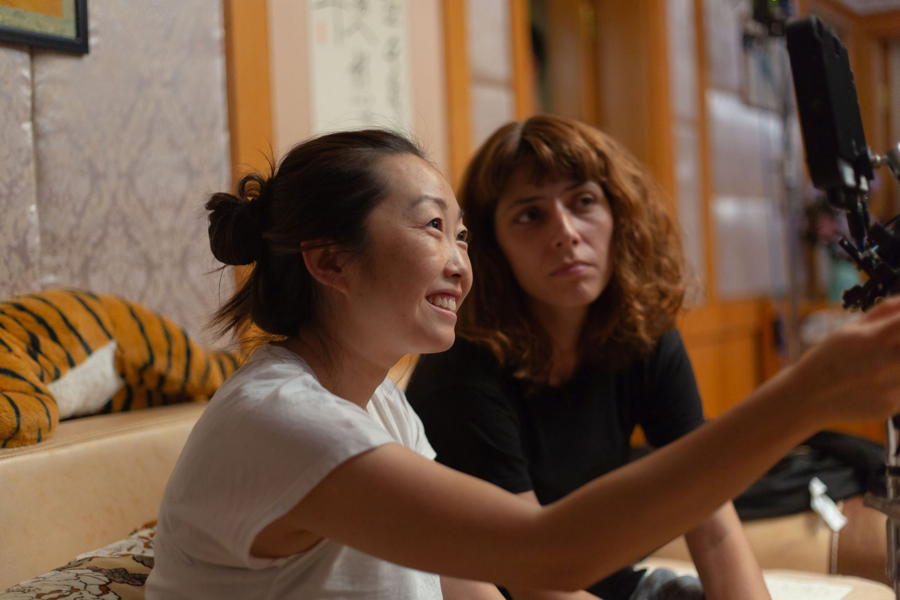
I enjoyed The Farewell very much, but I realise that I have seen many more East Asian family melodramas than Chinese-American films. I’m wondering why there aren’t more ‘Asian-American’ films and trying to think through whether the situation is different in the UK. I recognise that there are shockingly few Chinese-British films and that those that do exist are based mainly on the post-colonial immigration from Cantonese-speakers from Hong Kong, rather than the Mandarin migrations to North America. Much more prolific in the UK are the South Asian diasporic films whether from high-profile filmmakers such as Gurinder Chadha or more recent independent filmmakers from both Indian and Pakistani diasporic communities. I think that probably I’m simply not knowledgeable enough about the range of American cinema. I raise the whole issue partly because of a feature of The Farewell that is to some extent recognisable in the UK. I refer to the different attitudes of the generations of migrants, especially in relation to the ‘old country’. In The Farewell, it is clear that Billi loves her Nai Nai and wants to do the best for her. She gets on well with her but bows to her parents wishes not to expose the lie. She can’t understand why her parents adhere to the ‘old custom’ of not being open about terminal illness. Her parents and her uncle argue that by not telling her, she does not become distressed and life is easier for everyone else – in a sense the old tradition retains a collectivist sense and I’ve seen it argued that this comes from growing up in Communist China. Another example of this is whether children in the diaspora learn the language of the old country alongside that of their new country. Billi does but her cousin living in Japan doesn’t. It is almost a universal experience that children often get on with grandparents more easily than with parents. Partly that might be because we all need to ‘rebel’ against our parents’ ideas as part of growing up. But the experience of second generation migrants is slightly different, complicated by the importance of tradition within the family and the ‘distance’ in cultural terms from the culture the family has left behind. This manifests itself in the UK experience of British-Asian families who seek husbands from South Asia for their British-raised daughters. I think the autobiographical stimulus for The Farewell is important and at the end of the film there is a surprise closing sequence that you may wish to have explained. I read it slightly incorrectly but Wikipedia points to an explanation by Lulu Wang on this website.
 itp Global Film