

Here is another film that possibly suffered (outside France) from a release during COVID lockdowns or at least a time when many of us decided not to visit cinemas during 2020. That’s a shame because it must have looked amazing on a big screen. I watched it on a free stream from All4 in the UK. All4 lists it as a ‘science fiction drama’ but includes it in the ‘drama’ section rather than the ‘science fiction-fantasy’ section of its streaming offer. That’s a sensible decision, avoiding some of the problems of expectation that seem to have cropped up in the US. A brief outline of the film narrative suggests that it is an almost documentary-like procedural crossed with a mother-daughter drama about a French woman preparing for an international space flight. The narrative ends with the launch of the rocket from Kazakhstan. Reading some of the comments on IMDb, it’s clear that some American audiences thought this was a Hollywood movie (!) and were disappointed by the lack of ‘action’.

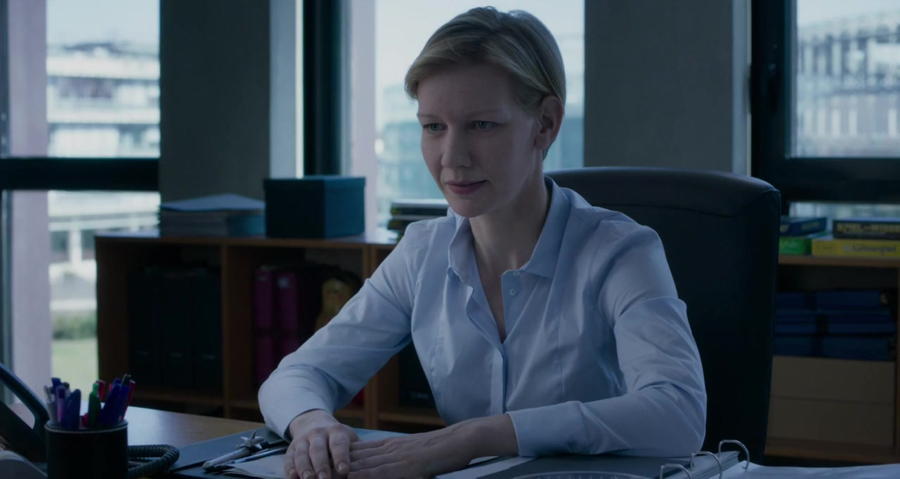
Sarah (Eva Green) is a French engineer and astronaut and the single parent of her 8 year-old daughter Stella (Zélie Boulant). She also has a cat named Laika so her interest in space travel since childhood is evident. Stella’s father is Thomas (Lars Eidinger), a German astrophysicist. Sarah and Thomas now live separately though Stella carries both her parents’ family names. The narrative begins at the European Space Agency (ESA) astronaut training centre in Cologne where Sarah is about to be introduced to the press alongside an American astronaut, Mike (Matt Dillon) as part of a new mission to spend a year on the International Space Station as the final part of the preparation for a planned mission to Mars. Sarah is a late addition to the three person crew. The third member will be a Russian cosmonaut Anton (Aleksey Fateev) who Sarah will meet at Star City, the Russian space facility outside Moscow. The major issue for Sarah is going to be her separation from Stella for over a year. Her daughter will have to change schools to live with Thomas and the ESA provides Wendy (Sandra Hüller) as a ‘fixer’ who will help Stella and Thomas to visit Sarah during her final training in Star City and then the Kazakhstan launch facility.

Proxima (the title refers to the nearest galaxy to our solar system) was conceived, co-written with Jean-Stéphane Bron, and directed by Alice Winocor. I recently posted on her 2022 film Paris Memories and earlier on her 2015 film Disorder. I haven’t seen her first feature Augustine (2012). Proxima is an ambitious production project which included location shooting at all three ‘real’ locations; ESA, Star City and Baikonur in Kazakhstan. Sarah speaks French with her daughter, sometimes German with Thomas and English with Mike. The language used in Star City and Baikonor also includes Russian. Lars Eidinger and Sandra Hüller are both multingual like Eva Green. In a sense there are two parallel narrative threads. One is the training procedural and the other the family melodrama. Eva Green is asked to play what are almost two contrasting roles. During the training she has to be the body-toned and memory-sharp engineer/astronaut, a woman in what is still a masculine world, but with her daughter she must be softer, warmer, more loving. In both roles she must portray the stress the character feels faced with the very different challenges. It’s a tall order but Eva Green is very good. The sexism of the astronaut world, at least that presented by the US astronaut Mike, is perhaps surprising, but Winocour in the Press Notes suggests that Mike is less macho than some of the real astronauts she was told about during her research. I found him insufferable until he is allowed to be a little more forgiving when he tells Sarah that he himself was a wreck coming back from Afghanistan before he joined the astronaut programme. In contrast Thomas seemed to me to behave very well when suddenly confronted with the change in his daughter’s arrangements. I think this is a feminist film which tries to deal with several serious issues. Wendy’s role is interesting in that respect. In the final credits sequence Winocour shows female astronauts from different nations and lists their flights emphasising that there have been many but perhaps media coverage has not properly represented their importance.


Personally, I tend to go for ‘hard SF’ stories or the more realist stories of space exploration or alien encounters like Contact (US 1997) or Arrival (US-Canada 2016) but I haven’t watched any of the several films about the Apollo space flights. I was therefore not aware of some of the training exercises and I found they made me quite anxious, wondering what made anyone want to go through such training and submit to what seem to me like the horrors of spaceflight. I thought it was a very good decision to shoot on the real location, although it must have been difficult to obtain permissions. I was fascinated by the landscapes surrounding both Star City and Baikonur. I was reminded of Tarkovsky’s Solaris (USSR 1972) and Claire Denis’ High Life (France 2018) (if I have remembered the Earth sequences accurately). Winocour says she wanted to make an ‘international film’ about an ‘international mission’. She invited Sakamoto Ryuichi to provide some music for the score but I confess I was so on edge that I didn’t notice if there was a score. I’ve read that it came in the last 15 minutes. The photography is by Georges Lechaptois in 1.85:1 and it works very well.
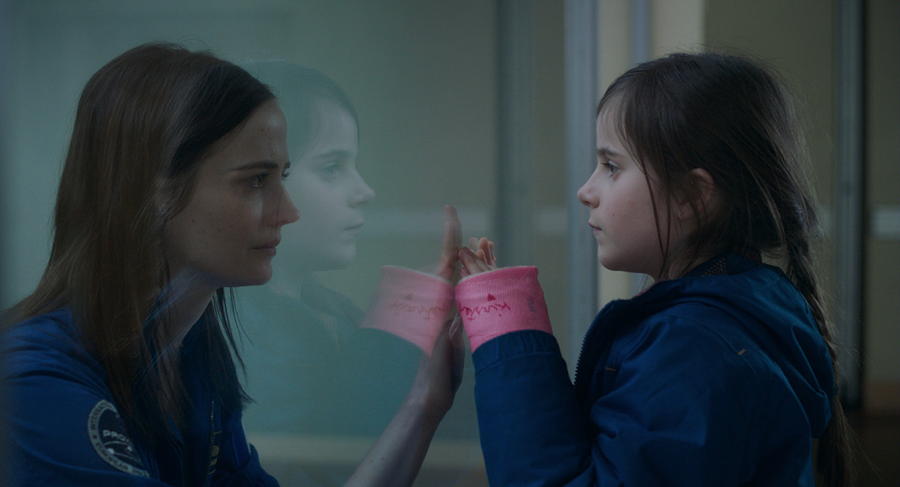

I was fully engaged by the film but as noted above I was often anxious. I reject most of the negative comments about the film though I do agree that towards the end of the film Sarah makes a decision to act in a way that is emotionally quite understandable but seems highly unlikely to be possible during the final hours before the final countdown. It’s kind of ‘required’ by the melodrama but shouldn’t happen in the procedural. The girl playing Stella is remarkable and Lars Eidinger and Sandra Hüller are rather under-used for two such wonderful actors. I could have taken a longer film and had a little more of the story of Stella, Thomas and Wendy away from Sarah – but I might be in a minority of one on that. The film should be on All4 for a few days. Otherwise it is available on Apple, Amazon and Sky. I recommend the film and my advice is to ignore the low user ratings on IMDb or audience ratings on Rotten Tomatoes – as long as you have the right expectations.
 itp Global Film
She seems to be a very interesting and ambitious director
LikeLike
Yes. She trained as a screenwriter, later being César-nominated for her screenplay work on Mustang in 2015. All of her projects seem to focus on stories about women in difficult/challenging situations.
LikeLike
I also saw this on some version of C4 a bit back – possibly Film4. It was a challenging story, not least as I would imagine an astronaut’s emotional stability would be a prime consideration for their respective supervisors, and Eva Green’s character was a bit erratic at best. That said, I could watch Eva Green in anything. This includes that weird horror cum parable about the clothing trade and the exploitation of workers in the Philippines, with Mark Strong as hubby, that I saw at Vue a while ago. There were not many there.
LikeLike
This sounds really interesting. Great review. I’ll check it out.
LikeLike