

I came across this film while scanning the collection of films free to stream on ITVx in the UK. Watching films on ITVx runs the risk of long compulsory ad breaks. However, in this case the film is so obscure that the ad breaks were quite short. It may be obscure (I don’t remember it at all) but that doesn’t mean it lacks any of the good qualities that make for an entertaining ride. I came across one review that described it as an ‘erotic thriller’ but apart from a few flashes of nudity that’s not really accurate. There are some reviewers who see it as a film noir and one who describes it as a ‘spoof film noir’. I’m not sure where the ‘spoof’ comes in, though I guess that if you find the plotting to be ‘contrived’, you might think it was a spoof. Basically it is a murder mystery/crime melodrama and it does have a femme fatale and a ‘doomed man’ so ‘neo-noir’ is a possible description. For UK audiences, however, its setting is arguably the most important element, in terms of both time and place.

The time is the Christmas season in 1959 leading into New Year 1960. The UK was not yet ready for change (and didn’t have a government sensitive to what most people wanted) and the archaic laws referring to divorce, homosexuality and the death penalty for first degree murder were all still in place. The place of the criminal act is Brighton. For audiences outside the UK, Brighton is the seaside resort town (now a city) that has long had a connection to London, both for show business and for crime. Quite a few well-known crime films have a Brighton setting. Graham Greene’s Brighton Rock (1948) was joined by Jean Kent as the Good-Time Girl (also 1948) in which a gangster has a club in Brighton. Jigsaw (1962) is a very good police procedural set in Brighton and Hove covering a murder investigation and Mona Lisa (1986) is a terrific film which ends with a shooting in a Brighton hotel. Another Brighton hotel is the key location for Under Suspicion. Liam Neeson plays a police officer (Tony Aaron) who struggles to keep his penis in his pants. This leads to his eventual dismissal from the force and he ends up as an impoverished ‘private detective’ whose main activity is providing evidence of marital infidelity to enable his clients to gain a legal divorce (a process in itself an illegal act). Tony provides a woman to sit in bed with his client in a hotel while he pays a maid to open the hotel room door and then photographs the ‘adulterous couple’. One night it all goes wrong and when the door is opened he finds both the woman and his client shot dead.
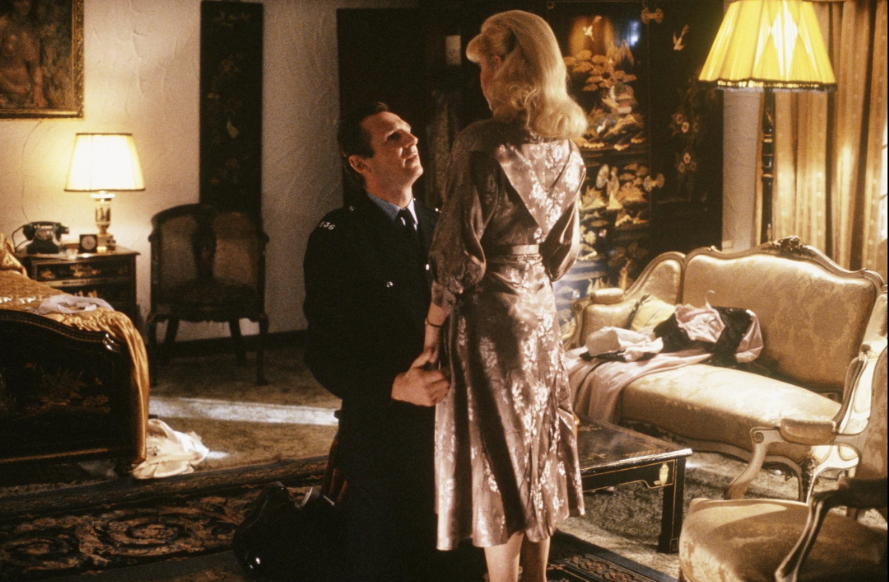
I don’t want to spoil the narrative so I’ll just present the other important characters. The man who was killed has a wife Selina (Alphonsia Emmanuel) and a mistress Angeline (Laura San Giacomo) from his time in Miami and both might have a motive. However, there is a suggestion that Tony himself might have committed the murder and then attempted to ‘discover’ the bodies. Tony will try to find the killer but his only real advantage as an investigator is his ex-partner who is now a detective inspector, Frank (Kenneth Cranham) who does attempt to help him. But events and circumstantial evidence do seem to point to Tony as the killer and he is arrested and put on trial. Did he do it? Will he be found guilty? And if so, will he hang? I’m not telling!

The real star of the film for me is Kenneth Cranham – one of the great British character actors. Here he is a long suffering but dogged and determined detective prepared to do what he can for Tony out of comradeship and genuine friendship, even though he disapproves of Tony’s overall behaviour. Cranham has had a long career across television, film, radio and theatre. He grounds the film and offsets some of the wilder scripting ideas. The film was written and directed by Simon Moore, a British writer best known for his television work (e.g. on the Channel 4 series Traffik from 1989, which formed the basis for Steven Soderbergh’s film, Traffic in 2000). He also wrote the original script for the Sharon Stone film The Quick and the Dead (US 1995). Moore has directed only one other film since Under Suspicion. While there is nothing particularly notable about the visual style of Under Suspicion, it is efficiently made and does the job. Moore appears to have retired to Los Angeles.

The two leading players of the film are Liam Neeson and Laura San Giacomo. IMDb reports that Tony Aaron was initially to be played by Irish actor Patrick Bergen but he withdrew early in the production. He was replaced by Liam Neeson, another Irish man, albeit from the North rather than the South. I have no idea why the producers wanted a 6′ 4″ Irishman for the role but both Bergin and Neeson fit the bill. I don’t know Bergin’s work so I can’t comment on whether Neeson was a better choice but in 1991, Neeson had more experience and a higher profile. Variety thought he was weak in the role, but I thought he was fine. In 2007, Neeson starred in the film Taken (France-UK-US 2007) for Luc Besson’s EuropaCorp. It changed Neeson’s profile in many ways and he emerged as a new but ageing ‘action man’ hero. It spawned two sequels and proved an international box-office smash but in the long run it possibly degraded Neeson’s star persona. He’s actually had a diverse range of roles and worked with many high profile directors but he now seems trapped to some extent in his Taken guise. In this 1991 film he does stand out, especially with his height and his flyer’s/motorcycle jacket set against the more conservative dress of every other man in the film. But then, there is a sense that Under Suspicion is slightly ‘out of time’. There are plenty of ‘1959’ references but I’m not sure they feel authentic. More visually disturbing is Leeson’s pairing with Laura San Giacomo. I was reminded of Sofia Coppola’s recent film Priscilla (US 2023) when I saw a clinch between Leeson at 6′ 4″ and Giacomo at 5′ 2″. In a sense Giacomo takes us back to 1950s British crime films when importing second-rank American actors was a familiar commercial strategy. Perhaps in this case it was an attempt to woo the American market? The other oddity about this film is that Angeline is given a romantic/expressionist mansion by the sea that appears to be almost on top of the waves (whereas Brighton has shingle beaches). Perhaps it is meant to invoke the California beach houses in films like The Long Goodbye (US 1973) or Mildred Pierce (US 1945)? That would tie in to the idea of this as a ‘neo-noir’ with Angeline as the femme fatale. The house was actually filmed at Portmeirion in North Wales, famous for The Prisoner TV series from 1967-8.
Under Suspicion was made by an independent, Carnival Film and TV, with funding from LWT (London Weekend Television), Columbia and Rank, the two distributors of the film in most territories. The only place to watch this film in the UK today is on ITVx. You might be able to find it free online if you search. Beware, however, that there have been three other films/TV series with the same title since 1991. The best known title is the 2000 film with Gene Hackman and Morgan Freeman. If, like me, you are stuck for something to watch, I recommend this as a diversion.
 itp Global Film
I did catch this on general release when it first came out, which was probably not long after Laura San Giacomo made a big impression in ‘sex, lies and videotape’ from Soderbergh. Her appeal as a leading lady did not last too long after this but her smoky voice was effective in this noirish thriller. I have seen it again rather more recently, maybe on Talking Pictures (though I could be wrong here). Maggie O’Neill does well in a relatively minor role, and she is still very active in mainstream cinema and was in something last year that I didn’t catch. The film does rather confound the audience’s expectations at the end, which is perhaps why it wasn’t better received at the time. I enjoyed the time spent in the company of various doomed characters.
LikeLiked by 1 person
I’m always impressed by your memory of screenings from 30 years ago or more, John. Laura San Giacomo had 5th billing in Pretty Woman in 1990 and must have hoped that Under Suspicion would help her career really take off but alas the roles didn’t come from then on and most of her work has been in TV. She didn’t do anything wrong in the British film but it doesn’t seem to have made too much of an impression in the US. I thought the ending was quite clever.
LikeLiked by 1 person
Cranham deserves more celebration than he gets. I fear that these ad-supported films will eventually become unwatchable due to the number of breaks and ads. It’s particularly annoying when watch tv shows when the ads are not in the ad breaks, or films where the ads interrupt the final scene!
LikeLike