

Long-time readers of this blog may have noticed that we have not covered popular Indian cinemas since the pandemic. This is primarily an issue related to accessibility. For various reasons I can’t often get to the cinemas locally that show Indian films in the UK. Also it has become apparent that it is much more difficult to find DVDs or Blu-rays of popular Indian films and many are only available to subscribers of streamers such as Amazon Prime or Netflix, neither of which I use. I very much miss the chance to keep tabs on the best of Indian cinema but I’m pleased to say that after quite a bit of searching I found that I could rent both parts of Mani Ratnam’s historical epic Ponniyin Selvan from Apple TV.

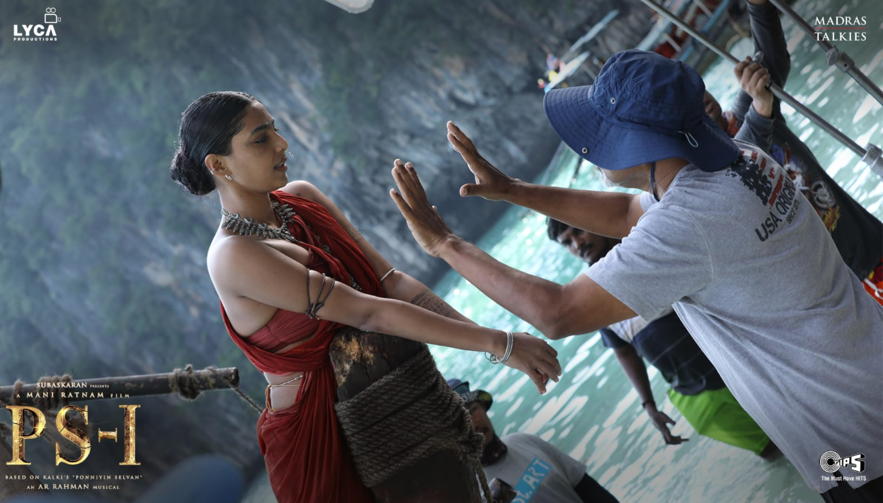
These two mammoth productions are adapted from the five books by Ramaswamy Krishnamurthy (aka ‘Kalki’) published in serial form from 1950-1954. The books explore the history of the Chola Empire in the 11th century and have proved to have endured for a Tamil readership ever since. Mani Ratnam, the most celebrated Tamil director, whose films have been seen across India in both original and dubbed versions in Hindi and Telugu and I think more recently in Kannada and Malayalam as well, has been trying to adapt the the books for a long time. This production came about when Madras Talkies received financial support from Lyca Productions. Lyca is a subsidiary of Lycamobile founded by the British-Sri Lankan Tamil entrepreneur Subaskaran Allirajah and since 2014 it has been a co-producer of Tamil blockbusters giving the Chennai industry some financial muscle to allow it to compete more effectively with Mumbai. I think I need to find out more about Lyca at some point.

Ponniyin Selvan was adapted by Mani Ratnam and two other Tamil writers Elango Kumaravel and Bahuleyan Jeyamohan. The book/film’s title means ‘the son of Ponni’. Ponni was the ancient term for Tamil Nadu’s longest river, the Kaveri, or ‘Golden Mother’ because of the fine silt it washed down from the mountains (the Western Ghats). The narrative is an historical epic about the identity and heritage of the Tamil peoples. The Chola Empire at its greatest extent was a maritime empire that controlled South East India and its navies also spread its influence over parts of Sri Lanka, parts of Burma, Malaya and Sumatra and extended up the Eastern coast of India to the Ganges delta. The Empire lasted over 400 years from the 9th to the 13th centuries and it left a legacy of architecture and literature and also sent emissaries to China. The film deals with what are often the problems of imperial rulers – struggles within the ruling family as siblings and generals quarrel over the succession when the Emperor is ailing.

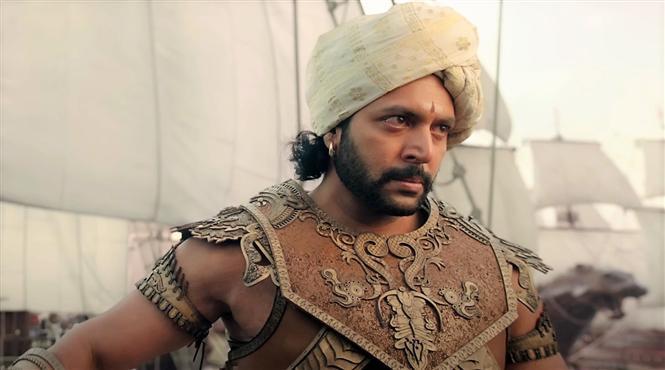
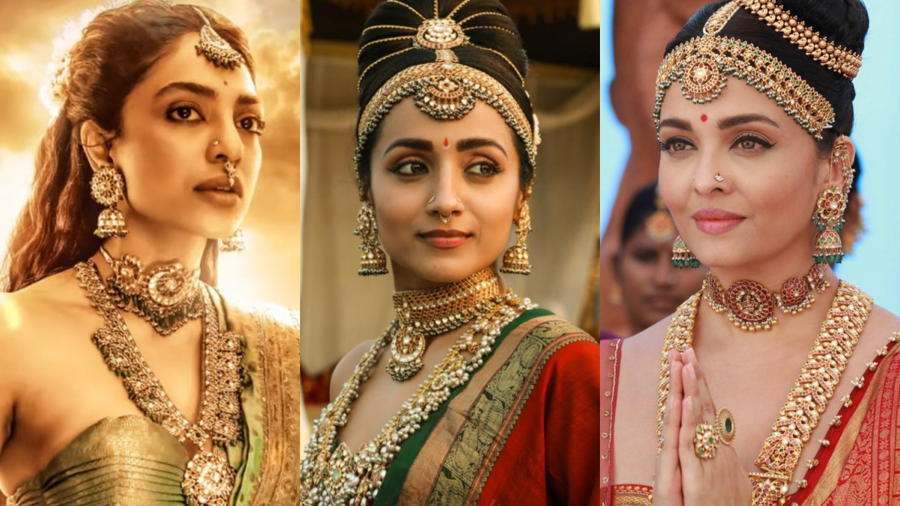
There are three star names in the cast who I recognise. Vikram plays the older of the two Princes, both of whom are away fighting battles with neighbours. Aishwarya Rai plays Nandini, the wife of the Treasurer and she also has a second role as a mysterious woman who appears, riding an elephant, at moments of danger which threaten the the ‘son of Ponni’ (i.e. ‘Ponniyin Selvan’). Karthi plays Vanthiyathevan, a Chola warrior chief who is entrusted by the older Prince Karikalan with a mission to find out the intentions of the plotters who would overthrow the Emperor and then to report what he finds to Kundavai (Trisha), the sister of the two Princes. The second Prince, Arunmozhi (Jayam Ravi) is at this point leading an invasion fleet to capture the King of Lanka. Whatever the plotters are up to, they must capture the two Princes who are both powerful leaders of their armies. Vanthiyathevan who travels between the different strongholds of the Cholas, carrying messages is in effect the driver of the narrative. Two other important women in the narrative are Vanathi (Sobhita Dhulipala) and Aishwarya Lekshmi as Poonguzhali, the ‘boat girl’.
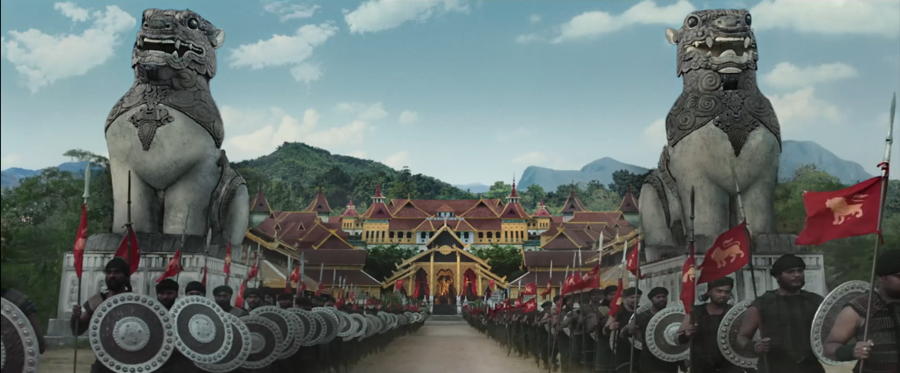
This is a terrific action film and a complex drama of court intrigue. As one of the most expensive Tamil films ever made it is as spectacular as might be expected. Compared to similar films from Bollywood, China or the US, I would argue that this feels more ‘authentic’. As some reviewers have noted, many of the architectural triumphs of the Cholas remain intact in Tamil Nadu and it is likely that there is less CGI than might be expected. (Much of the film was actually shot in Thailand and Ratnam had plans for shoots across Southern India and Sri Lanka but production was delayed by COVID and its travel restrictions.) Crucially the film also benefits from a score by A. R. Rahman, arguably international cinema’s most celebrated music composer. The film credits actually announce first that this is “An A R Rahman musical” before “A Mani Ratnam Film”. The only time I think I’ve seen something similar in credits is when John Ford allowed Greg Toland’s credit to appear on the same title card as his own in the 1940s. Rahman provides six songs as well as the scoring. I have wonderful memories of Rahman songs in Ratnam movies so this was a re-assuring sight. The music is complemented by Ravi Varman’s cinematography, editing by A. Sreekar Prasad and an excellent art design and production design team. In short, the film is genuinely a spectacle and I wish I had been able to see it in 2.35:1 on the big screen.
The performances are all very good and it would be invidious to name some performers rather than others. In terms of action, the film has everything. It is primarily a swordfight film but the large scale battles include catapults and other weapons. The lead characters are effective killing machines taking on multiple attackers at any one time. I have no idea how many stunt artists are used but one thing that struck me was that all the leads appear athletic despite not being as young as some other action stars in movies. There is some use of slo-mo but mainly fights are presented in realist mode. Having said that the more outrageous stunts that see characters caught up in such as in a storm at sea are fantastical. I’ve been trying to think of comparisons for the mixture of epic battles and court intrigue and I think this film stands up against Anthony Mann’s El Cid (US-Italy 1961), Zhang Yimou’s Hero (HK-China 2002) or Kurosawa’s Ran (Japan 1985). I was very impressed.
How should we see this film in the context of Indian cinema over the last few years? This is where I struggle. I am aware of the tremendous success of films like RRR (India, Telugu 2022) which was a massive international hit. I would like to have seen it as it represents the most visible indication of the rise of Telugu cinema outside the confines of Andra Pradesh and Telangana. It too was an expensive epic, but one concerned with the Indian colonial struggle against the British in the 1920s and therefore, perhaps, a more accessible narrative for international audiences. Ponniyin Selvan Pt 1 did good business internationally but not on the same scale as RRR. The more difficult question, perhaps, is how Mani Ratnam’s film was seen around India. It was dubbed into Telugu, Hindi, Kannada and Malayalam. Ratnam has been a major figure in India since the mid 1980s and around 2000 he was one of the few directors to make films that were dubbed into other Indian languages and sometimes he was able to make two completely different versions of the same film (e.g. Yuva (2004) in Hindi had a different cast but the same narrative as Aayitha Ezhuthu made in Tamil. Mani Ratnam was seen to be one of the few directors making films that were both popular and speaking to national Indian concerns (e.g. Roja (1992) and Bombay (1995)), but in the 2000s he seemed to fall out of favour to some extent. I need to think about how this exploration of the Chola Empire’s history fits in with the jingoistic India of Narendra Modi but I’m going to leave that until I’ve seen Part 2 of Ponniyin. If you are intrigued to see this first episode it is available from both Apple and Amazon in the UK. I recommend it highly.
 itp Global Film