
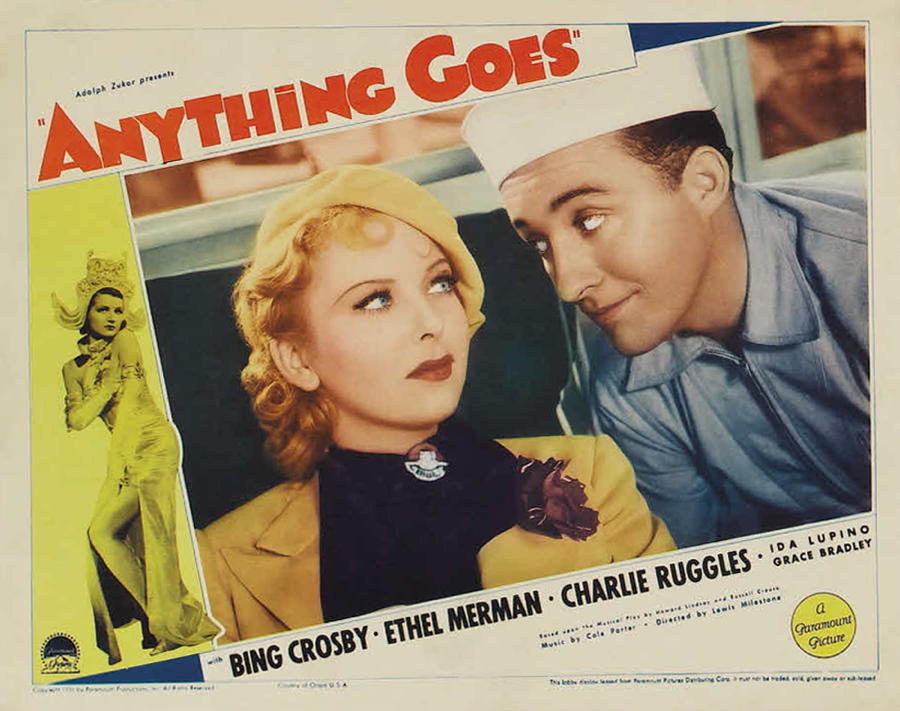
Ida Lupino was all of 17 when this film was produced. She had been at Paramount for two years during which time she had made six films but none with what Lupino saw as a worthwhile role for her. But at least Anything Goes was a prestige A picture starring Bing Crosby and Ethel Merman in an adaptation of the Cole Porter Broadway musical. Ida was fourth-billed after Crosby, Merman and Charles Ruggles. The Broadway musical became a musical comedy romance, with a ‘gangsters in disguise’ element providing ‘snappy dialogue’, all set aboard a ship sailing from New York to Southampton. Crosby plays a Wall Street man who is seeing off the singer played by Ethel Merman when he fails to leave the ship in time. Instead he becomes besotted with young Hope Harcourt an unhappy young heiress (Lupino) who had fled England but is now being taken home by a stuffy young aristocrat (Arthur Treacher). Charles Ruggles plays a rather unlikely con-man mixed up with Crosby who is then mistaken for a notorious gangster. The film was directed by Lewis Milestone and photographed by Karl Struss so it was definitely a prestige pic.

It’s a silly comedy but the songs performed Crosby, Merman and The Avalon Boys are generally very good with four of Porter’s best songs from the Broadway production and four more written for the film. Ida Lupino was contracted to Paramount and they had attempted to make her into a junior version of Jean Harlow when they realised that she couldn’t play the lead in Alice in Wonderland, the original idea when she was invited to Hollywood after her early British roles. Lupino was required to become a platinum blonde but in this film her hair seems less metallic and quite nicely styled as befits a young heiress. There are two quite lavishly-mounted musical production numbers at the beginning and especially in the climactic final sequence. Paramount was a studio with a focus on comic and musical talents. Crosby has a couple of intimate songs, one of which is used to seduce Hope. Nobody in this period seemed to think it was slightly disturbing to see a man in his early thirties making love to a 17 year-old (but to be fair Lupino plays older). There are also some jokes that don’t work today because of a homophobic suggestion or an Orientalist approach to Chinese culture. The final sequence also made me think of the later ‘Road’ pictures featuring Crosby with Bob Hope and Dorothy Lamour, including some ‘to camera’/’breaking the fourth wall’ moments. I’m generally well-disposed towards Crosby who at this point was already several films into his long career at Paramount. In the 1940s he was often voted the biggest star attraction in Hollywood. Graham Greene, in 1935 writing reviews for The Spectator, thought Crosby’s ‘crooning’ and generally slow movements undermined what should have been the sharp comedy dialogue and rhythm of both the songs and the movement. I think this is possibly unfair but I did think that at times Crosby appeared a little like a bemused Stan Laurel. Greene also thought Ethel Merman’s singing was “really dreadful”. I think it’s certainly different but it works.

The film seems to have been popular and can’t have done Lupino any harm in terms of visibility, but it did confirm her status as just another ‘pretty young face’ at this time. The major criticism of the film seemed to focus on Charles Ruggles’ performance which was thought to be weaker than the Broadway performance by Victor Moore as well as the London stage performance by Sydney Howard. IMDb suggests that W. C. Fields was originally considered for the Ruggles part – that would probably have changed the film significantly. Crosby and Fields would have been an interesting combination. Overall, Ida Lupino’s time at Paramount was not a success for her or her career. In some ways she would be better off on her ‘loan outs’ to other studios. In the clip below from the start of the film, we see Ethel Merman’s performance of Cole Porter’s ‘I Get a Kick Out of You’ with Crosby in the audience when he sees Ida Lupino as Hope Harcourt at a table on her own. Anything Goes is not officially available to stream, but I found no difficulty in accessing a decent print via an online search.
 itp Global Film