

This film was arguably the most important in Ida Lupino’s career. She was just 22 but she had already appeared in some twenty-four films since 1932. Most of those early films did not make much of a lasting impression. But then her third-billed role in They Drive By Night created such a stir that she was given top billing in her next picture and she was able to make four pictures in a row with four of Warner Bros’ top male stars. They Drive By Night was a special film, the director too, Raoul Walsh had just established himself at Warner Bros pictures at the the beginning of the peak production phase in his long career as actor and director. In all, he made three pictures with Lupino at Warners and he had already made one with her at Paramount. I remember first seeing They Drive By Night in March 1974 in NFT1 on the South Bank. 1974 was the year when Walsh became the subject of an Edinburgh Film Festival retrospective. It was also around the time when the Bogart revival had begun in earnest. But in this film, Bogart was only fourth-billed.

There was a great deal of talent that came together to make They Drive By Night and it turned out to be a fast-paced and very enjoyable movie with action and snappy dialogue and with a performance by Lupino that won her the most acclaim. The source material was a novel by A. I. Bezzerides, Long Haul (1938) with a screenplay written by Jerry Wald and Richard Macaulay. I watched the film again recently on a Warner Bros DVD and one of the disc extras discussed the background to the production with Leonard Maltin suggesting that Warner Bros was well-known for ‘recycling scripts’ (I think most of the studios did this). In this case the recycled property was Bordertown with Bette Davis and Paul Muni from 1935. The new film is not a simple remake but takes narrative events from the 1935 film and melds them with those of the 1938 novel. The result is a mixture of genre repertoires. The trucking novel provides both a story about independent truckers ‘rising up’ in a rough industry – the kind of story associated with Warners’ social issue and New Deal dramas of the 1930s – and mixes it with a murder melodrama of emotional turmoil.
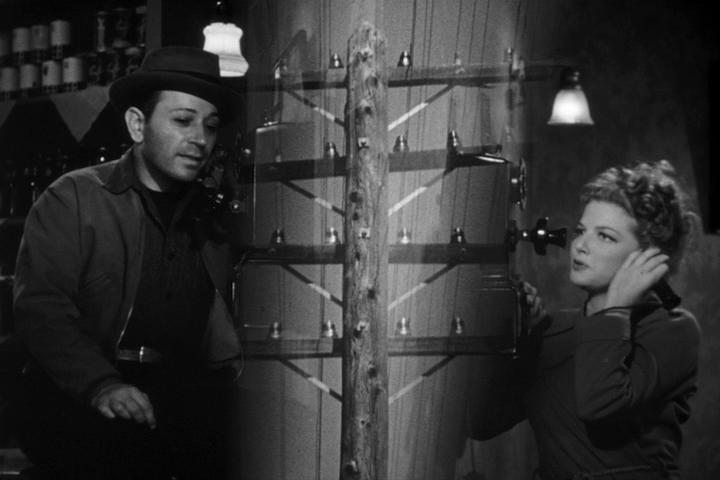
The project came under the watchful eye of production chief Hal B. Wallis and producer Mark Hellinger. William Donati, Lupino’s biographer, reports that Hellinger was instrumental in casting Lupino. The story is a variation on the usual Warner crime melodramas. Raft and Bogart are the Fabrini Brothers, Joe and Paul, who drive their own truck on jobs for a boss who doesn’t always pay on time. Sheridan is the girl behind the counter at a truck-stop diner who decides she’s had enough and ends up in a relationship with Joe. Paul is already married to Pearl (Gale Page). Joe is the more ambitious of the two brothers and Paul is eventually forced to take an even more secondary role as the brothers join the operation owned by Ed Carlsen (Alan Hale). Carlsen’s young wife Lana (Ida Lupino) has known Joe for some time and she soon makes her interest in him clear. An emotional conflict looks primed to explode into open warfare.

At this point in 1940, Bogart was one of the longest-serving Warners’ contractees. Raft, Walsh and Lupino had all been at Paramount. Bogart had become stuck in ‘second’ or ‘third’ gangster roles supporting Edward G. Robinson or James Cagney. Now it looked like he was behind Raft. In this film, Raft is a revelation and seems quite different from the characters he plays in some of the other films in which I’ve seen him. He is lively and amusing and certainly seems to drive the narrative (no pun intended) whereas Bogart is literally the sleeping brother in the dual driving partnership. But Raft would later make some poor decisions about which Warner Bros roles to accept and Bogart would soon overtake him. As for Sheridan, she was at this point suffering from being marketed as the ‘Oomph Girl’ – glamorous and attractive but by implication not a ‘serious actor’. She must have been taken aback by the praise Lupino received. Personally, I like Ann Sheridan very much and I think she was poorly treated by Warners.

As well as watching this film I’ve been looking back at the book on Raoul Walsh published by the BFI and Edinburgh International Film Festival in 1976 and edited by Phil Hardy. Hardy’s introduction tries to understand how the film studies and film criticism of the early 1970s was attempting to deal with directors like Walsh. As Hardy notes in his introduction, Anglo-American critics at this point were still struggling to work out an approach to American cinema that went beyond recognising John Ford for his landscapes and exploration of tradition and Hitchcock for his showmanship. They had only just recognised that Howard Hawks’ films might be approached via the concept of ‘professionalism’. Unlike the French critics, some of whom had written at length about Walsh and his films, the Anglophone critics hadn’t got much further than seeing Walsh’s characters seeking ‘adventure’. The problem for film studies in getting to grips with Walsh is that in a career spanning five decades he was involved in over 200 productions as first an actor and then from 1914 combining directing with acting in two-reelers. He was also a writer and producer. During his peak period in the 1940s at Warner Bros., Walsh was a ‘house director’ and like Michael Curtiz, another problematic director who shot many of Warners’ most successful pictures, he was constrained by the Warners’ approach to genres such as Westerns, crime films etc. By the 1970s most of Walsh’s early films were difficult to see in any form in the UK. They Drive By Night arrived in the UK in 1941 and was reviewed in Monthly Film Bulletin in February under the title The Road to ‘Frisco – a British film titled ‘They Drive By Night’ had been released in the UK in 1939. Ironically the earlier film was made by Warner’s British studio and released under the original title in the US as well as the UK. Presumably it had made little impact in the US or was perhaps not released at all. It did involve a lorry-driver but had a different plot. David Quinlan in his 1984 book on British Sound Films lists it as the sleeper hit of the year with his highest rating.
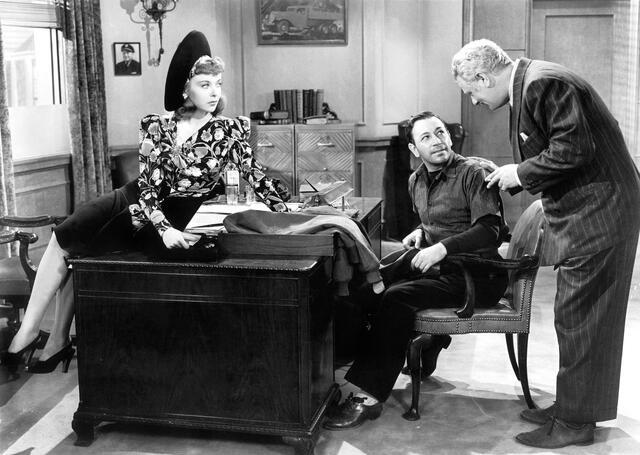
MFB’s reviewer ‘EHL’ (Ernest Lindgren, a BFI archivist and writer) was impressed by Raoul Walsh’s film, suggesting “It is definitely one to see” because “there is a realism about it”. However, he clearly states that the interest is in the depiction of the trucking industry and the struggles of the drivers, not in the courtroom drama at the end of the film. (The MFB synopsis describes the film as a ‘sex melodrama’.) Lindgren does not mention Lupino and the entry promotes Bogart’s billing above Lupino’s. This suggests that he had little interest in the British actor’s career in the US. I think this is a sign that the Warner Bros’ profile of Bogart outweighed that of Lupino at this point. I think Lupino’s films at Warner Bros. would get more attention later in the 1940s. In the US the response to the picture was different, Lupino’s performance as Lana in her ‘breakdown scene’ at the end of the film was what struck American audiences. Lana is very definitely a ‘bad girl’ and in retrospect the role was seen as an early femme fatale role which perhaps helped to cause Lupino to be typecast through much of her later career. In fact it’s possibly the only time she played the bad girl as such. There was usually some essence of humanity even in the roles where she did ‘bad things’ (such as in Ladies in Retirement in 1941). Reading around it seems like it was women who particularly enjoyed her performance as Lana, partly, I think, because she gets to wear the best clothes and to portray glamour but also because her breakdown releases so much emotion. But it doesn’t really matter why audiences were so take with the performance, Ida had ‘seized the moment’ and Hal Wallis, for one, was impressed, so much so that he gave her top billing in her next picture, High Sierra (1941), the film that finally made Humphrey Bogart a star – but that’s another story.

I should end by trying to pull together the two parts of this blog – the connection between Ida Lupino and Raoul Walsh. Ida was a ‘serious, trained actor’ studying at RADA aged 14. She could play any part and she was, famously, a ‘trouper’ in the family tradition. Walsh was similar as a director. He would accept most jobs the studio threw at him and produce something snappy and tight as any genre picture. I don’t have any evidence but I suspect he and Ida got on. He was the director of High Sierra and the two came together again for The Man I Love (1946), a romance melodrama with Lupino as a nightclub singer. Back to They Live By Night, add Raft and Ann Sheridan on top form and Bogart, underused but effective, to Walsh’s direction and Lupino’s ‘excess’ and you have a very engaging picture. It’s available to stream/rent/buy on Apple and Amazon.
 itp Global Film