
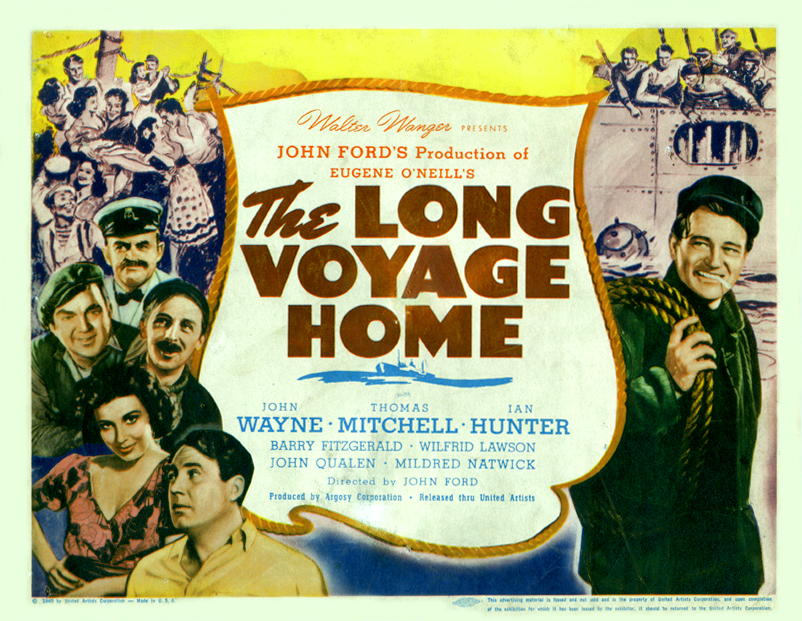
I’d always wanted to see this film after studying extracts featuring Gregg Toland’s amazing cinematography. When I finally managed to see the whole film a few years ago I realised that it raises a host of questions about Hollywood at the peak of the studio period and especially about the director John Ford, who at this time was the undisputed king of cinema for mainstream film critics. Over the space of three years, from 1939 to 1941, John Ford made seven pictures. Only Tobacco Road in 1941 was not a critical success and only the film considered here was not a commercial success. Ford was nominated three years running for the Best Director Oscar and won twice, the second time for How Green Was My Valley – the famous occasion when Ford’s film received 10 nominations and pushed out consideration of Citizen Kane. I’m no believer in Oscars other than as indicators of the Academy’s voting patterns, but personally I enjoyed Ford’s film at least as much as I did Kane. The other four films in this run spanned the three ‘American myths’ of Stagecoach, Drums Along the Mohawk and Young Mr. Lincoln – all in 1939! – and The Grapes of Wrath, the other Oscar winner in 1940. Ford was certainly prolific, but throughout his later career the great films tended to be dotted about in periods of more mundane production (although that evaluation too is contestable and Robin Wood refers to the later films in terms of weariness and disillusion with contemporary American society). The quality of these seven films as a group prompts me to look for other factors to explain the importance of the run that included The Long Voyage Home.

One of the factors is Ford’s ‘independence’ as an established director. The Long Voyage Home was made for Argosy Pictures, Ford’s own company, in conjunction with the independent producer Walter Wanger. It was released by United Artists, which also released the Wanger-produced Stagecoach. The other five films were also made for a single producer, Darryl F. Zanuck, even if he was the main figure behind 20th Century Fox. Ford was never a studio hack, but instead a director to be respected and accommodated. But he was also dependent on scripts and properties. His 1930s films were often scripted by Dudley Nichols who in The Long Voyage Home adapted four short plays by Eugene O’Neill. Two other big strengths for Ford were his regular leading actors and a powerful ensemble company of character players. These were certainly present in the early 1940s with Henry Fonda emerging as a key leading man for three of the titles and John Wayne ‘introduced’ as a secondary player in two more – although here he shares top billing with two other actors. The other strength in this period was Ford’s relationship with some of the key cinematographers working at this time. Bert Glennon shot the three 1939 films (with Ray Renahan alongside on the Technicolor Drums Along the Mohawk), Gregg Toland shot the pair in 1940 and Arthur C. Miller shot the 1941 films. Miller and Glennon had worked with Ford before but for Toland it was a new experience. Miller told Charles Higham (Hollywood Cameramen, Thames & Hudson 1970) that Ford’s eyesight was so poor that he left all the compositional and lighting details to his cinematographer. Miller is perhaps not the best reporter but it’s interesting that the major films of this period from Ford all share certain techniques which the cinematographers were collectively developing – more on this a little later.
A plot outline of The Long Voyage Home (no spoilers)
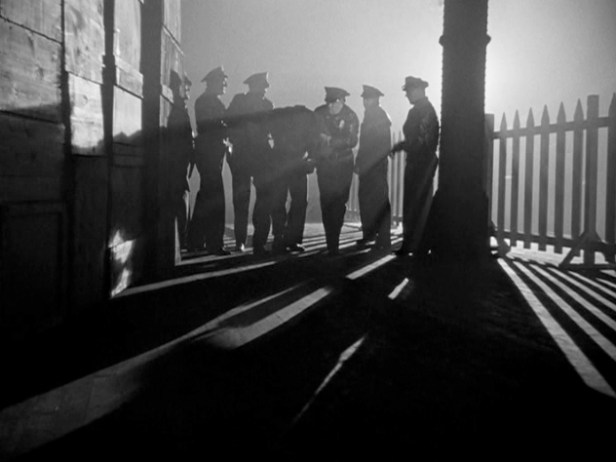
The four O’Neill plays concern a group of merchant seamen aboard the British freighter, the SS Glencairn. Dudley Nichols brings the four stories together into one trip which begins in the Caribbean and ends in a British seaport via a brief stopover in Baltimore on the east coast of the US. The original plays were written around the time of the First World War but Nichols makes them contemporary, so war has already started when the ship is in the Caribbean. In the US, the ship picks up a cargo of ammunition and TNT which places it in peril on the Atlantic crossing, but it doesn’t join a convoy. This may be because an American production at this point, well before Pearl Harbour would not have been able to work with Allied naval authorities (i.e. British and Canadian)? The drama comes mainly from the impact of the conditions at sea and the common anxieties of merchant seamen. O’Neill’s main theme was that sailors could never really ‘go home’ and that they were condemned to spend their whole lives at sea – ‘home’ in effect means death. From this brief outline it’s clear that this film deals with the symbolic nature of life at sea – men living in close proximity to each other and experiencing the same pleasures and horrors wherever in the world they might be. This places the film in relation to similar filmic narratives from the 1920s and 1930s, in particular the films of German Expressionism and in that sense the expressionist sets and cinematography seem quite appropriate. The image below predates the fantastic film noir work of John Alton in the late 1940s. The film actually starts with a text explaining this interpretation of O’Neill’s main theme. This was added in post-production by Gene Fowler, a scriptwriter commissioned by Wanger. Ford did not see it, but approved such an addition.
This expressionist feel is, however, somewhat at odds with the ‘realism’ of the films about the war at sea which began to emerge from the UK at this time. The Long Voyage Home reached the UK in March 1941, just at the time when the success of the German U-boats was forcing concerted action from the British War Cabinet, leading to the beginning of the ‘Battle of the Atlantic’. The British films were all part of the general propaganda effort and the one which in some ways best resembles The Long Voyage Home is San Demetrio, London (UK 1943). This Ealing film deals with an oil tanker in the Atlantic which is torpedoed but which fails to sink after the crew abandon ship and is eventually brought home after the crew re-board it. I mention this not to criticise Ford’s film in any way, but to point to the major differences between the two films. A second British film, a documentary about the ‘Battle of the Atlantic’ is Western Approaches (UK-Netherlands 1944) which uses colour for a very different image of the sailors’ world (and utilises ‘real’ ships’ crews rather than professional actors).
Toland and ‘deep focus’
The development of deep focus photography in the early 1940s was one of the most discussed technology-driven changes in the Hollywood studio era. When it first began to emerge in film studies as a concept to be explored, the filmic examples were generally chosen from the work of Gregg Toland on films by the leading directors of the period and the most often cited was Citizen Kane in 1941 for Orson Welles, followed by The Little Foxes for William Wyler also in 1941 and The Best Years of Our Lives, again for Wyler in 1946. Since then, it has become more well-known that other cinematographers such as Bert Glennon and Arthur C. Miller, James Wong Howe and Arthur Edeson had also included deep focus photography in their films and sometimes this was well before Citizen Kane. Gregg Toland (1904-48) was one of the youngest men to become a cinematographer in his mid-twenties in 1929. He had become fascinated by film technology and experimented during the 1930s while working for many leading directors. ‘Deep focus’ refers to the possibility of creating images in which the ‘depth of field’ is such that objects relatively close to the camera (foreground) and those far away (background) are all in sharp focus, as well as those in the middle ground. This was possible on location with plenty of sunlight and had been featured during the period of ‘silent cinema’. But on studio sets it was more difficult because it required so much more light. To achieve deep focus means closing down the aperture on the camera. This in turn requires a stronger light to illuminate the captured image. In simple terms, the cinematographer needed three advances in technology to fully exploit the depth of field in an image. One was more powerful studio lights, a second was ‘faster’ filmstock and a third was the camera itself and the lenses available. Why did this happen towards the end of the 1930s and into the early 1940s? Partly it was because cameras were getting smaller and being used more often on location and especially for ‘reportage’ and newsreel and also because there were moves towards greater realism in the images.
There are many issues here. One is to connect a drive towards cinematic realism with films shooting on sometimes ‘expressionist’ and highly stylised studio sets such as those in Citizen Kane. One of the earliest critical texts that explored what deep focus might mean in terms of story-telling was written by André Bazin in 1948 and is re-produced in the edited collection of Bazin essays by Bert Cardullo published by Routledge in 1997. The essay title translates as ‘William Wyler or the Jansenist of mise en scène’. By this Bazin meant that Wyler was a filmmaker of “stern virtues, including austerity and self-denial, order and a certain artistic hauteur”. The example from The Best Years of Our Lives is explored in my post on that film or you can read Bazin’s take on this extract from the essay. The force of Bazin’s analysis is that Wyler’s approach here allow the director to make comments on three individual characters in the same shot. One is in the foreground, one in the middle ground and one in the background. Convention might suggest that the three elements in the image might each be framed in medium shot and edited together as three parts of a single sequence. By covering all three simultaneously Wyler not only creates a more ‘realist’ image of how the scene plays out, but he also makes possible the choice for the audience who can look at different parts of the image, rather than be pointed towards a particular character at a particular moment.
Toland’s camerawork in The Long Voyage Home is rather different than in Citizen Kane or in The Best Years of Our Lives. He was asked by Ford to produce ‘natural light’ and especially to light faces, but not to flood the scene with high key lighting set-ups. Much of the film actually happens during nighttime on studio sets, but there are other passages of the ship at sea (filmed off Wilmington harbour in Los Angeles). The image that I’ve included above and described as ‘Altonesque’ is actually an expressionist anomaly in the film. There are deep focus set-ups in the film but in many scenes ‘below decks’ in the ship, space is limited and cramped. It’s as if Toland was keen to develop an approach, but was in this case limited by realistic sets.

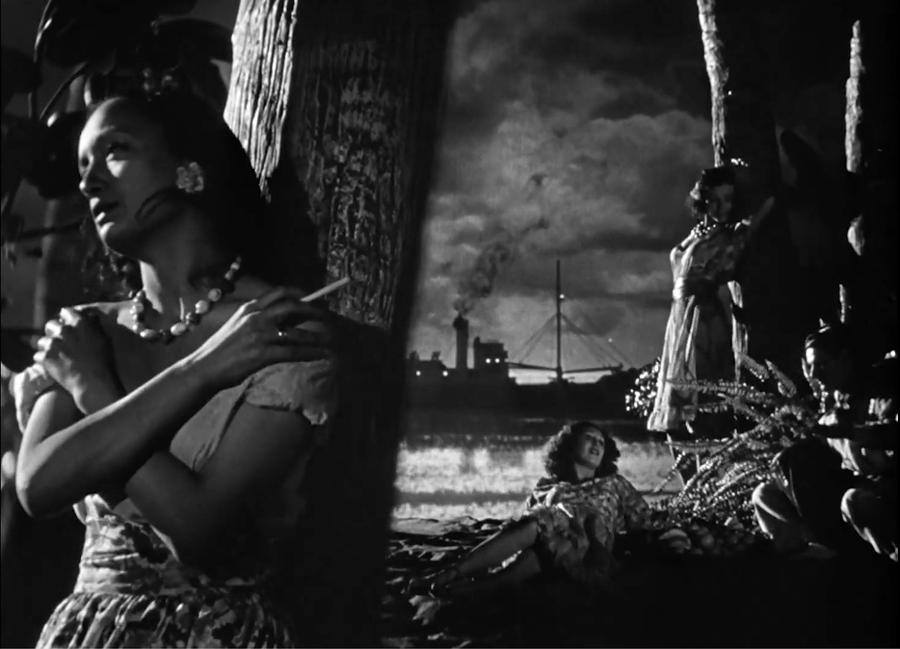
The image above uses deep focus and works a little like the Wyler image but not so clearly perhaps. The sequence shows the wife and children of a sailor killed at sea by a German air attack. They are being given the sailor’s personal papers before an official car takes them away. Unlike the Wyler film, here the ‘middle-ground’ is actually dead space but the set-up allows us to see the crew watching the events across the dock. The scene is actually quite complex. The other seamen have discovered that the man who was killed felt that he had disgraced himself in some way and he didn’t want to return to his family in England. His death re-unites him with his family but we can’t know whether it would have been possible if he had lived. A second seamen died from his injuries on the voyage during a storm but he was buried at sea. Also looking down at the quay is a third character who, unlike everyone else, actually wants to get home on this trip.
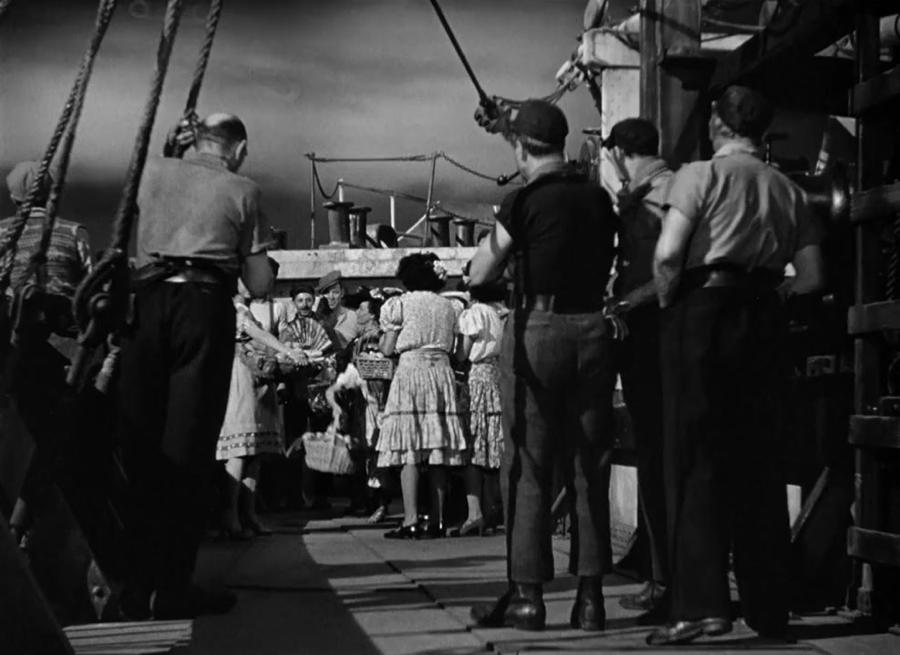
The image above is from the opening sequence of the film when women from the island are ‘allowed’ aboard to entertain the men. Toland shoots from a low angle, something that is quite marked as a feature of his work on Kane. He sometimes organised shots in which he and his assistant were in a pit below floor level. Low angles were relatively unusual on Hollywood sets at this time, especially for interior scenes. Sets did not usually have ceilings and boom microphones would be in sight. For deep focus, muslin could be used as a false ceiling or for exterior shots like this, back projection or a painted backdrop could represent the sky.

In the image above from Stagecoach in 1939, Bert Glennon produced a deep focus composition on a ceilinged set for Ford. Again it is a slightly low angle looking up towards the Native American scout standing behind the table who is in sharp focus, just like the waste basket in the foreground.

The Ford company
The Long Voyage Home does not have a star as such but it certainly presents the Ford stock company in all its glory. Wayne was just in his second role for Ford and it is a significant part. Ole Olsen is Swedish and Wayne had to take lessons in how to speak English like a Swede. At this point, however, Ford restricted his dialogue scenes dramatically, maintaining that Wayne’s best features were his movement and posture. Thomas Mitchell was very much the opposite as as ‘Drisc’ (Driscoll) the Irishman and effectively the organiser of the men below deck. Mitchell has been lauded as one of the finest character actors in Hollywood during the 1930s and 1940s. Like Ford he was first generation Irish-American and he had already appeared memorably for Ford in The Hurricane (1937) and Stagecoach (1939) (for which he won the Best Supporting Actor Oscar). Ian Hunter blays ‘Smitty’ an Englishman who the rest of the crew seem a little unsure about. Hunter was born in South Africa but became an actor in the UK and didn’t appear in Hollywood until the 1940s. I don’t think he appeared for Ford again. The rest of the cast, however has some very familiar faces. Among the main group of crew members are Ward Bond, John Qualen, Arthur Shields and Barry Fitzgerald. I hadn’t realised that Shields was Fitzgerald’s younger brother. Both Irishmen appeared in The Quiet Man (1952) for Ford and earlier in The Plough and the Stars (1936) – both films made by Ford in Ireland. Bond was perhaps the most familiar face, but this was relatively early in his time with Ford. John Qualen was Norwegian-Canadian before he moved to Hollywood and according to IMDb he had some 220+ roles. He developed a ‘Scandinavian’ accent for many of his Western films with Ford. Mildred Natwick appeared in this film as the first in her Ford roles as a ‘goodtime’ girl, paid to seduce Wayne’s Ole Olsen. Danny Borzage’s role was often to play music on the set (usually his accordion) to entertain Ford and the rest of the cast and crew. Occasionally as in this case this was built into his role as a character in the narrative, but in The Long Voyage Home the musician in the crew is John Qualen (who had been a professional musician before becoming an actor). Finally, Jack Pennick, who was usually somewhere in most crews or casts for Ford, has a small part as a sailor.
Ford had a very long career from the 1910s to 1970 and the company changed personnel over time, but the idea of a stock company was nearly always there. For this reason there always seems to be a sense of community on Ford’s films as well as a sense that everyone knows exactly what’s going on. It means that most of the time things ran very smoothly but at other times there were practical jokes and Ford could very cruel to some of the company including some who revered him.
The production
Argosy was the company founded by John Ford and Merian C. Cooper who had a relationship going back to 1934 when Cooper invited Ford to join him in Pioneer Pictures. Ford was interested and bought the rights to two short stories, ‘Stage to Lordsberg’ and ‘The Quiet Man’. But Pioneer Pictures was soon absorbed by David O. Selznick who didn’t want to make either adaptation. ‘Stage to Lordsberg’ would then become Stagecoach made by Ford for Walter Wanger in 1939 and The Quiet Man would be made by Ford’s Argosy for Republic in 1952, becoming one of Ford’s biggest hits. Ford, however, hedged his bets and agreed to make a run of pictures for Darryl Zanuck at 20th Century Fox while at the same time committing to Wanger for a further production. (See The Hollywood Renegades Archive.) Walter Wanger was one of the main independent producers who were founder members of SIMMP (The Society of Independent Motion Picture Producers). He had a distribution deal with United Artists but by the early 1940s was beginning to worry about how UA’s management was handling his films. They failed to to get some of his films into cinemas in key markets in the US and once this became known within the industry, their leverage options worsened. Wanger recognised in 1939-40 that the film was industry was struggling because the ‘core audience’ for whom entertainment was of prime importance were struggling with the cost of living and were more wary of buying tickets. Wanger calculated that this large potential audience of around 50 million was in the current context harder to reach and that his productions should look to the 30 million strong audience of more educated people who often stayed away from Hollywood entertainment films. To this end he saw The Long Voyage Home as ‘high art’ and attempted to sell it that way. He commissioned ten well-known artists to paint portraits of characters from the film or re-create actual scenes. The results were then exhibited in galleries in 35 major cities. The artists were there from the beginning of the production and Ford, usually very resistant to outsiders on his sets, found the artists to be “a grand bunch of guys”. He and Wanger encouraged the industry trade papers to think of the film as ‘arty’ and they responded very well. (This section of the blog is indebted to Walter Wanger, Hollywood Independent, Matthew Bernstein, University of California Press, 1994). The film was duly honoured with six Oscar nominations and actually won three awards from the National Board of Review and the New York Critics Circle. Ford brought the film in only very slightly over budget at $682,000 and it was completed in thirty-seven days at the Samuel Goldwyn studios. But Wanger’s fears about United Artists proved justified as the bookings for both this film and Wanger’s other 1940 release, Hitchcock’s Foreign Correspondent, were not well-handled and he lost money on The Long Voyage Home.

Closing thoughts
I have enjoyed watching The Long Voyage Home, principally for the performances, the cinematography and the art/production design by James Basevi, another collaborator on several Ford films. I mentioned the Oscar nominations for the film. It seems fairly incredible that Ford actually won Best Director for The Grapes of Wrath in the same year. I’ve seen suggestions that Voyage was one of Ford’s own favourites and that seems to make sense for a man born on the coast of Maine, who became perhaps the most well-known Hollywood ship’s captain on his ketch The Araner and would eventually become an Admiral in the US Naval Reserve. The two Irish characters are important roles and they provide some dramatic conflict with the English characters. Eugene O’Neill is reported to have liked the film very much. Yet the film quickly fell from favour in the post-war years and several of Ford’s later critical supporters said it was a difficult watch. The split by critics between the pre-war and post-war films has always baffled me, though I can see why it has happened. My final observation allows me to mention another of Ford’s regulars – the music composer Richard Hageman, another migrant, from the Netherlands, who on this film provides a diverse range of familiar melodies that speak to the multinational origins of the crew and the ship’s experiences. The opening in the Caribbean reminds me of Jacques Tourneur’s I Walked With a Zombie (1943) with its drums beating on the island and the mix of voices to the swaying beat as the images introduce some of the main crew members. This follows the conventional orchestral sequence and the strings under the titles and opening text. The contrast is the end of the film with its plaintive score, seen as defeatist by some critics and contrasting with more defiant endings in both British and and pro-British American films at the time. I’m also puzzled by the use of the white ensign for the sequence in which the English sailor dies – shouldn’t it have been a red ensign for the Merchant navy?
There is now a restored version of the film available on Blu-ray and it is streamable on Amazon. If you look carefully you will also find good quality free versions online. Here’s a very short clip from the opening section featuring ‘Donkeyman’ (Arthur Shields) and ‘Smitty’ (Ian Hunter) with that Caribbean voices score in the background.
 itp Global Film