

This film offers two of the most famous scenes in the Western genre. After the credits an opening sequence shows a woman in a doorway as a rider approaches across a landscape dominated by vast rock monoliths. At the end of the film the same rider is seen standing in another doorway and walks away as the door closes. Both scenes are accompanied by variations of a major musical theme in the film. In the intervening nearly two hours we come to know this character, Ethan Edwards (John Wayne), a driven man, on a five year odyssey as he searches for a lost child, his missing niece Debbie (Lana Wood and then Natalie Wood). This is one of the true masterpieces by director John Ford, ably supported by the cinematography of Winton C. Hoch and the music of Max Steiner.
The screenplay of the film by Frank S. Nugent adapted a novel by Alan le May, published in 1954. Le May’s novel used the actual story of a man who searched for his kidnapped wife and children from Comanche in 1865. This man, Britton Johnson, was an African-American teamster; the only black character in the film is the supporting Old Mose Harper (Hank Worden). Some writers have noted that the film story resembles another incident of kidnapping, search and rescue from 1836 in Texas where James C. Parker spent years searching for his niece, also kidnapped by Indians. It seems that Le May studied some 64 such cases in researching his novel.
After the main title the sound track presents a ballad, written by Stan Jones and performed by the Sons of the Pioneers; the music provides Steiner’s major theme for the film. The opening words are,
What makes a man to wander? What makes a man to roam?
and it ends,
Ride Away. Ride Away.
The intervening narrative includes battles between white settlers and Indians: massacres by Indians: the aftermath of a massacre of Indians by the U.S. Calvary: and other deaths as well. The first in the film is when most of the Edwards family, Ethan’s brother Aaron (Walter Coy), his wife Martha (Dorothy Jordan) and their son Ben (Robert Lydon) are killed in an Indian raid. But the focus of the film is the wanderings of Ethan accompanied by the adopted brother of Debbie, Martin Pawley (Jeffrey Hunter), and the fiancée of Debbie’s kidnapped sister Lucy (Pippa Scott), a neighbour of the Edwards family, Brad Jorgenson (Harry Carey Jr.) Brad dies in a suicidal attack on an Indian camp when he learns of the death (and likely rape) of Lucy. Martin is part Cherokee, found by Ethan after another battle between settlers and Indians years earlier.
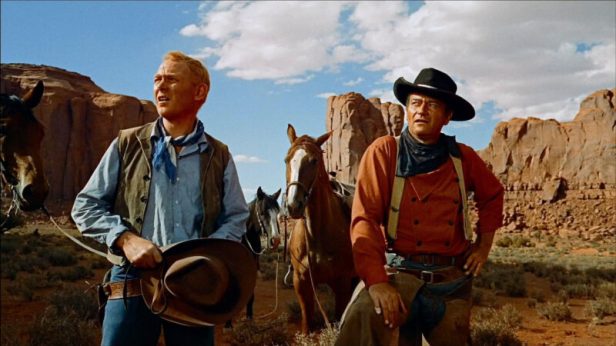
As they search on their long journey Martin is the continuing butt of Ethan’s sardonic humour and even downright antagonism. Ethan is a man consumed by hatred of the Indians and, though mainly implied, a fear of miscegenation. Here he embodies one of the dominant characteristics of the white settlers in Indian territory; a racist preoccupation with the peoples that they displaced.
The main story takes place three years after the end of the U.S. civil war, which plays in the story with Ethan’s continuing allegiance to the Confederacy. The raids and battles are part of the Texas – Indian wars, commencing in 1868. Texas was created not only by displacing the Indians but also by one of the wars by the U.S. to aggrandise its territories. The Texas Rangers figure in the plot, a paramilitary organisation which played an important role in the seizure of Mexican lands.
The target of Ethan, his fellow settlers and the Rangers are Indians, or as we now recognise, Native-Americans. Specifically they are Nawyecka, (correctly the Noyʉhka or Nokoni), Comanche. The Comanche were a nomadic horse culture in the southern plains. Like other Native American tribes they battled to retain their lands from the encroaching settlers. They often took captives in raids on white settlement, some being adopted by the tribe (as is the case with Debbie), or others being sold on to Mexican or Spanish settlers. The representation of Comanche in U.S. films is as fearsome and often brutal warriors, very much the case in Ford’s film. The Comanche have an opposing term for themselves, nʉmʉnʉʉ, meaning “the human beings” or “the people”. This is the last name or appellation applied to them by the white settlers.

John Wayne’s Ethan dominated the film and it is reckoned to be his finest performance. Wayne is not a great actor but he is a great screen presence. His physical presence is important in defining the character as is his typically broad intonation and sharp accent. One mannerism, a crooked elbow, feature in the key shots of him. Ethan may hate the Indians but he also understands them and has respect for their skills in the wilderness and in warfare. When the posse or the rangers in pursuit of the Comanche must consider their actions, Wayne’s is the voice that dominates; and he is constantly shown to be correct. It is worth adding that Ethan’s commitment to the Confederacy suggests that he is equally racist about the slaves and ‘Niggers’ oppressed by the separatist regime.
The rest of the settler cast is fine as supporting characters. Jeffrey Hunter’s Martin is young , relatively unformed and allows enthusiasms to overbear calculation. In the race to save the Edwards family Martin kills his horse and is stranded as Ethan rides by. Later in the film he acquires an Indian bride, whom he calls Look, because he fails to understand the barter he makes with an Indian Chief. And his childhood sweetheart, Laurie (Vera Miles) comes close to marrying another man whilst Martin becomes as obsessed with the search as Ethan, but without his dark purpose.
Of the Edwards family killed in the Indian raid Martha, wife of Ethan’s brother Aaron, is the key. A series of looks between her and Ethan hint at an earlier romance. And the care with which she folds Ethan’s old army coat speaks volumes. Ethan last saw her as he rode off the Civil War, eight years previous to his return. This possibly suggests a deeper and more compelling motive for Ethan’s obsessive search.
The only surviving member of the Edward’s household when Ethan and Martin return is Prince, the family dog. Likely a cairn terrier or cross and un-credited. In a familiar Hollywood trope we never see Prince again.
Captain the ‘Reverend Sam Clayton (Ward Bond) is an extrovert and larger than life character. He heads the Texas Rangers and also performs important rituals such as wedding and funerals. He is only a little less experienced than Ethan and has a clear grasp of the characters around him. His look away as Ethan and Martha part speaks volumes.
Old Mose does not really figure in the action. Seemingly deranged, possibly from earlier battles, he acts almost like a Greek chorus commenting on the other characters.
The Comanche characters certainly come off second best. The Chief Cicatriz / Scar is played by Henry Brandon. He came of German migrant stock and played white and other ethnic characters on film, including Fu Manchu. It was to be some years before ethnic casting became common. Brandon plays him as a fairly brutal character, including indigenous Indian dialogue. The film does allow some justification for Scar’s warlike actions as he lost two of his family to settler violence. The other Indian character is Look / Wild Goose Flying in the Night Sky played by Beulah Archulett. She is the butt of the film’s humour, the type of stock character found in a number of Ford films. However, Ethan and Martin find her body among the victims of the US Calvary massacre, recognising the white violence against Native-Americans.

At a surface level the film replays the racist representation of Native-Americans that were the dominant mode in the Hollywood western. However, the film offers greater complexity than most of that era. It also allows the Indian characters to speak in a native tongue as well as English; another uncommon practice in that period. Note though, the Indian dialogue in the film is Navajo whilst the Comanche speak one similar to Shoshoni. Ford had a special relationship with the Navajo people. Settler violence and racism is part of the narration though it lacks the emphasis’s given to the ways of the Indians. And Ethan is particular is a walking/riding vessel of racist hate. Looking at responses to the film it is clear that different people experience it in different ways; for some it is an example of the way that dominant US culture has used Native-Americans as an ‘otherness’ in the depiction of the conquest of the west. For others the apparently central drive to solve the problem of the Native-Americans is subverted to a degree by this ever-present undercutting.
The film was shot in Monument Valley in Colorado, not the story setting in Texas. Some sequences were shot elsewhere including an important scene showing Ethan and Debbie together. Monument Valley is a familiar setting in Ford movies, and its impressive rock formations and desolate landscape are well suited to the rugged western. It was, apparently, a harsh environment for the large crew work on the filming. But the craft work on the film is excellent.
The screening in the Piazza Maggiore on the opening night of the 38th Cinema Ritrovato was celebratory rather than critical. Several thousand guests and citizens of Bologna packed into the Piazza to watch the film in 70mm. There were several introductions; the best a brief but eloquent comment by Wim Wenders explaining his long relationship with a film that he, like many, regards as a masterpiece. It is worth noting the film has long been admired and celebrated, including by the American Film Institute (i.e. of the USA) and by the British Film Institute.

The 70 mm version screened that night was equivalent to the original release version, shot using VistaVision with a 1.85:1 aspect ratio and on Eastman film stock and processed in Technicolor. It was released for a limited range in VistaVision and in standard 35mm, though the latter benefited from the higher visual quality of a VistaVision negative. This restoration was scanned from the original VistaVision camera negative. The restoration work was carried out at 6.5K. Then a 65mm negative was filmed out. The mono soundtrack was restored at a post-production laboratory.
On the large screen in the Piazza Maggiore the print looked exceptionally fine, with digital subtitles in Italian. In particular the landscapes and the colour were the best I have seen for many years. I did notice some back projections which stood out a little and some studio set-ups. The sound, mono as in the 1950s, rendered Steiner’s fine score extremely well as it also did with the dialogue and noise.

The good news for cinephiles who did not make it to Bologna is that this restoration produced a 70mm negative. This should mean that 70mm prints are available across any number of territories. Here in West Yorkshire there are two venues with 70mm projection so I am optimistic about revisiting the print. Whatever one’s critical response The Searchers remains one of the seminal films of the western genre and an outstanding, masterwork; one that repays any number of revisits.
Wikipedia has a detailed page on the film with links to other relevant pages.
And there are numerous books on Ford and his films; specifically there is The Searchers: The Making of an American Legend by Glenn Frankel, Bloomsbury 2013.
 itp Global Film