
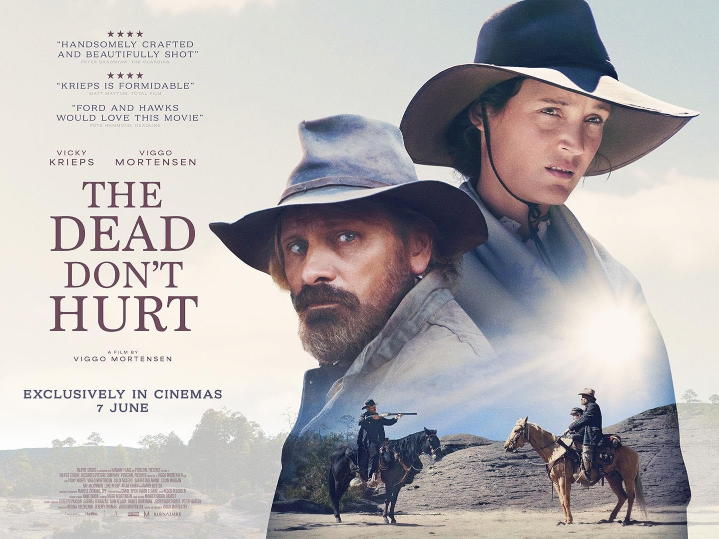
The Western is arguably the most manipulated of all genres as well as the longest running. I’m not counting the melodrama as a genre here but more a ‘mode’. It’s worth noting, however, that Westerns were once described in the film trade papers as ‘melodramas’. Westerns began as being an American genre about the history of the nation in various ways as well as vehicles for more action melodramas but the genre itself refused to restrict itself to the US and we’ve seen Argentinian, Australian and South Korean ‘Westerns’ – not to mention Indian and Japanese and even Malian. Genre scholars would argue that most American Westerns since the 1960s have veered in some way towards a ‘revision’ of the original genre repertoire in various ways and that some of that revisionism could be attributed to the impact of European Westerns. More recently a specific form of revisionism has focused on Native American narratives which have in turn been influenced by or have themselves influenced similar trends involving Indigenous peoples in Australian and other film industries. All of this is something of a meander but is important in setting The Dead Don’t Hurt, written and directed by Viggo Mortensen, in context. This is a many-layered narrative that takes a simple revenge story but presents it in a complex way and adds another inflection of the genre from the 1990s onwards, the feminist Western. It is a Western and it’s violent but it isn’t a ‘shoot ’em up’. Unfortunately the distributors don’t seem to realise that, so there will be audience members who find it baffling or ‘boring’ because they don’t see what it is doing. I’m intrigued by the quote above in the poster that says “Ford and Hawks would love this movie”. I’m a huge fan of Ford and I respect Hawks greatly and perhaps they would enjoy it but also find it perplexing? The film was released ‘wide’ on 239 screens in the UK on 7th June by Signature Entertainment. The audience response was poor and it dropped out of the Top 15 the next week. It’s not on streaming yet but is still playing in some Vue multiplexes. It’s definitely worth seeing on a big screen if possible. I saw it at the Hebden Bridge Picture House.
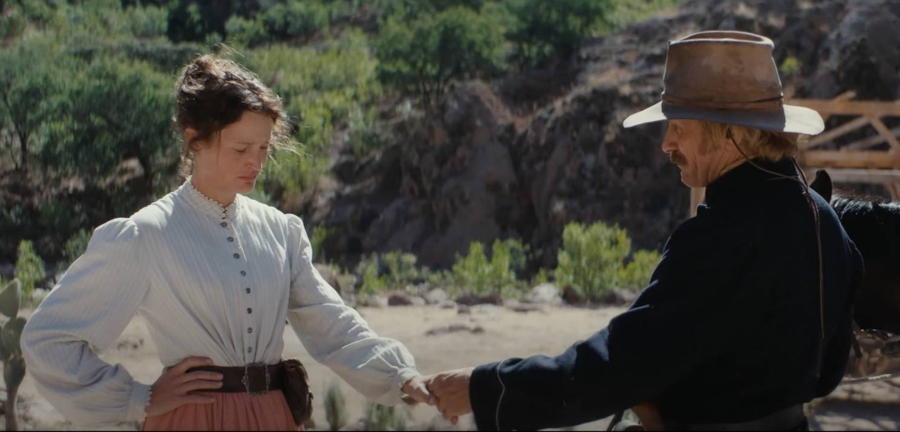
The star of the film is Vicky Krieps, the Luxembourgish-German actor playing Vivienne, the daughter of French-Canadian parents who meets ‘Olsen’, (Viggo Mortensen) a Danish carpenter in San Francisco around 1860. There is an instant connection and she goes with him to his cabin in the Nevada mountains, leaving behind the irritating wealthy man who seems to assume that she is his. When they have been happily settled for a few months (?), Olsen (who she now discovers has a first name, Holger), announces he is going to enlist in the Union Army to fight against the slave-owning South. For him, it’s a moral issue, the ‘right thing to do’, not a case of glory or adventure. Though he’s technically arguably too old to be a recruit, he has already fought in Denmark (the First Schleswig War?) and his experience will be useful. This is perhaps a surprise, but at this point Vivienne becomes a single woman living in the mountain cabin and the narrative stays with her. We don’t see Olsen again until he returns from the Civil War. But I’ve already misled you. Mortensen the director presents the story as a non-linear narrative so he begins the film almost at the end of the narrative and repeatedly circles around from flashback to the present and back to the flashback. This way he’s more visible on screen even if we never see what happens to him during the Civil War battles. All that is important is that he does return. The narrative focuses more on Vivienne and how she survives, working in the saloon of the local small town – which in true genre fashion is run by a corrupt mayor (Danny Huston) and a ruthless local family, the Westons with a group of vicious thugs at their command. I missed some of the details, partly because I couldn’t decipher some of the dialogue, although I did wonder if it was not necessarily recorded for clarity. However, the narrative events are quite easy to put together.
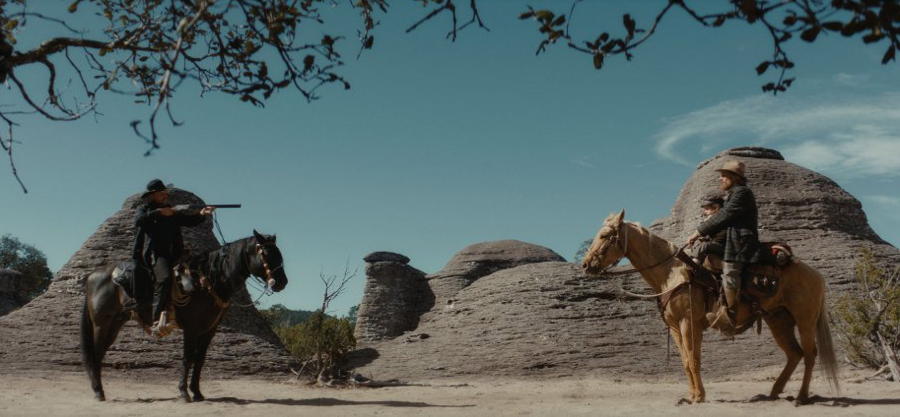
Language is in fact a major issue in the story. Vivienne speaks French, whereas Olsen speaks Danish and there is a Spanish-speaking piano player in the saloon. The Indigenous girl who appears is wordless. One of my favourite moments in the developing relationship between Vivienne and Olsen is when she makes him a meal and they argue about the pronunciation of ‘omelet/omelette’. Perhaps the major innovation that has confounded some audiences is the inclusion of Vivienne’s dream sequences in which she visualises her ideas about her childhood ‘hero’ Jeanne d’Arc who she learns about from her mother and the book that she read as a child..

The film is Viggo Mortensen’s second as ‘writer-director’ following Falling (US 2020). He’s also composed the score for The Dead Don’t Hurt. IMDb carries the suggestion that it was not his intention to act in the film but the actor he cast dropped out for another project close to the production start. I’m intrigued as to who was originally cast. Mortensen has appeared in other Westerns and other films involving horsemanship. I was surprised to discover just how many of his films I’ve seen. But the performance I remembered most and which I’m sure must have informed this narrative is in the Argentinian art film Jauja (Argentina-Denmark 2014) from Lisandro Alonso. In that film he plays a Danish military engineer in the late 19th century who is assisting the Argentinian Army in their genocidal campaign to survey and ‘clear’ the ‘jungle’ – the desolate area in Patagonia sparsely populated by indigenous peoples. This character has perhaps unwisely agreed to take his grown-up but unmarried daughter with him. (Mortensen lived in Argentina as a child and speaks Spanish.) I was also reminded of the two Kelly Reichardt films which have been discussed as Westerns, Meek’s Cut-Off (US 2010) and First Cow (US 2019). Though rather different narratives, these two films suggest a different way of thinking about the development of the West in the 19th century. They both involve encounters with Indigenous peoples. First Cow further links to The Sisters Brothers (US-France-Belgium 2018) another European perspective on the Western, set in the American North-West. This in turn prompts me to consider the production context of The Dead Don’t Hurt. I’ve noted that the ‘country of origin’ is given differently on various industry websites. I’ve gone with the three main production companies. Perceval Films is Mortensen’s company (which was a co-producer of Jauja), Talipot is Mexican and The Recorded Picture Company and Hanway are British. I’ve added Canada since much of the film was shot in British Columbia and Ontario. The other major location was Durango in Mexico and much of the post production was carried out in Denmark. There is minimal, if any US involvement. One of the delights for me was to see that Marcel Zyskind was the cinematographer working in Mortensen’s Danish crew. Along with editor Peder Pedersen and a large contingent of artists Ziskind produces a ‘Scope projection print which looks terrific utilising the locations effectively. This is a very handsome Western.
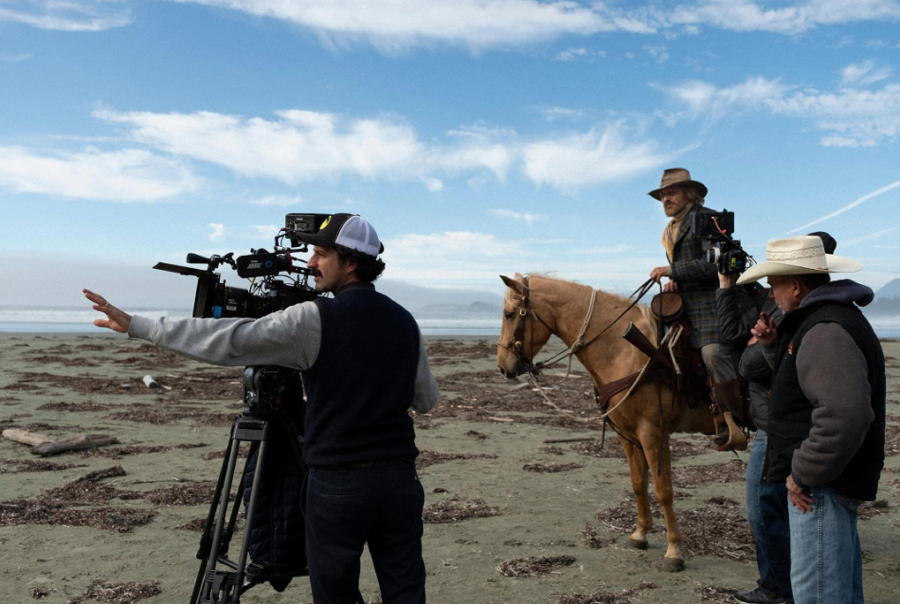
I haven’t stressed enough that this is a feminist Western, telling a woman’s story with Olsen, in effect the narrator (even if he wasn’t there for much of the story). Here’s Viggo Mortensen on the Western from a Cineuropa interview:
I like the genre and the period, but I also really like the fact that, in a sense, it’s a story in large part about a woman who’s created her own boundaries. At that time, the rules were not clear, even less clear than today: a lot of corruption, a lot of violence, all dominated by males. It’s a movie about a woman, really: she is of her time, but is independent and knows herself.
If I have a criticism of the film it is the English title. I think the title in Danish, French and Spanish translates as ‘Until the End of the World’ which seems to be related directly to the closing sequence of the film and perhaps refers to the love affair which is the real basis of the story. Olsen at one point describes going to San Francisco to see ‘The End of the World’. The English title to me just suggests a standard generic Western narrative. Understated perhaps, but the performances of the two leads produce a moving love story. The trailer below gives away several more plot points, so ignore it if you want to watch the film without foreknowledge.
 itp Global Film
I saw this as a freebie several weeks back at Reel in Wakefield which seems to be the recipient of a number of guest tickets for films that might otherwise be overlooked courtesy of some lottery-sponsored deal with some group called Cinematik. There is another free viewing for Korean film ‘Sleep’ this coming Monday, also at Hyde Park I believe. The latter I have seen before.
I tend to approach these free films with some slight trepidation, as the intention is they need to benefit from favourable word of mouth if not an extensive advertising budget. I was not too disappointed here, the excellent Vicky Krieps notwithstanding. The bad guys were very bad guys with not much in the way of charm, and fortunately not much in the way of shooting skill either. The title of the film was foreshadowed in the dialogue which might not bother most, but it bothers me. Weird things happened with no word of explanation other than it might be a dream, such as the indigenous girl materialising holding a massive fish when Viggo and son were making their escape. Did they eat the fish? Where did she get it? Whose dream was this?
Apparently Viggo doubled as the knight on horseback and I have seen him tell the story that the sword he had was a replica of the one Aragorn wielded in ‘Lord of the Rings’.
LikeLike
Have you seen Jauja? I think the image of the girl might be inspired by that film. Its meaning might be more concerned with a form of ‘otherness’ – that ability for indigenous people to appear suddenly and silently because they know the terrain so well. Now I think about it, Jauja is set in Patagonia leading towards Tierra del Fuego and ‘The End of the World’.
LikeLike
oh okay. No. Not seen that. Seems a little bit obscure. I just took it that Mortensen was a little inexperienced as a director and the film could maybe have used a tighter edit.
LikeLike