

When I first began to learn about ‘B’ movies in Studio Hollywood, one of the first titles that stuck with me was My Name is Julia Ross. I began to come across references to the film in various scholarly texts and although I don’t think I watched the film at the time, the title stuck. In my recent work on Hollywood films in the immediate post-war period, I’ve come to understand why it has such a high profile and now I have found a decent quality print online and I can explore it in detail.

First, in terms of definitions, this film was certainly originally conceived as a ‘B’ or a ‘programmer’, a second feature. It’s only a 65 minute narrative and that was the principal factor in designating a B film as they were expected to be the second feature in a long programme so a shorter running time was attractive to cinemas. Why then did it stand out? It appears that Columbia, the producing studio known as a ‘mini major’ like Universal because it did not have a big chain of its own cinemas, was so taken by the completed film that they previewed it and alerted critics (who often ignored Bs). Their instincts proved correct. The film was liked by some leading critics and proved popular with audiences. It found itself as a short ‘A’ feature in some double bills as its popularity seemed to eclipse some A features.

The script by Muriel Roy Bolton was an adaptation of a British novel, The Woman in Red, by Anthony Gilbert, the pen-name of Louise Beatrice Malleson (1899-1973), a cousin of the British film industry character actor Miles Malleson. It was photographed by the talented Burnett Guffey, who in a career lasting from 1924 to 1970 was Oscar nominated four times and won twice. He moved from camera assistant to cinematographer in 1935 and was contracted by Columbia, for whom he worked consistently from 1944 through to the mid-1950s. He was already well-established by 1945 so having him shoot a B was a huge bonus. In much the same way, director Joseph H. Lewis (1907-2000) was a major figure but one recognised much later. A director from the late 1930s onwards he made many ‘B’ pictures before and after My Name is Julia Ross but it was only when retrospective interest in B films noirs developed in the 1970s that Lewis was picked out as one of the best noir directors. My Name is Julia Ross got him noticed but it was later films such as Gun Crazy (1950) and The Big Combo (1955) which really kick-started the interest in his work. Paul Kerr wrote an article about B films noirs that he titled ‘My Name is Joseph H. Lewis’ (Screen Vol 24, Nos 4-5, July-October 1983). This was partly a polemic about how films were being seen retrospectively in relation to both new categorisations and auteurism – John Ford, an early choice as a Hollywood auteur once introduced himself with “My name is John Ford and I make Westerns”. The star of the film, ‘Julia Ross’ is played by Nina Foch, still only 21 but already established in Columbia’s Bs of the early 1940s with twelve roles between 1943 and 1945 before her role as Julia Ross. May Whitty, familiar to British viewers as the character actress who appeared in Hitchcock’s The Lady Vanishes (UK 1938) as Miss Froy plays the woman who hires Julia.

Outline (No major spoilers)
The film begins on Westminster Bridge behind the credits until it begins to rain and across a the wet pavements a bedraggled young woman heads for her room in a boarding house in Bloomsbury. Julia Ross has recently had an operation and lost her job in the process. Now well again she is desperate to get a new job and pay off her rent arrears. At first she is dismayed to discover the man she has recently had a relationship with has got married to someone else but she must press on. In the newspaper she sees an advertisement from a new employment agency and immediately makes a visit. There is a job available with a Mrs Hughes (May Whitty) as a secretary. She meets her prospective employer and her son Ralph (George Macready) and learns the conditions. She must indeed need the job desperately as first the agency woman and then Mrs Hughes ask her questions to confirm that she is single, has no husband, boyfriend or living family and must accept to remain in post for at least a year. I think most of us would be suspicious at this point. But Julia takes the job and receives an advance. She just has time to discover that meet Denis (Roland Varmo) back at the boarding house. His wedding day didn’t work out and he’s already separated. Does he still hanker after Julia? There is no time to find out. She is soon on her way to her new job.

The next time we see Julia she is waking up to be addressed under a different name and responds “My name is Julia Ross!” I don’t want to spoil any more of the narrative events. I’ll only say that the bedroom is quite palatial in a somewhat Gothic style and the house is perched on a cliff-top in Cornwall. When Julia opens her windows she recoils at the steep drop to the rocks below with the waves crashing against them. This narrative pushes a number of buttons. Daphne du Maurier wrote the story that became Hitchcock’s Rebecca (US 1940) with Joan Fontaine, who had a similar role in another Hitchcock film Suspicion (US 1941). Both those films feature houses by water, supposedly in the UK, in which a young woman feels threatened. Anthony Mann’s ‘B picture’ Strangers in the Night (US 1944) is another possible reference. There are claims that My Name is Julia Ross is a film noir, but I think the terms ‘Gothic’, ‘mystery’ and ‘thriller’ are more appropriate descriptors and there is a whole other genre category of a ‘woman in peril’ to consider. This would tie the film to a narrative like Sorry, Wrong Number (US 1948) in which a bed-ridden Barbara Stanwyck is afraid of a husband who might be terrorising her by telephone. The same link would also take us in the films now recognised as ‘gaslighting’ a wife or partner (after the two versions of Gaslight in the UK (1940 with Diana Wynyard) and the US (1944 with Ingrid Bergman)).
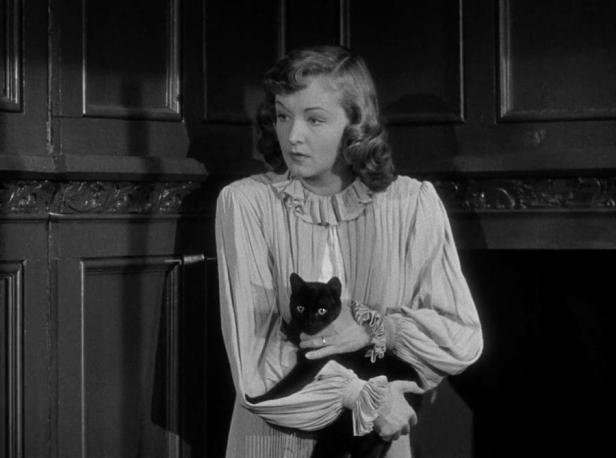
There were plenty of Hollywood Bs that utilised British stories and the studios could draw on British writers and the large colony of British actors, both stars and character players resident in California. In The Golden Age of B Movies by Doug McClelland (Bonanza Books 1981), Evelyn Ankers, the ‘Queen of the Bs’, describes in detail what it was like for a young woman to be cast as an ‘English girl’. Like Joan Fontaine she was born to British parents working abroad but then educated in the UK. She started work in the film industry in the UK but then moved to Hollywood and became a familiar face in Universal horror films, Sherlock Holmes stories and adventure films, nearly all Bs. She describes how difficult it was to learn American accents for a run of films and then to get a British role, to remember her own accent for a run of films and then go back to American parts, sometimes alternating more frequently. She also fond that she might have to change dialogue herself when it was clear that the scriptwriters didn’t know about British regional accents or idioms. In My Name is Julia Ross, George Macready was the only American among the main cast. Roland Varmo, like Foch was born in the Netherlands. Most of the cast were born in England with one Scot and one Irish-born player. I think the film represented an English/British story fairly well. The only false step for me was the sudden appearance of an automatic pistol. The whole issue of adapting British properties and then using a polyglot group of actors was very much the norm in Hollywood at the time, I think, but with the narratives of Bs compressed and the budgets low there wasn’t much leeway for directors to create a particular ambience through attempts at realism. In the reverse position, American actors in UK productions, especially in the late 1940s/early 1950s, were cast as either Canadians or as visiting Americans. Partly this was because an American in the cast was thought to make a film more attractive to a British audience. This prompts a much bigger question about British imports in Hollywood and the universality of American stories that seems to overcome some of the obvious differences. But in the Bs Evelyn Ankers says she was accused of ‘English stuffiness’ by Abbot and Costello when she first worked with them.

My name is Julia Ross has been retrospectively placed in the canon of films noirs, but as I hope I’ve indicated, there are several other categorisations that are arguably more useful. Some of the critics in 1945 before film noir became a term used in Hollywood recognised that Lewis and Guffey had made a stylised and effective film with good photography and a firm control over the mystery thriller narrative. McClelland comments on the unusual number of well-selected close-ups at key moments, especially of Foch and Macready. The music for the film effectively supports the approach. It was the responsibility of Columbia’s musical director Mischa Bakaleinikoff from the Russian family which included Constatin Bakaleinikoff, possibly the better known brother at RKO. Both men stayed with their studios throughout the 1940s and into the 1950s.
My Name is Julia Ross is available on an Arrow Blu-ray disc but is also easily found free online. It is definitely worth a watch as what Kerr might have described as an ‘ambitious B’.
 itp Global Film