

The Delinquents is a three hour plus film (189 mins) with a narrative involving the theft of more than half a million US dollars from a bank in Buenos Aires. But it’s not really a crime movie or a ‘heist’ movie. Instead, it plays with ideas about what constitutes a genre film, including the conventions of camerawork and music score. The real meaning of the narrative is something to do with the drudgery of life working in a bank (or most forms of economic activity under capitalism). The film is ostensibly in two parts, though the credits suggest four or five parts. The two parts are distinguished by which of two characters is the main agent in the part of the story being presented.

Morán (Daniel Elías) initiates the narrative by openly taking the money (as registered by the security cameras in the bank vault). His plan is to stash the money, give himself up and serve a minimum gaol sentence after which he can retrieve the cash. His plan involves inveigling another bank employee named Román (anagrammatic names run throughout the list of central characters) to hide the money on the basis of a half share when Morán is out of gaol. Román (Esteban Bigliardi) knows nothing about the theft before Morán tempts him with the money. I’m not sure this plan makes much sense but then I don’t know anything about the Argentinian legal system. I don’t want to spoil the narrative pleasures of the film so I’ll simply note that conventional plotting is not what this film is about. It’s more about exploring storytelling and conventions. If that interests you alongside any fascination you have with different cultures you should enjoy the film as much as I did, but if getting involved in mainstream filmmaking’s narrative drive is essential for you I would give this film a miss. I watched the film on MUBI which started streaming it in the UK a couple of days ago. MUBI has the film in many territories and it did make a brief appearance in UK and Irish cinemas earlier this year. I watched the film over two nights and I was never bored.

The rave reviews by international critics following its appearance at Cannes in 2023 classify it mainly under the headings of ‘Crime’, ‘Comedy’ and ‘Drama’. I think this is a little misleading as it suggests genre pleasures. I did find it sometimes amusing but it isn’t a comedy as such and it certainly doesn’t have the genre excitement of a ‘crime movie’ – though there are moments when it does use the fear of being discovered or the fear of prison life. Much of the sly comedy comes from the playful ‘doubling’ of narrative elements. For instance, the grouchy boss of the bank is played by the same actor, Germán De Silva, as the prison ‘daddy’. The prisoner character, born in Brazil is known as ‘Garrincha’. If your memory goes back to the 1960s, you may remember Garrincha (‘little bird’ in Portuguese) as the fiendish and deadly winger who played for the Brazilian national football team. Two or three of the actors in the film looked familiar to me and several were in the successful film Wild Tales (Argentina-Spain 2014).

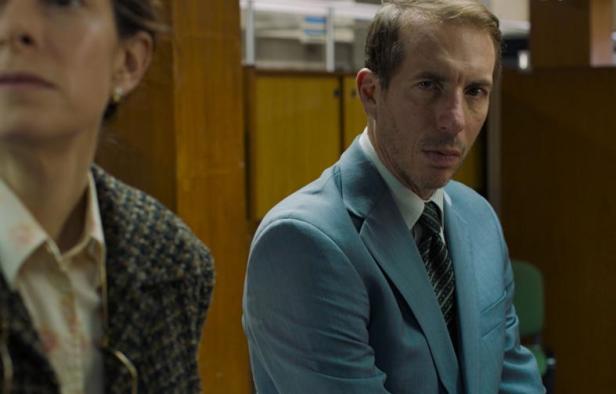
The doubling is also represented visually by one of the devices used by the writer-director Rodrigo Moreno. A split screen on two or three occasions shows two characters in different locations but similar framings. The overall visual style of the film is as ‘playful’ as the narrative structure. I noted the squarish screening ratio on both my computer screen and my TV and couldn’t be sure which ratio it was – Academy (1:1.37) or the standard early widescreen (1:1.66). IMDb tells me it is actually 1:1.55, definitely not standard but presumably easy enough to set up with digital photography. The irony is that, for me at least, the most enjoyable aspect of The Delinquents is the use of ‘long shot’ framings for the landscapes of Córdoba Province and the specifically the western part of the province in the Sierras de Córdoba. Director Moreno perhaps thought about Kurosawa Akira’s use of Academy ratio in a film like Seven Samurai (1954). With a squarer frame, the expectation is that vertical compositions become as important as horizontal compositions familiar from widescreen. (Don’t be fooled by the seemingly widescreen promotional images on this posting.) In one scene in particular in The Delinquents we watch one of the characters climb up to a small peak on the other side of a stream. He is a tiny figure against the rocks and bushes but clearly visible. The climb is further enhanced by the use of so-called ‘lap dissolves’. With a static camera showing a long shot of the hillside we see a climbing character slowly fade away and re-emerge (‘fade up’) further up the hillside. Similar lap dissolves are used in other scenes as well. Argentina’s physical geography is always worth exploring. I’ve noted before the range of landscapes in the country and I highly commend the cinematography of Alejo Maglio and Inés Duacastella. As well as the stunning landscapes, I also enjoyed the almost neo-realist sense of the narrative taking place in the Buenos Aires against a background of city life happily carrying on oblivious to to the unlikely bank robber with a backpack stuffed with banknotes.

Further references include the Robert Bresson film L’argent (France 1983) which Román watches in an art cinema (it’s about a series of interlinked crimes featuring counterfeit money, embezzlement etc.) and a vinyl album taken by Morán when he heads to Córdoba. The LP is by the band Pappo’s Blues (1971) led by Norberto Anibal Napolitano. I think the main track from album I remember is ‘Adonde Está La Libertad’ which Google tells me translates as ‘Where Freedom Lies’. It certainly reminded this old hippie music fan of the rock guitar style of someone like Carlos Santana and of course it evokes the sense of ‘dropping out’ that Morán hopes to achieve. The Bresson reference takes us back to Russian literature – in this case a Tolstoy story. Literature does play another role in the story of The Delinquents and the film’s narrative is certainly intriguing as each of the elements is revealed.
The trailer for the film is below. I should warn you that the trailer may suggest aspects of the narrative which I haven’t discussed on the grounds that it is more fun to just let the film unroll at its own leisurely pace. I certainly recommend the film but you do have to accept the pacing. As well as MUBI, the film is available via Amazon and Apple to rent.
 itp Global Film
I saw the movie at the Showroom. The screening looked like 1.66:1 and I noted the .1.55:1 given on IMDB. It seemed odd because, as Roy notes, there are a lot of landscape shots. Even if aiming for television or streaming I was still puzzled.
Like Roy I enjoyed the humour and the picaresque narrative. I did think that the plotting did not really justify 189 minute running time. In the last quarter of the movie I thought that the plotting rambled, not to great effect.
Overall though it is engaging and the cast and production values are good.
LikeLike