

How has the Republic of Ireland been represented on the big screen? At the moment I’m exploring films from both the Republic and the North of Ireland and I remembered this slick Hollywood thriller that appeared in 2003. Here is a relatively big budget Hollywood mainstream picture from the action producer of the time, Jerry Bruckheimer and directed by Joel Schumacher. This is essentially a ‘runaway production’ made in Ireland with UK support and starring the Australian Cate Blanchett as a major figure in Ireland during the early 1990s, the investigative journalist Veronica Guerin. The script is by two Irish-American writers Mary Agnes Donoghue and Carol Doyle and although some funding comes from Ireland, I’m guessing that the bulk came from Bruckheimer’s deal with Disney’s then studio brand, Touchstone Pictures.

My real purpose here is to explore how Ireland was represented in the early 1990s in two respects. One is in terms of the early stages of the so-called ‘Celtic Tiger’, the take-off of the Irish economy which grew very quickly compared with other parts of the European Union. The second is how the activities of the IRA are presented in films like this. Veronica Guerin is a form of biopic presented via the kind of crime film familiar from the crusading pictures ‘torn from the headlines’ by Warner Brothers in the 1930s. Perhaps because Guerin was an historical figure, the narrative begins with its end point – the murder of Guerin in June 1996 – and then rolls back to the events which prompted the attack.

The film received a very mixed reaction in the US and I confess that I don’t remember what my own reaction was when I saw it on release in the UK. I think I thought it was an effective thriller but there were aspects of the story that I didn’t know much about. Two of the more sensible reviews of the film at the time came from the stalwarts of the period, Roger Ebert and Philip French. They both refer to the John Boorman film The General (Ireland-US 1998) which I hadn’t seen at the time. Boorman’s film is a far superior effort.
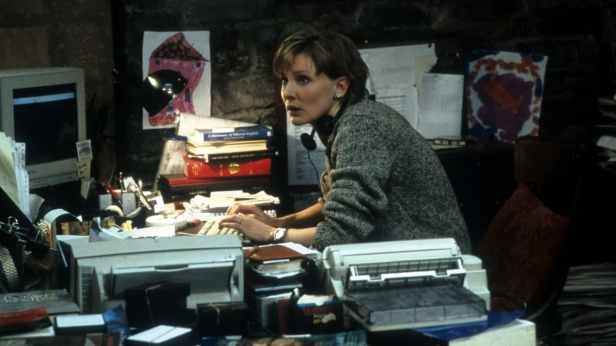
Veronica Guerin was a remarkable woman who at school in Dublin excelled in various sports, playing football and basketball for Ireland. At Trinity College, Dublin she studied accountancy, then worked for father’s company before moving into PR and getting involved in working for Fianna Fáil and its leader Charles Haughey. She didn’t start writing for the Irish Press until 1990 and specifically on crime stories for the Sunday Independent from 1994. Though she undoubtedly found and pursued headline stories, she wasn’t a trained journalist and didn’t work as part of a team. She was bold in pursuing face to face contacts with leading criminal figures while working on her own. But she also had close contacts with politicians and the Garda. All of this is mentioned in throwaway lines in the script but I’m guessing much of the detail might be lost on audiences following the breathless story-telling of her investigations. The sports obsession is also covered in a strange encounter with a heavily tattooed Colin Farrell staring at an image of Eric Cantona (Guerin’s hero) in a shop window.

Guerin’s behaviour is reckless, especially after she is beaten up when doorstepping John Gilligan, a criminal boss with a very short fuse. What makes her so driven and reckless? The film doesn’t really give enough background for the biopic angle. Her main investigation is into the drugs trade and its impact on North Dublin estates, especially on children. It appears that she isn’t interested in possible IRA involvement in gang wars (even though it seems she had previous experience investigating IRA activities). I was a bit puzzled by this as in Boorman’s film The General, the IRA are clearly implicated.
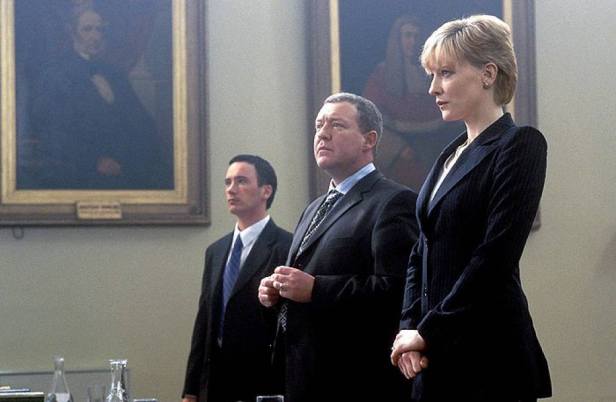
In the end I think this is a rather ’empty’ film in terms of representing Ireland. The mid 1990s was a time when Irish cinema seemed to be beginning to find its feet with increased government support for the industry and by 2003 it had achieved international acclaim through pictures made by Irish directors such as Jim Sheridan and Neil Jordan. Blanchett is as good as you would expect from such a skilled performer. There are some very good performances in the film from actors who had built their careers in both Irish and international cinema in films that were essentially Irish but used Hollywood money. As well as the odd sighting of Colin Farrell, there is Brenda Fricker as Guerin’s mother and Gerard McSorley and Ciarán Hinds as two of the crime bosses, Gilligan and Traynor. McSorley is actually from the North and Irish cinema generally has had a strong link to UK film and TV production as well as its long association with Hollywood. Ireland’s film culture has in the past suffered because of the domination of Hollywood films and its use of English in an international context with bigger players such as Hollywood, the UK, Australia and Canada able to use Irish actors and locations in their own productions. Soon after the release of Veronica Guerin, Irish filmmakers such as Lenny Abrahamson began to develop careers with films such as Adam and Paul (Ireland 2004) and Garage (Ireland 2007) ‘smaller’ stories set in more realist contexts. Abrahamson has gone on to make bigger, international films, as have the British-Irish brothers John and Martin McDonagh. Christine Molloy and Joe Lawlor are an Irish filmmaking couple who make quite distinctive films in both Ireland and the UK. We have a category of Irish cinema on this blog which includes the work of some of these filmmakers. I’ll be looking out for Baltimore (Ireland-UK 2023), the latest Molloy-Lawlor film about Rose Dugdale, the upper-class British IRA supporter and activist who died earlier this year.
There was actually a slightly earlier film about Veronica Guerin in 2000, When the Sky Falls (UK-Ireland-US) with the American actor Joan Allen as a fictionalised Guerin in a film from the British director John Mackenzie. The story had to be fictionalised as the trials of Guerin’s killers were underway at the time. The film was not well received. It’s interesting that both Veronica Guerin and When the Sky Falls featured Hollywood actors. Today we might expect stars like Saoirse Ronan or Jessie Buckley to be considered for such roles. Some developments since Guerin’s murder have seen the setting up of the Criminal Assets Bureau in Ireland which has the power to seize assets of convicted criminals, raise taxes on any criminal income and investigate false welfare claims. The Hidden Assets TV series (Ireland-Belgium) features the operation of this bureau. Here is the trailer for Veronica Guerin and below it, an interview with Veronica Guerin in 1995 exploring her work on crime stories.
 itp Global Film