

Regular readers will know of my passion for the films of Kelly Reichardt. I was a little dismayed by the treatment of her latest film after its screening in competition at Cannes in 2022. The film was bought by Sony Classics and then leased to A24 for distribution in the US where it was released in 2023. When it didn’t appear in the UK despite notifications that it was coming, I started to worry. When it finally arrived this year it went straight to a Blu-ray, courtesy of a small independent distributor I’d never heard of. What makes this development so disturbing is that the star of the film is the wonderful Michelle Williams who has appeared in three previous Reichardt films. Now that I’ve watched the film I think I can see what the possible problem might be but the way the film’s (non)-release in the UK has been handled doesn’t help at all. The Blu-ray is a bare bones release with only a trailer and no other extras. I need to do some digging to try to place it in any kind of context.

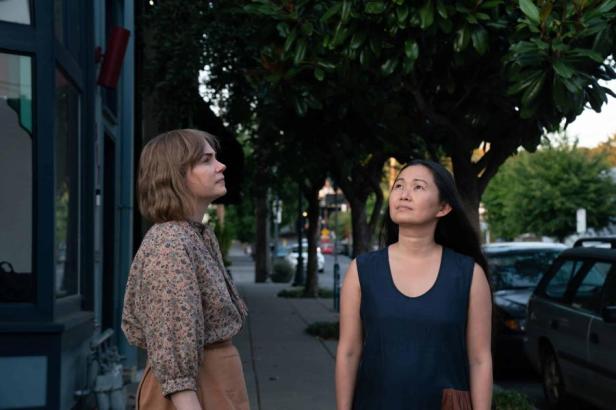
Let’s start with an attempt at a classification. This film might be described as a form of chamber-piece. The narrative takes place over eight days. The ‘action’ never extends beyond a particular part of a single urban setting and the list of characters is restricted to a single group of artists. Such films are often adapted from stage plays but this is an original idea by Jonathan Raymond who has written five previous films for Kelly Reichardt. She is also credited as a writer. The setting is an artists’ colony in the city of Portland, Oregon. I’m not sure if this is ever signified directly but nearly all of Reichardt’s films have been set in Oregon for at least part of the running time. It wasn’t until a character says that they are from Tacoma and a little later that visitors arrive from Victoria in British Columbia that I got confirmation that we were in the North West. There is an Oregon School of Arts in Portland I think and an Oregon Society of Artists but the community of artists in this film is not identified as such. In fact I wasn’t sure if this was a community group or an academic institution – I felt it that it was the former. Our central character is Lizzy (Michelle Williams) a sculptor working on small figurines of women in clay. She also seems to be an administrative assistant to her mother Jean (Maryann Plunkett) who runs the group. Lizzy lives in a house owned or leased by a fellow artist Jo (Hong Chau). Lizzy appears to be ‘unattached’ but she also has her father Bill (Judd Hirsch) and her brother Sean (John Magaro) living relatively close by. Her father is a retired artist and her brother might be a conceptual artist, but doesn’t seem to be working on anything right now. His mother thinks he might be a ‘genius’. Jean and Bill are separated but they live in the same community and they are part of the same art world. This could be a family melodrama as well.
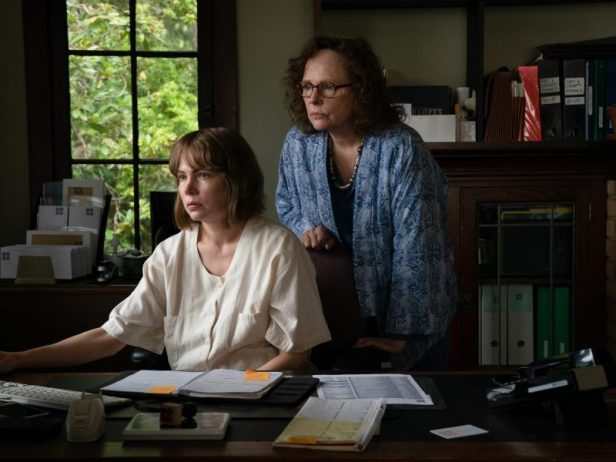
The other clue or ‘way in’ to the film is the title ‘Showing Up’ which in this context seems to have at least three meanings. In one sense everything is driven by the next artist’s show, placing pressure on the artist themselves and on an administrator like Jean. But that’s really about ‘showing’. ‘Showing up‘ could refer to the idea of expectations in a social sense – being there for friends and family, even if it means just attending your show But it could also be the opposite – doing something that is designed to ‘show up’ a colleague or a rival as being somehow lesser or unworthy in comparison. All of these are pressures on Lizzy. Michelle Williams is an extraordinary actor and she and Kelly Reichardt must have a close working relationship. In this particular role Ms Williams plays ‘put upon’ and seemingly world-weary. Her feelings are expressed in her clothes and appearance generally. She dresses in subdued colours, loose fitting and no doubt comfortable clothes. Her movements are also subdued. In these few days before her next show, she has to deal with her father and her brother, both of whom she worries about for different reasons but both she also wants to come to her show. She works for her mother which has its own stresses but the two plot points that run through the film refer to Jo, her landlord. Lizzy has no hot water and Jo is too busy to fix the problem. Then there is an injured pigeon which Lizzy finds herself looking after, although it is Jo who appears to be in charge of it. Both the lack of hot water and the saga of the pigeon could be symbolic/metaphorical and it does seem that Jo is almost like an annoying sister or partner who manages to do everything with more joy and decisiveness than Lizzy can conjure up. There is a range of minor characters in the community and most are helpful towards Lizzy. One is Eric, the operator of the kiln in which Lizzy’s figurines will be fired. He’s played by André Benjamin a.k.a the Rapper, André 3000.

We don’t go to Kelly Reichardt’s pictures to enjoy exciting action. Instead we go to see what a film artist can achieve, how she can present often marginalised or troubled characters in ways that enable to us to understand them as people in a classic humanist way – with their good points and bad points, the full range of human behaviour. There are no explosions or car chases (except in Night Moves, Reichardt’s eco-activist picture from 2013). One question might be the extent to which audiences might need to know about art education, community arts etc. I can’t claim to know that much and what I do know is from a UK context. Ideas about art in the UK were distorted I think by celebrity artists during the YBA (Young British Artists) period of the 1980s and 1990s. But then I guess that throughout history there has always been an aura around major artists. The setting for Reichardt’s narrative is slightly more mundane and local. I think, however, that the setting will be more ‘authentic’ than in many mainstream films. Kelly Reichardt herself has had an artist in residency position at Bard College in New York state, a highly rated institution, since 2006. The artworks produced by Michelle Williams and Hong Chau were actually made by local artists who also taught the actors how to present techniques on screen. Cynthia Lahti who produced the ceramic figures in Lizzy’s exhibition is a local Portland artist known to both Jon Raymond and Kelly Reichardt. Michelle Segre created the installations seen in Jo’s exhibitions.
There are relatively few contemporary filmmakers who fulfil the original 1950s idea of the auteur but Kelly Reichardt comes closest. She is involved in the writing and she directs and edits her own films. She works with regular collaborators such as Jon Raymond and Christopher Blauvelt (this is his fifth film with Reichardt) and there is continuity in the actors in her films. As well as Michelle Williams, John Magaro and James Le Gros are returnees on this shoot. In her excellent review of Showing Up in Sight and Sound April 2024 (in the DVD-Blu-ray section), Kate Stables makes an important point in her reference to the film as a ‘canary in a coal mine’. If a filmmaker of the stature of Kelly Reichardt can’t get her Cannes competition film into UK cinemas, something has shifted in UK film culture. I agree and it’s something that is quite noticeable here in West Yorkshire with the current temporary closure of the Media Museum’s three screens it feels like the few films we would like to see in the cinema appear, if at all, only once or twice in our other cinemas with at least commitment to cultural cinema. As an ironic aside, Michelle Williams and Judd Hirsch were both Oscar Nominated in Steven Spielberg’s The Fabelmans in 2023 as part of their other work in 2022. I’m sure that film was everywhere in cinemas.
I haven’t mentioned the music score for Showing Up by Ethan Rose which I read included André Benjamin playing flute. I confess I didn’t notice the flute and first time around, I really didn’t like the opening music for the titles, but when I listened again it seemed to make more sense. This is a minor quibble and in a film like this, made with such care and attention to detail, re-watching is important, I think. The cinematography is interesting too with Reichardt choosing a slightly wider screen ratio than the Academy frame she often uses. Showing Up is listed as 1.78:1 or the familiar 16:9 of modern TV. I’ve seen the suggestion that this allows the more ‘open’ feel of this Portland art community compared to the restricted view that Michelle Williams has from under her bonnet in Meek’s Cutoff (US 2010). I think that Christopher Blauvelt must have shot the film mainly using available light – there seems to be a softer feel to some of the interior scenes. The other aspect of the film I haven’t mentioned is the gentle humour in many scenes. It all adds to the sense of an understated but fully thought out presentation. This film has perhaps not surprisingly seen very different responses from most critics (favourable) and some audiences for whom its gentle pacing and keen observation is not a substitute for action and grandstanding. The gentle cooing of the pigeon is again perhaps symbolic. Showing Up is available to buy or rent on download Apple TV or Amazon look the best bet, but there are others as well. Here’s the French trailer – it did get into French cinemas:
 itp Global Film