
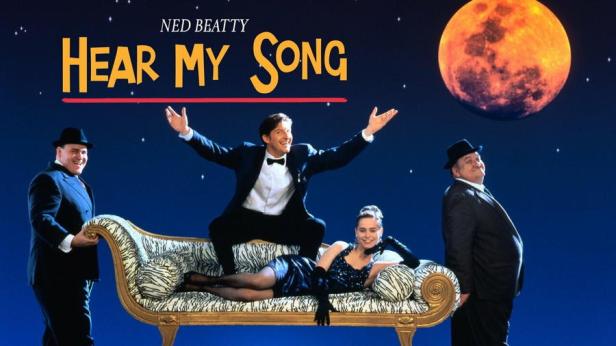
Peter Chelsom’s first three features, starting with Hear My Song, are all very good. After that things seemed to go a little haywire. But Funny Bones (1995) and The Mighty (1998) are both worth finding as well as Hear My Song. I’m returning to the film now as part of my project looking at representations of Ireland and Irish characters, especially in terms of the Irish-British connection.
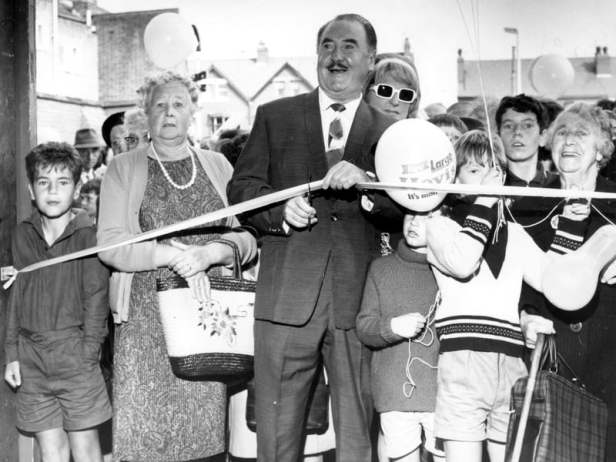
I’m not sure how I missed Hear My Song on release in 1992. Peter Chelsom was born in Blackpool and though the town doesn’t figure in the film, there is a direct connection since this is a film about Josef Locke. Locke was an Irish tenor who chose to become a popular variety performer instead of an opera star and in the 1940s became a legend in Blackpool, taking his place alongside Frank Randle and George Formby as a celebrity resident and frequent headliner of shows at the Opera House in 1946 and later the Hippodrome during the 1950s. Locke was a ‘colourful character’ like his two mates and eventually had to flee the country allegedly owing thousands to the Inland Revenue. He did eventually return and star in shows at the Queen’s Theatre, again in Blackpool in the 1960s and carried on performing until his death in 1999. For younger readers, I should point out that in the 1950s Blackpool was at its peak as a major international resort in terms of show business with Frank Sinatra, Judy Garland and Marlene Dietrich among the visiting stars. Josef Locke is said to have been so miffed at not being included in the Royal Command Performance held in Blackpool in 1955 that he decided to try the United States for a few years.

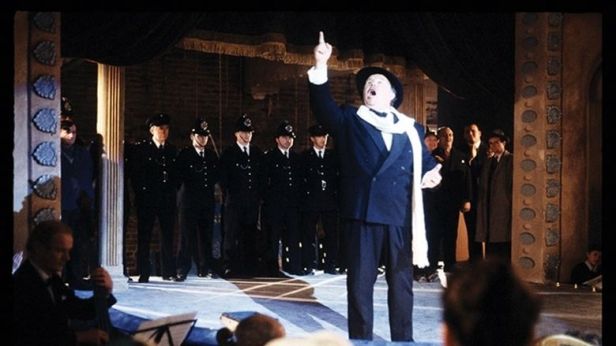
Chelsom and his star, Adrian Dunbar, wrote Hear My Song as a fictionalised and romanticised version of the real story of Josef Locke. The narrative focuses on a young Irishman named Micky O’Neill (Adrian Dunbar) whose childhood dream had been to be an impresario. Now he is running a club in an old theatre in Liverpool (actually filmed in Dublin) and hoping to propose to his love Nancy (Tara Fitzgerald). But things go badly at the club and he faces financial disaster. His two burly assistants persuade him to put on a show starring a Josef Locke impersonator but billing him as Mr ‘X’ while promoting the idea that he is really the famous Irish tenor. Micky’s problem is that Nancy’s mother (Shirley Anne Field) once had a fling with the real Josef Locke (reputedly like many other women) and she will be difficult to fool. Without spoiling the plot too much Micky is going to be forced to visit remote parts of Ireland looking for the ‘real’ Josef Locke in order to placate his prospective mother-in-law. But waiting in the wings is a senior policeman played by David McCallum, now the Chief Constable but once the police officer who just failed to catch Locke before he left for Ireland and tax exile. Josef Locke turns out to be played by Ned Beatty (with the dubbed singing voice of Vernon Midgely).

Watching Hear My Song in the 2020s is strangely topical for two reasons. First, it offers a sustained look at the comic (and singing) talents of Adrian Dunbar who is now much better known as the head of the Anti-Corruption Unit AC-12 in the hit TV police procedural show Line of Duty (2012-2021). It’s quite a move from the chancer Mickey to Supt. Hastings of AC-12. More worryingly perhaps, Hear My Song is also a reminder of the great force for good that has been Film 4, something now threatened by the current incompetent but vindictive UK government who have seemed determined to sell off Channel 4 (and presumably Film 4) to the nearest American bidder they can find. It could be argued that at the nadir of British cinema around 1984, the only thing that kept the industry afloat was the innovative production plans of Channel Four films which produced films that showed on the TV channel but proved successful enough to later lead to cinema releases – one of the first to become popular in cinemas was My Beautiful Laundrette in 1985. Since then, Channel 4/Film 4 has been involved in many successful British films. Several of them have been made in Ireland or with Irish partners, helping to build the Irish industry while supporting UK production. One of the early Channel 4 films was Angel (1982) the first film success for Neil Jordan, starring Stephen Rea as a musician in an Irish showband touring the North of Ireland.
What does the film say about ‘Irishness’, Irish culture and the British connection? Locke was born as Joseph McLaughlin in Derry in 1917 when Ireland was still one entity as a British colony. Derry later became known as ‘Stroke City’ after partition since it was known as ‘Londonderry’ to its Protestant inhabitants and the British Crown, its name referring to the British ‘plantation’ in Ireland. McLaughlin was a Catholic who at 16 joined the British Army and served in the Palestine Police during the mandate period and in the Royal Ulster Constabulary (an unusual employer for a Northern Irish Catholic in a force dominated by Protestants – after the Good Friday Agreement the force was re-organised as the Police Service of Northern Ireland).

Hear My Song is taken from the title of a famous Josef Locke song which names his daughter, ‘Hear My Song Violetta’. The film appears to have been made almost entirely in Ireland with a couple of scenes shot in London and Liverpool. I was surprised that Blackpool didn’t figure at all but I suspect that might have been a funding issue. Funny Bones would be made almost entirely in the resort. As it was, Joseph Locke did appear in person at the Blackpool premiere in 1992 at the ABC, the then tripled cinema which had replaced the Hippodrome where Locke appeared in summer shows. The singer died in 1999 aged 82 – see his Irish biography entry. The core of the film is the representation of the Irish diaspora in England and the ways in which traditional culture was maintained by several generations of migrants, regularly replenished by new migrants following the famous routes from Dublin to Liverpool, Leeds, Birmingham and London. This has diminished I think in recent years but the film seems to be set in the 1980s, though dates aren’t mentioned. Like Funny Bones, it appears to be set in a hazy glow that could stretch from the 1950s to almost the 1990s. I don’t think this sense of a diaspora culture will mean that much to other audiences but I recognise aspects of it from my childhood in Blackpool (where Irish casual workers were a feature of Summer Seasons) and from London, living in Kilburn and Cricklewood. There is a neat touch in the casting with Shirley Anne Field (1936-2023) cast as Locke’s love interest. She plays a beauty queen from the 1950s, ‘Miss Dairy Goodness’ who is given a prize and then seduced by Locke. Field was a young actor who played a similar role in The Entertainer in 1960 when she is a young woman taken up by the aging variety star Archie Rice (Laurence Olivier). She appeared in eight features released in 1960, including her first major role in Saturday Night and Sunday Morning.

Micky is sent packing from his club by a terrifying band of older women who identify as Josef Locke’s audience. Once in Ireland he calls on his old mate, a showbiz agent Fintan O’Donnell, played by James Nesbitt. Nesbitt comes from Ballymena in the North but his presence in the film resonates now because in the early 1990s he was just beginning his career on UK TV where he has become one of the best known Irish actors of the last thirty years. Micky and Fintan travel around the more remote parts of the West of Ireland to find Josef Locke now happily in exile with his small band of friends. The expected ‘Irishness’ of this section of the film is laid on a bit too thick perhaps and is a reminder of the American films that proved both successful but also controversial in ‘typing’ Irish characters and settings. The classic example is John Ford’s The Quiet Man (US 1952). Locke is played by the US comic actor Ned Beatty (1937-2021) who is very good in the role.
Hear My Song proved successful in North America despite an ‘R’ rating. I suspect that this is simply because in an early scene of Dunbar and Fitzgerald in bed together, she is shown naked. It’s an odd moment that wasn’t necessary for the narrative. It was Tara Fitzgerald’s first film role and it must have put pressure on her. I’m wondering if the film’s distributor in the US, Miramax (then owned by the Weinstein Brothers) had anything to do with it? Fitzgerald has appeared in many other films, but is perhaps best known for stage and TV appearances. She had one of her best film roles playing opposite Ewan McGregor in Brassed Off (UK-US 1996). The brief moment of nudity had no repercussions elsewhere, only in the US, I think. Another name which dates the fiction as set earlier than 1991 is Norman Vaughan (1923-2002) who pops up as a Merseyside TV reporter. Vaughan (a Liverpool comic) was one of the comperes of Sunday Night at the London Palladium in the 1960s and other shows in the 1970s. Finally, David McCallum (1933-2023) was well-known from various film parts but mainly for his TV role in The Man From U.N.C.L.E. in the 1960s. As Chelsom’s first film, there are a few moments that perhaps don’t quite work but overall Hear My Song offers solid entertainment and sets up Funny Bones quite nicely. Hear My Song is available from Amazon or Apple and is available free if you look carefully.
 itp Global Film
I remember remember seeing Funny Bones which I really enjoyed but I may have been put off seeing this by it being a music biopic. Will try and catch up
LikeLike
It’s a fictionalised partial biopic. Micky is really the central character.
LikeLike