
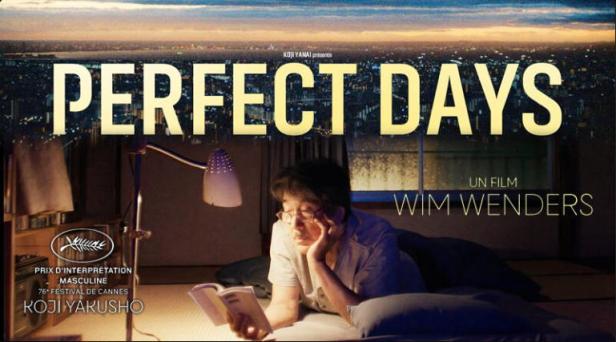
This Wim Wenders film was recommended to me but I initially ignored it. Though I had been a big Wenders fan in the 1970s, I lost interest in the 1980s and apart from a couple of documentaries I have since ignored what is now a very extensive body of work. I enjoyed The Buena Vista Social Club (1999) because of the music and the Cuban setting and The Salt of the Earth (2014) because of Salgado and his photographs. I did wonder whether I would enjoy Perfect Days because of Tokyo as its setting. The film is now streaming on MUBI and I decided to give it a go. I’m glad I did and I enjoyed it very much.
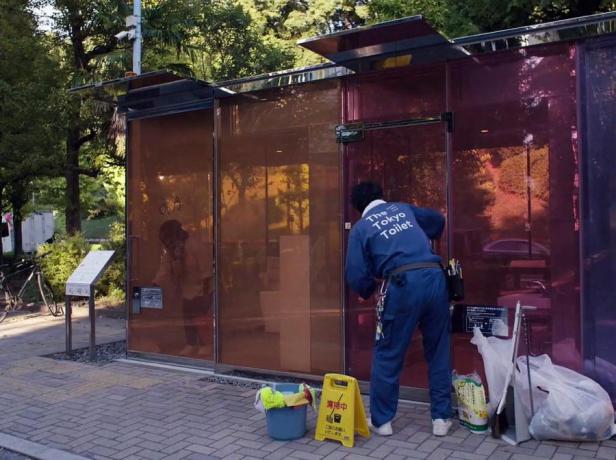
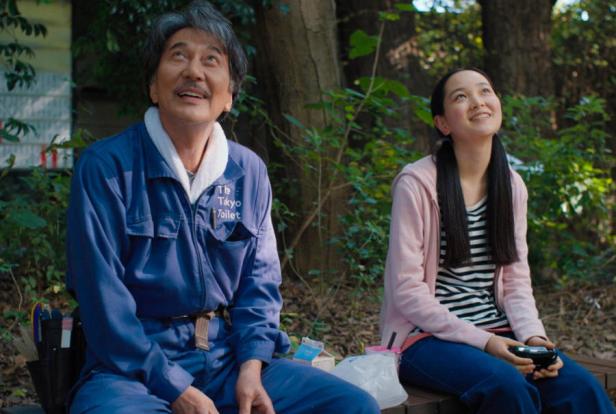
Perfect Days is difficult to categorise. At first it appears to be a documentary, a form of ‘observational procedural’ as we follow ‘Hirayama’ through his morning ritual and then his cleaning work schedule for The Tokyo Toilet project and finally his evening ritual. The only real clues that this isn’t a documentary in this first sequence are Hirayama’s acceptance of and ease with the camera and the fluid cinematography by Franz Lustig. In the next sequence the daily rituals and schedules are repeated. After this happens for a third time there was a part of my brain which remembered the avant-garde films of long ago that created narratives by endless repetitions which then started to show slight changes in the repeated sequences. Hirayama’s experiences do eventually change because of the actions of the other people he meets and eventually it is clear that this is a fiction with ‘characters’ and ‘performances’. Hirayama is played by Yakusho Koji who won the Best Actor Award at Cannes in 2023. In his performance he exudes calm and human warmth when he finds a small child in one of the public toilets he cleans. In the second half of what is actually quite a long film (124 minutes) we learn a little more about him when his niece is waiting for him at the end of his day’s work. This interaction and a couple of the other relationships that are explored help to build up a clearer picture of his life but we still don’t know too much about him. In the end it is two of Wenders’ own obsessions that, at least for me, dominate the film narrative. One is Wenders’ clear passion for – and understanding of – Tokyo and Japanese culture. The other, which goes right back to his earliest films, is his passion for all forms of music but especially rock and pop music.

Wenders isn’t the only European filmmaker to have made thoughtful films about Tokyo and Japanese culture. I remember Doris Dörrie’s film Cherry Blossom (Kirschblüten – Hanami, Germany 2008) and Fukushima (Germany 2016) and also the Chris Marker documentary Sans Soleil (France 1983) which focuses mainly on Japan but also other locations. I’ve only spent a few days in Tokyo and that was more than four decades ago but I probably remember more about those few days in that city than about any of the other places I’ve visited since. Of course, it’s also true that I’ve seen a lot of Japanese films set in the city. I’m amazed at how many aspects of the city are still more or less the same as they were in the 1970s – the vending machines on back streets, the underground markets and food stands, the beautiful parks, the bath houses etc. The revelation of course is the group of high-tech public toilets that Hirayama cleans. You can explore the amazing Tokyo Toilet Project in Shibuya on this amazing website. Many of the toilets in the project appear in the film. Like so many other aspects of Japanese culture, I wonder why we can’t have anything as impressive as this in the UK? Wenders’ ‘feel’ for Tokyo’s social/cultural landscapes is also partly informed by his co-writer Takuma Takasaki.

Wenders did make a documentary about Tokyo and specifically about his fascination with the films of Ozu Yasujiro back in 1985 with Tokyo-Ga. That film has now been restored and it too has now arrived on MUBI. I’ll look at it in detail in a few days. As for Perfect Days, I think that there are moments and images that make me think of various filmmakers. There are moments that might prompt memories of relatively recent films by Kore-eda Hirokazu and Hamaguchi Ryusuke – nothing concrete, just isolated images of the city. Similarly I thought of films by Kurosawa Kyoshi, Naomi Kawase and Bong Joon-ho (his story in the portmanteau film Tokyo! (2008)). I don’t think I noticed any specific Ozu images but I was struck by one composition of Hirayama and his niece walking beneath very tall trees which reminded me of Mizoguchi’s The Lady of Musashino (Japan 1951). That image framing is emphasised by Wenders’ choice of an Academy ratio, which most reviewers who mention it seem to feel is a key part of the Ozu hommage. It does, however, also recall all the other Japanese masters of the 1950s. There is bar sequence in the film that does evoke Ozu for me and it is the bar that Hirayama found a few years ago – the kind of tiny bar serving food and booze but with room for only around a dozen customers. Such bars pop up in many Ozu films – and again in other Japanese films.
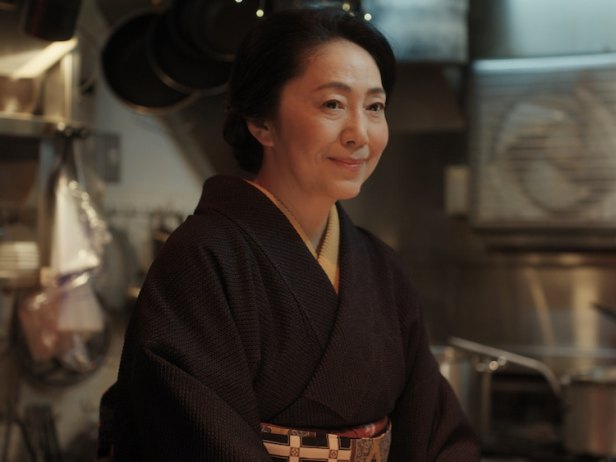
The use of music is a feature of much of Wenders’ work and he has made a number of music videos as well as commissioning scores from musicians such as Ry Cooder. The Wenders film that particularly springs to mind is his first feature, Summer in the City (West Germany 1970), seemingly named after the Lovin’ Spoonful song. It’s a film that includes so many tracks that I wondered if the rights were ever acquired. There were a host of Kinks’ songs in that film and the Kinks turn up again in Perfect Days as well as Lou Reed, Van Morrison, Nina Simone and Patti Smith among others. Wenders again ‘gets’ an aspect of Japanese culture and its obsession with specialist collections of music as well as specialist bookshops. Hirayama plays his music via cassette tapes and this gives him a connection to the younger characters in the film who are fascinated by analogue music. We visit both a traditional record store and a bookshop. In the former we learn how valuable some cassettes might have become and in the latter Hirayama buys a Patricia Highsmith short story collection. Hirayama is an educated man who also reads poetry and William Faulkner’s Wild Palms. This last reference takes us to a final categorisation – the fantasy film in which he seems to dream about trees as shapes against the sky.
I came to this film as a sceptic but it won me over completely and now I want to return to Tokyo. That seems unlikely for me but perhaps I’ll simply watch and rewatch the Japanese films in my collection. Perfect Days is available on MUBI and also Apple and Amazon (for subscribers, but watch with a free trial). Here’s a trailer (which unfortunately stresses the narrative developments too much):
 itp Global Film
I never cared much for Wenders’ American films, but loved this even more than Wings of Desire, so much that it may become one of my all time favourite films. I found it profoundly moving and uplifting, and have never felt such a deep connection to a screen character.
I didn’t at first realise I’d already seen Yakusho a few days earlier in a much smaller, semi-cartoonish role as the robber in Tokyo Sonata, which I also really enjoyed – and have now also seen him in another impressive performance in The Third Murder. Fascinating seeing very different faces of Japan in these two films, in terms of human connection and the value/status of work, specifically the job of a toilet cleaner.
I’d heard a lot from friends and family about Japan’s impressive high-tech toilets and was utterly absorbed from the start by Hirayama’s pride in his work as inherently rewarding. I wish there were many more films portraying low-status key workers like cleaners and carers with this level of dignity and humanity. I also really enjoyed the pleasure he radiated in all his daily rituals, and noted their subtle, clever variations as the narrative unfolds. I particularly liked his morning smile, gentle plant tending, the golden lighting on the symbolic bridge during his moments of human connection, and all the wonderful music he plays on the way to work, and though I would have liked a little more Japanese music, was pleased to hear Wenders explain in an interview how his Japanese co-writer resolved questions about how authentic his choices were for Hirayama.
A very refreshing change from western films about the empty monotony of urban work routines. However, I’m struck by how some western reviewers (eg a long, quite fierce debate on Reddit) seem determined to believe Hirayama’s serene smile is masking a desperately miserable, lonely, unfulfilled man who’s using his ‘OCD’ work routines as an escape from unresolved trauma, shown by his mask slipping in the final sequence of the film…. Yes, there’s an underlying strain of melancholy in the final act and Yakusho’s masterful performance in the last sequence is open to a little interpretation. Even so, I think the point is more that he’s not avoiding pain, but living with it, which I feel is confirmed by Wenders’ carefully chosen music, lighting and symbolism in the final frames. I just think he’s actively chosen a simpler, more mindful life than one focused on status, others’ judgements and attachment to material things, instead finding contentment in little daily rituals of work and leisure that give his life structure and meaning.
I think the sunlight and shadows tree shots, his photos of them, the exquisite monochrome dream sequences and his bitter-sweet night-time shadow dance by the bridge with the dying man are all manifestations of the ‘komorebi’ motif – symbolising living in the fleeting moment, and accepting that light and shadows, pain and joy, life and death are all part of existence. I didn’t know this word but really admired where Wenders placed it: it felt thematically fitting – a reward for those (especially if they see it in the cinema) who appreciate the film in the same patient, meditative spirit as Hirayama lives his life. A perfect end to a well-titled film that I will enjoy watching many times on DVD.
LikeLike