

Another Blu-ray for today’s post because I can’t get to the cinema to see the new films by Kore-eda and Hamaguchi. This time it’s the 2017 Masters of Cinema release of Daughter of the Nile by Hou Hsiao-hsien. The only extra on the disc is a very detailed (42 minutes) presentation to camera by Tony Rayns (he certainly gets around!). I remember the Channel 4 TV screenings of some of Hou’s films in the UK in the 1980s and I think that Rayns would have introduced them then. I was grateful for his contribution on the disc as this was a Hou film I saw at the NFT in the late 1980s and found very difficult to read at that time.

At this point in his career Hou had made two types of films. He began with what were essentially ‘acceptable’ conventional genre films under the strict censorship controls in place in Taiwan since the 1950s. Two of them Cute Girl (Taiwan 1980) and The Green, Green Grass of Home (Taiwan 1982) are discussed on this blog as well as a third film The Boys from Fengkuei (Taiwan 1983). Already, by that 1983 film, Hou’s films were becoming more ‘personal’ and less conventional. The next three films continued this trend and used biographical stories about growing up in Taiwan provided by writers close to Hou. By the late 1980s, however, Hou was aged around 40 and he realised he was to some extent out of touch with the contemporary youth of Taiwan. Also, his previous films had been mainly based in the smaller towns or rural areas of Taiwan. This time he decided to do some research and find out what was happening in the fast-growing capital city Taipei. Daughter of the Nile was the result of this research and it focuses on a young woman, Lin Hsiao-yang played by the pop singer Lin Yang. This in itself wasn’t new, those earlier films featured the Hong Kong pop singer Kenny Bee. This time, however, there would be no conventional genre narrative. The title refers to a popular Japanese manga which in its Chinese translation was being read in Taipei and which Hsiao-yang identifies with very strongly. As Rayns points out, although 1987 did see the beginnings of the loosening of the repressive martial law structures in Taiwan, it was still the case that Japanese popular culture (films in particular) were proscribed. The manga concerns an American young woman who time travels back to the time of the young pharaoh Memphis and becomes infatuated with him. This situation is linked to Hsiao-yang’s position as an older teen interested in one of her brother’s friends but feeling increasingly marginalised and trapped.
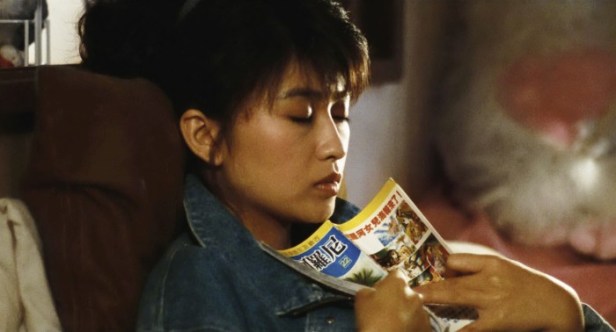
Hsiao-yang’s family is, if not dysfunctional, definitely struggling to hold together. The narrative is very much about the difficulties of the move from small town/rural village to the big city as well as the broader theme of contemporary youth struggling for ‘modernity’ and freedom from ‘tradition’. Mother has died and father (Tsui Fu-Sheng) is a police officer in a small town on the East coast, so he’s not around much. Hsiao-yang’s brother Hsiao-fang (Jack Kao) is a part-time thief and part-owner of a ‘Pink’ Escort bar. The youngest member of the family, Hsiao-yang’s little sister is still at junior school – Hsiao-yang attends night school to finish her education. To earn money she works at a large KFC restaurant. Her grandfather (played by Hou regular at this time Lee Tien-lu, visits from nearby where he lives with Hsiao-yang’s aunt and her family. Hsaiao-yang is often called on to do the mundane, routine jobs. She cooks, washes dishes and clothes, looks after her younger sister. She reads her manga while listening to her Walkman (stolen for her by her brother).
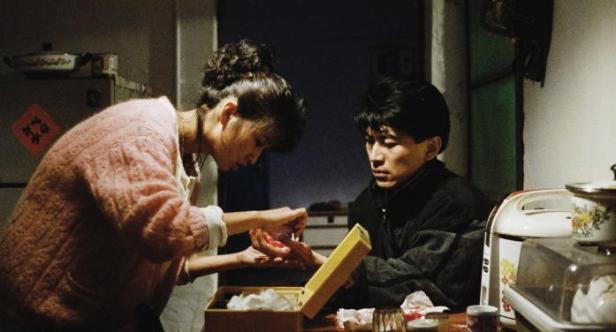
The generic elements of the film are the moments of conflict between Hsiao-fang’s group who own the bar and similar groups. It’s never quite clear what the roots of the conflicts are but gambling is rife among the young men and money is tight so perhaps it is about gambling debts, ‘turf wars’ or simply macho posturing. Unfortunately Hsiao-yang is keen on one of her brother’s friends who seems the most likely to get into trouble. There are two other characters who are picked out. One is the young woman who Hsiao-fang announces as his fiancée. She has a mainly symbolic role in suggesting that Hsiao-fang might actually think about ‘settling down’ at some point. The other is Hsiao-yang’s lecturer at night school who is played by one of Hou’s writing partners, Wu Nien-jen. His other regular writing partner Chu Tien-wen wrote this film. Again, this is a symbolic role. The tutor appears to be teaching Chinese Philosophy but there are also indications that he is being targeted as a subversive/communist etc. This is just one of the aspects of the script that requires knowledge about the situation in Taiwan at this time.


The booklet that comes with the Blu-ray (which also includes a DVD with the same film plus presentation) is unusual for this kind of release. There are lots of photos of the shoot but only two short statements by Hou himself, one from the original Press Book issued at the time of release. Hou is self-deprecating, letting us know that he thinks the film is a failure because he had become too interested in ‘style’ and had not worried too much about the narrative he was constructing. As a result, he feels that he lost his energy and didn’t take enough care about ‘covering’ scenes. During editing he had the dilemma that he wanted to cut out material he thought was weak but if he did so the narrative would not work. He explains that the production company was the one that had made his first feature Cute Girl and that it was they who wanted him to use the pop singer Lin Yang. He met her and decided to use her but he thinks he failed to give her story ‘energy’ and that it suffered from ‘stylisation’. The irony is that for the international arthouse audience it is the stylisation that makes the film so interesting.
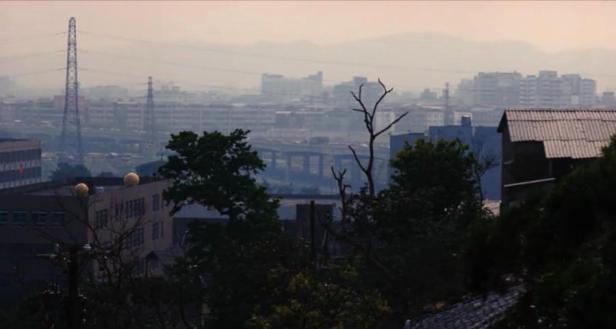
Watching the film this ‘second time around’, I was much more aware of Hou’s style, familiar from the later films. Rayns maintains this is a ‘transitional film’ and I think I agree. Two obvious points are related to the presentation of the Lin household. After the opening in which Hsiao-yang reminisces about her time as a younger teenager, the framings of action in the Lin household are all similar. A static shot looks into the kitchen where two people might be sat at the table viewed down a corridor from within the house. Alternatively a slight adjustment might show the bathroom/washroom or a dark living room where a larger family meal might be hosted. Secondly, Hou begins to use what some Ozu-watchers might call a ‘pillow shot’ following the analyses by Noël Burch (i.e. they are like phrases in poetry which balance lines rather than adding meaning). David Bordwell appears to disagree with this definition, arguing that the shots are closely allied to what happens before and after, suggesting that they mirror the composition strategies and are linked in some way to the other shots. Make up your own mind but you will soon get used to the shot which is taken from Hsiao-yang’s house on a hill looking across the city below.
I’m glad I watched this film again and I enjoyed it very much this time round, partly because I recognised some of the actors but mainly because I think I understood what Hou was trying to do. I’m sorry he thought the film was a failure. For me, it gave an insight into how a young woman like Hsiao-yang might have felt in 1987.
 itp Global Film