

Witness in the City is a Blu-ray of an unfairly neglected French crime film released recently by the UK label Radiance. Its neglect is surprising because the film has many interesting features, not least a lead performance by one of our favourite actors, Lino Ventura. The film is directed by Édouard Molinaro, still a relatively young man at 30 when he made this, his third feature. The ‘scenario’ was conceived by the writing team of Pierre Boileau and Thomas Narcejac (known as the writers who originated Les diaboliques for Clouzot and Vertigo for Hitchcock) plus a newish writer Gérard Oury (mainly known as an actor at this point). It required more inputs as the original idea was adapted and the director became involved as well as three other writers. This is surprising because the film doesn’t have too much dialogue in its 90 minutes running time. It was photographed in 1.66:1 by Henri Decaë, then best known as a collaborator with Jean-Paul Melville and edited by Monique and Robert Isnardon. The striking jazz score is credited to the young tenor saxophonist and composer Barney Wilen who had been with Miles Davis on the score for the Louis Malle film Lift to the Scaffold (Ascenseur pour l’échafaud, 1958).

I can outline the plot since this isn’t so much a mystery but almost a tale about fate. A man (Verdier – Jacques Berthier) throws a woman from a speeding train. She is killed but the man is not charged because the evidence is not conclusive. He is not prosecuted because the investigating judge is forced to give him the ‘benefit of a doubt’. The woman who was killed was having an affair with her murderer and now her husband M. Ancelin (Lino Ventura) murders the lover in an almost judicial manner. However, Ancelin is unlucky and, making his getaway, is surprised by a witness, the taxi-driver Lambert (Fabio Fabrizi) who had arrived to collect Verdier at his house. Ancelin knows that when the body is discovered the taxi-driver will remember him. He sets out to follow Lambert. At this stage there is an enigma – will the police find the body and determine it was murder? If so, will Lambert help the police? Ancelin can’t be sure and must watch Lambert.
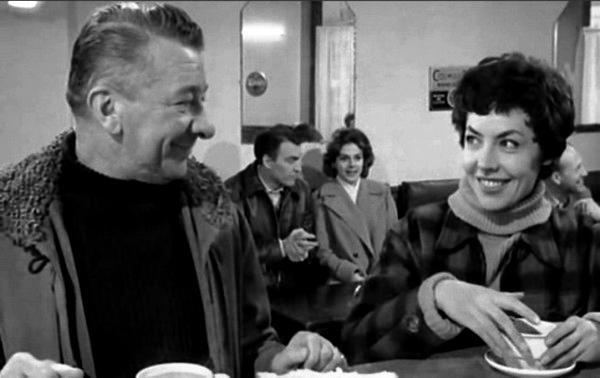
The key to the film narrative is how the locations in Paris are used. Ancelin must follow Lambert on foot, on the Metro and in his taxi. Lambert works for a company using the latest radio technology with telephone receivers in their Peugot 403s. This is the ‘Radio-Taxi’ company with a fleet of vehicles connected by a radio network. The network is supported by a group of women in a control room. The young woman seemingly in charge is Lambert’s girlfriend Liliane (Sandra Milo). lambert is very popular among the drivers and the women in the control room. Unbeknown to Ancelin, taking on Lambert could mean taking on all of the drivers. The dénouement of the narrative will take place on the streets of Paris at night.

The Radiance Blu-ray looks and sounds terrific and comes with three extras. Film journalist Philippe Durant, the biographer of Lino Ventura, explains what attracted Ventura to the role. Tony Rayns and Ginette Vincendeau discuss the film in two separate presentations, Rayns taking the film as a polar and Vincendeau placing in the context of the French conception of film noir. These three presentations direct to camera are engaging and informative but there is a fair degree of overlap. It would have been interesting to see the three together discussing the film, but that is not how these things work and the Durant interview (for Gaumont in 2014) is conducted in French with subtitles (as is the film, of course). I did find all three useful and learned several things about the film I didn’t already know. The different perspectives of Rayns and Vincendeau perhaps come from Radiance and their briefing. The case for this film as a noir depends on the nighttime setting of most of the action and Decaë’s camerawork (the camera operator is Jean Rabier who would eventually become a cinematographer for Claude Chabrol’s crime melodramas and films for both Agnès Varda and Jacques Demy). There are certainly several distinctive noir images and the thematic of the ‘descent into hell’ of the central character Ancelin fits the conception of the ‘doomed’ man in the film noir. However, I’m not sure about a noir in 1959. On the other hand, I’m not sure about the polar either. In some ways it is more feasible but the police are not really directly involved that much and the crimes are crimes of passion/revenge. The strongest links are arguably to the films of Jean-Paul Melville.

The location work in Paris is very impressive and has an almost documentary feel in the way in which the radio cabs operate and the presentation of the metro is very detailed. All this makes me think of what I guess is my obsessive interest in the development of la nouvelle vague. Molinaro was a young director, the action is on the streets of Paris and the film was released in 1959 these place it within the New Wave period. In some ways the film reminds me of Chabrol’s Les bonnes femmes (1960) in terms of location work. I guess that in Truffaut’s terms it is a highly-scripted film but on the other hand the jazz score reminds us of Ascenseur pour l’échafaud, 1958 and Louis Malle was seen as a kind of outlier of the main group of New Wave directors. Lino Ventura is a police inspector in that film.

This Blu-ray is very good and definitely worth seeking out. I’m not sure if this restoration is available on streamers. The Blu-ray is one of the three titles in the World Noir Vol 1 collection from Radiance, along with I Am Waiting (Ore wa matteru ze) 1957, Japan and The Facts of Murder (Un maledetto imbroglio) 1959, Italy. Here’s part of the car chase:
 itp Global Film