

The Settlers is a major international film with funding support for a Chilean production from an array of European funders plus Taiwan and Argentina. It won the Critics’ Prize in Un Certain Regard at Cannes in 2023 and was the Chilean Oscar entry. It was also involved in several other Film Festival Awards around the world. Its narrative deals with the activities of ‘settlers’/colonialists in Patagonia around the start of the 20th century. It has been released by MUBI in most major territories, including the US and the UK where it is now streaming. The film is the directorial début of Felipe Gálvez Haberle. The exploitation of this region, as in many other parts of South America was an international undertaking in the 19th century and the film is presented with dialogue in several languages including Spanish, English and Indigenous languages. The visual presentation is unusual and the film adopts an aspect ration of 1.50:1. Just for clarification I should note that ‘Patagonia’ is the name of the large region comprising the the whole of the Southern part of South America, over 1 million sq km of mostly Argentina (90%) and Chile 10%). The further South you go it becomes wilder and less populated. The ‘tip’ of the continent becomes an archipelago of large and small islands and here the majority of the land is on the Chilean side of the border in the administrative region known now as Magallanes.

In 1901 José Menéndez (Alfredo Castro) is attempting to fence in the vast amount of land he appears to have been granted by the Chilean and Argentinian states which share the territory known as Tierra del Fuego, ‘the land of fire’ – supposedly named because the earliest European adventurers saw the fires lit by Indigenous peoples. The Menéndez business is sheep and he intends to remove anything from the land which will attack his sheep. This means he requires the ‘elimination’ of all the Indigenous peoples on ‘his’ land. To achieve this he turns to Alexander MacLennan (Mark Stanley), an ex-British soldier, still wearing the scarlet coat which gets him the local name of ‘The Red Pig’. MacLennan selects just one man to go with him, a mestizo from the island of Chiloé further to the North. This man Segundo (Camilo Arancibia) is a marksman with a rifle. However, Menéndez insists that MacLennan needs a third man and assigns him Bill (Benjamin Westfall – a Chilean-American actor) an American cowboy who has fought the Apache and Comanche and presents a character who might have come straight from the Lonesome Dove novels of Larry McMurtry or the Border novels of Cormac McCarthy. From the beginning there is an obvious antipathy between the Imperial soldier and the Texas cowboy, especially in their different forms of racism and brutalism.
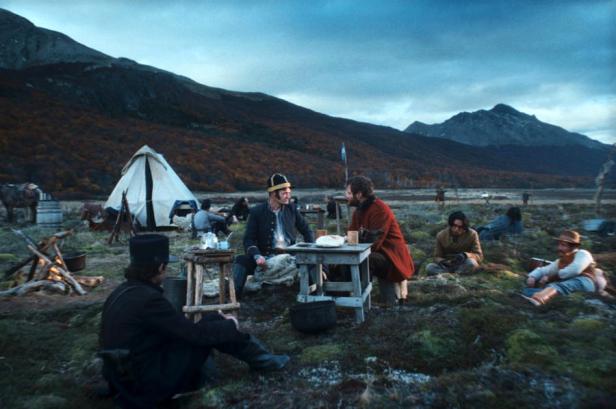
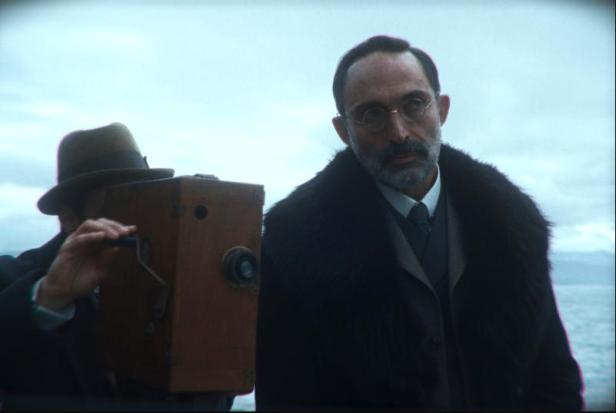
This odd trio will meet three different groups of people on their travels – an Argentinian group attempting to survey the border region, a group of Indigenous people who they will murder as an act of ‘ethnic cleansing’ and finally another mixed group of Europeans and Chileans led by the British Colonel Martin, who has left the UK under a cloud of some kind. One of this group is a woman who will become the wife of Segundo. Roughly the last third of the narrative leaps forward seven years and finds José Menéndez in his large house in Puntas Arenas, the major settlement in the region. He is waiting with his daughter and grand-daughters for a visitor from Santiago: Marcial Vicuña comes direct from the Chilean President. Vicuña is revealed to be undertaking some kind of semi-judicial investigation of what happened to the Indigenous people of the region. This will eventually take him on a trip to visit Segundo, now back on the island of Chiloé, where Vicuña attempts to shoot a short film showing Segundo and his wife drinking tea outside their shack by the sea. The end credits of the film reveal archive material about the Menéndez family which still owns a major sheep farming business. As well as Menéndez, MacLennan too appears to be an historical character.
The presentation of the film is remarkable. As well as the unusual aspect ratio, Felipe Gálvez employs a sometimes startling score by Harry Allouche and sound design by Tu Duu-Chih and Tu Tse Kang who both worked on The Assassin (Taiwan-France 2015) for Hou Hsiao-hsien. The use of the sounds of the wind is unsettling in many parts of the narrative. Ideally the film should be seen and heard in a cinema auditorium with a large screen and high quality speakers. The cinematography by Simone D’Arcangelo and editing by Matthieu Taponier also contribute a great deal. This is the closest region to the Antarctic with a cold temperate/sub polar climate. The landscapes are vast and we watch three small figures on horseback in ‘very long shots’ suddenly contrasted with close-ups. There is a sequence in which the trio find an Indigenous community of around a dozen people. Galvez at first presents the scene in ‘very long shot’. It is misty and he keeps a static framing for quite a long time until a tiny figure appears as the mist slowly moves away. Thus begins the attack upon the Indigenous people. I was reminded of the scene in Timbuktu (Mauritania-France 2014) when a deadly altercation is captured in very long shot.
There is a great deal to say about the background to this production project which Galvez says took him hine years to complete. The film has been generally very well received but there have been a variety of responses. A common critical starting point and one that also crops up in audience reactions is to see the film as a ‘revisionist Western’. The three men on a ‘mission’ traversing this wild country is a familiar Western set-up. At least one reviewer refers to Blood Meridian, the horrifically violent Cormac McCarthy novel that has so far not been filmed despite several attempts. The underlying racism and the presence of a mestizo character (a ‘half-breed’ in the racist language of the time) also connects to John Ford’s The Searchers (US 1956). It’s also important that the film was screened at Cannes around the same time as the first screening of Scorsese’s Killers of the Flower Moon. I can see why these connections are made but I’m not sure how useful they are. What they do allow is to consider how the genre knowledge of the Western perhaps makes the film more accessible for audiences. But really the connections are wider to other recent films about the histories of colonialist attacks upon Indigenous peoples in territories such as Canada, Australia and New Zealand (partly because of the British history of colonialism) but also because of the geographical remoteness of cultures ‘discovered’ by Europeans. The use of imperial force is universal however and we can find examples everywhere across the globe. It’s not just the technologies of the colonialists but also the deliberate attempt to destroy local cultures and to assimilate native peoples by force into European-style ‘civilisations’ (when genocide becomes too costly or politically unpalatable). Forced religious conversion is another part of this universal history of ‘settlements’.
Galvez himself in an interview in the Press Pack for the film tells us what motivated him to start his project:
The story of the film is not part of the official history of Chile. It does not appear in school curricula either. I knew nothing about the genocide of the Selk’nam Indians, called Onas by the whites, in our country. I discovered it by reading an article fifteen years ago which mentioned this hidden reality of genocide. At school, the history of Chile ends in 1973, we do not talk about the dictatorship that followed. The official history of the dictatorship has still not been written. Is it worth telling, and above all, how to do it? At the end of this reflection, I became interested in these other events of the beginning of the 20th century, also ignored. What happens in a country when we erase an entire page of its history? Rather than this erasure of the dictatorship in the present, why not return to another erasure, which took place a hundred years previously? What are the consequences up to today? (Translated from the French dialogue of the interview by Google Translate).
If Galvez read an article in 2008, he was indeed setting out to tell an unknown story but the critics who reviewed his film should have remembered that some of the key points were presented in Patricio Guzmán’s brilliant film The Pearl Button (Chile-Spain-France-Switzerland, 2015). Guzmán in his documentary uses the ‘pearl button’ to make the link between the genocide of the Selk’nam peoples and the brutal treatment of Allende’s supporters after the coup by General Pinochet in 1973. The communists and socialists were held in an internment camp on Dawson Island, one of the largest islands in the Tierra del Fuego archipelago. Some were also flown out over the sea and literally dropped into the Pacific. Guzman’s poetic and polemical film is quite short but devastating in its critique of Chilean history and politics. Another film that I’ve only seen mentioned by one reviewer is the Argentinian film Jauja (Argentina-Denmark 2014) which presents a similar campaign to wipe out Indigenous peoples on the eastern, Argentinian parts of Patagonia. Jauja, directed by Lisandro Alonso, is more of an arthouse film and its narrative is less clear but the setting in the 1880s is similar to The Settlers. The film stars Viggo Mortensen as a Danish military engineer hired by the Argentinian Army to help in the ‘clearance’ of the region. He has with him his teenage daughter which causes problems with some of the young soldiers. She also meets an Indigenous man so it becomes more of a colonial melodrama as well as a mysterious and possibly ‘fantasy’ narrative. There is also a coda in which the same actress playing the daughter is a young woman in contemporary Denmark. The presence of a Dane in Patagonia is not that unusual. The region in both the Chilean West and Argentinian East attracted many Europeans in the late nineteenth century when the only way to reach the Western coastline of North America was via the long voyage around Cape Horn. The Panama Canal did not open until 1914. The attraction for migrants was the the development of large-scale sheep-farming and the biggest migrant communities were British later overtaken by Croats (from what was then Austria-Hungary).
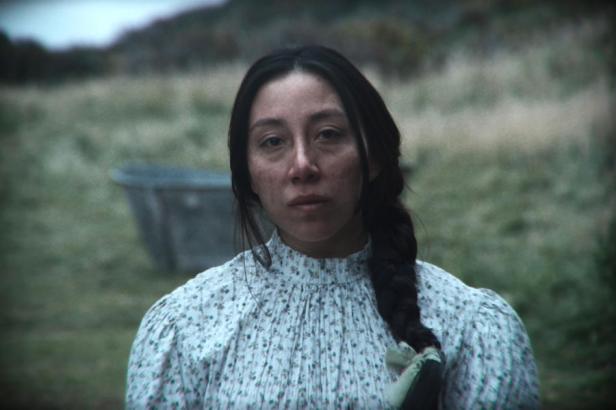
The Settlers has been seen as having two ‘flaws’ which might make it less accessible to some audiences. One is the rather abrupt closure of the initial narrative, so there isn’t any clear ending to the trip of the three men. This leads to the second dissatisfaction with the long coda set around 1908-9. This implies that the Menéndez sheep empire prospered but the real issue is the visit by the official from Santiago and his supposed ‘investigation’ of what happened to the Selk’nam. This appears to be a sham and instead he seems more concerned to create propaganda with his film of Segundo and his wife as ‘assimilated’ Indigenous Chileans. I personally don’t have a problem with either of these two ‘flaws’. I found this to be a powerful and affecting film. I hope more people are able to find it. it’s the kind of film that BBC2 or BBC4 should be showing with an introduction by a Latin-American specialist. In the UK we suffer greatly because of the absence of discussion of films on mainstream TV.
 itp Global Film