

In February 2024, Michelle O’Neill of Sinn Féin became the First Minister of the Northern Ireland Executive, sharing the leadership of the Executive with deputy First Minister Emma Little-Pengelly of the DUP. This is the first time Sinn Féin’s role as the largest party in the Assembly has been recognised. In the Republic of Ireland Sinn Féin is the joint largest party with a general election due later this year. I mention this simply to present the political landscape of Ireland in 2024 compared to 1996 when Some Mother’s Son was produced and to 1980-1 when the events depicted in this film took place. The film is based on the actual events of the period and some of the historical figures are played by actors. The four central characters are, however, fictional. The film was written by Terry George and Jim Sheridan and directed by George as his first directing role. It was made in the Republic with funding from the Irish Film Board and American co-funding by Castle-Rock Entertainment.

I’ve decided to watch or re-watch a number of Irish films, wondering whether the distance from the events of the early 1980s will significantly impact my readings of the films. I remember the beginnings of the so-called ‘Troubles’ in the 1960s, becoming more aware once I had moved to London in 1967 and I have strong memories of debates around the issue of the Hunger Strikes in 1981. I didn’t actually visit the North of Ireland until the early 1990s, though I first visited the Republic in 1980.

Soon after I started watching Some Mother’s Son I found myself hooked and intensely emotionally engaged. I surprised myself as to how enraged I was by the treatment of the Catholic communities of Fermanagh and Tyrone and then by the treatment of the prisoners. The narrative begins in a coastal community where Gerard (Aiden Gillen) is helping out on a fishing boat. This is an odd geographical fiction – South Tyrone does border Lough Neagh but the opening scene suggests a sea fishery. The location used was the village of Skerries, on the coast North of Dublin. We later learn that Gerard has taken a year out from his university degree course. His mother is Kathleen Quigley (Helen Mirren), a teacher in a local convent school. He also has a sister of around the same age and a younger brother. When his mother goes to work Gerard borrows her car. He is in fact helping a local IRA man Frank Higgins (David O’Hara) who is planning an attack on a British Army patrol. Higgins’ mother is Annie (Fionnula Flanagan) a farmer who has already lost one son in the struggle but she still has a young teenage daughter. This is 1980 and, following the election of Margaret Thatcher, the UK government is increasingly taking the fight to the IRA (and the Loyalist paramilitaries, but they don’t figure in this narrative). This is rural Ulster close to the border with the Republic and with a Catholic majority population.
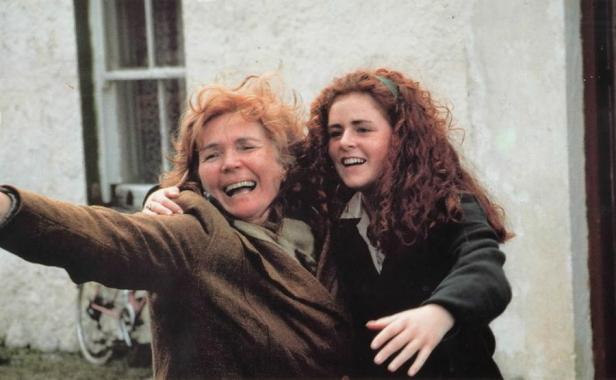
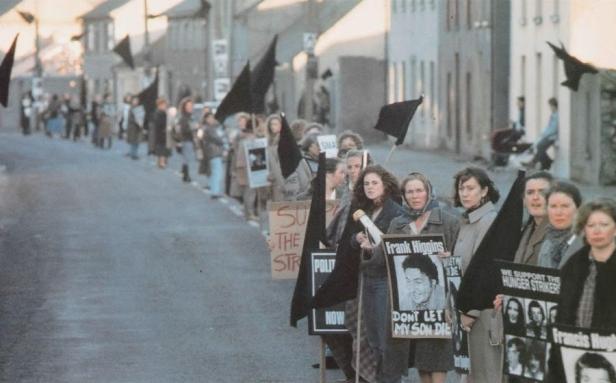
Eventually the Brits trap and capture Frank and Gerard who have killed a squaddie in a gun battle. The pair are put on trial, convicted by a judge (in a ‘Diplock court’ that dispenses with juries) and sent to the new Maze Prison (formerly Long Kesh) where they are locked up in the ‘H-block’. I’m not worried about spoilers here since this is a well-known historical case. Gerard finds himself in a cell with Bobby Sands (John Lynch). IRA prisoners at this time refused to wear prison clothes, maintaining they were prisoners of war, not criminals. The British called them ‘terrorists’. This protest led to the symbol of the blanket which the prisoners wrapped around themselves. The protest then extended to a refusal to shave, have haircuts and then to refuse to ‘slop out’ in a ‘dirty protest’ which saw excrement smeared on the cell walls. The final protest was the Hunger Strike which had been used by earlier generations of Irish prisoners in British colonial prisons. Bobby Sands was elected to the British Parliament when the death of a local MP caused a by-election in Fermanagh and South Tyrone. This proved a powerful statement about the imprisonment of a man elected by his community. Bobby Sands starved to death and in total ten of the prisoners died in 1981 in what was seen as part of the struggle. These are the facts (compressed of course – the blanket protest, dirty protest and hunger strikes had already been used by earlier IRA prisoners). The narrative includes these events but the underlying narrative is about the two single mothers – hence the film’s title.
Kathleen is a pacifist and doesn’t want to be involved in violent protest whereas Annie is fully in support of the IRA campaign. The two mothers are awkwardly brought together because of the fate of their sons. The key point of the narrative development is the revelation of the procedure which makes it possible for the mothers to intervene when it is clear that their sons will die without medical intervention. What should they do? This is, in turn, part of the long process of the propaganda war. In retrospect we know that the Hunger Strike and the deaths were covered by the international media and to a certain extent eventually led to the settlement of the Good Friday Agreement in 1998.
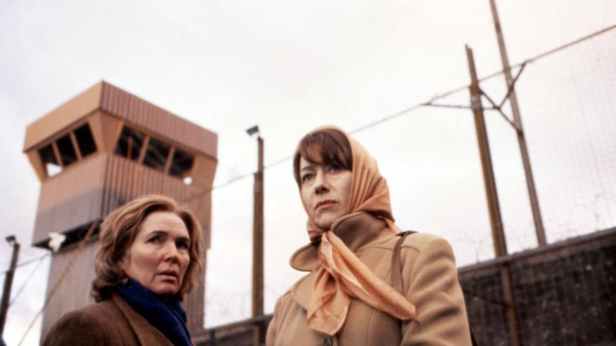
The focus on the mothers is important for several reasons. Although there were several female figures in the history of Irish resistance to the British occupation of Ireland, the IRA was an organisation generally represented by the men who fought rather than the women. The women were more likely to be seen as political figures – Bernadette Devlin was one of the Civil Rights leaders who became an MP (for Mid Ulster) in 1969 aged 21. She was an Independent Socialist Republican and not part of the IRA. Today, of course, Sinn Féin is led by women in both the North and South. Republicanism in Ireland was a product of a conservative and patriarchal culture and the friendship and mutual support between Kathleen and Annie is an important element of the narrative. Kathleen has a car which is essential for the visits to the Maze. She is the educated middle-class woman and Annie is the small scale farmer with a long family history of IRA involvement. They have much to teach each other. It’s worth noting that similar narratives would develop in the UK coalfields in 1984 when the women of pit communities were politicised by the strikes.
I’m not sure why I didn’t see this film on its release in 1997 but I was intrigued to see what kind of reviews it got. Like many of the American-backed films about Northern Ireland, the film was on the whole well-received in the US. There are a couple of the usual right-wing reviewers who traduce the film completely in the UK, but I was surprised to find some local newspaper reviews in the UK which praise the film as ‘good entertainment’. It’s quite difficult to find accurate box office figures for films like this from the 1990s., but it does seem to have had some success in the UK and Ireland (a single territory for distribution), though how much of that refers to the Irish market is unclear. The Lumiere Database of European Admissions suggests that Spain saw the most successful release. It’s also worth noting that this was a period in the 1990s when ‘ancillary’ (i.e. VHS cable TV) was a significant market. There are some signs that the film might have done well in this market. Helen Mirren’s casting was important for the film in most markets. Aiden Gillen was yet to have the breakout he achieved with the TV series Queer as Folk (1999-2000) but that may have been a factor in the later ancillary market. The film followed the earlier successes for Jim Sheridan as a director – My Left Foot (Ireland-UK 1989) and In the Name of the Father (Ireland-US 1993).

On reflection, a number of points stand out in terms of what to make of Some Mother’s Son. The first is that most reviewers recognised that this isn’t a ‘message’ film as such. It’s much more about the two women. Having said that, it does make some strong arguments about the duplicity of the British and it’s important to think about how important this might be. I agree with a couple of the reviewers that aspects of the film caricature the British position and certain characters so much that the argument is actually weakened. There are also a number of mistakes in the presentation which might be simply mistakes or misguided attempts to strengthen the arguments. Two examples only need to be picked out. One is the playing of Tom Hollander as Farnsworth, seemingly No. 10’s ‘man on the ground’. He seems remarkably young and comes across as an Oxbridge privileged student telling the prison staff and the Army how to deal with the IRA. The film implies that this ‘new’ policy is one of the changes under Thatcher (the film starts with her statement outside N0. 10 when she is first elected), whereas it was actually introduced by the Labour Secretary of State for Northern Ireland Merlyn Rees in 1976. This simplification of British government policy doesn’t work in presenting the background. There is a rather mysterious character who challenges the government line. ‘Harrington’ (Tim Woodward) seems to represent slightly more liberal groups within government. At one point he is described as a ‘Foreign Office monitor’ at the prison. He seems to have some support in Westminster but is in the end outmanoeuvred by Farnsworth.
The other element in the narrative is the church. A local priest and an unnamed cardinal both make appearances in the Maze to conduct services for the prisoners. Katleen is not so well-supported by the Mother Superior of her convent school. There are communications with the Sinn Féin spokes person locally (Ciaran Hinds playing ‘Danny Boyle’). I don’t think the narrative has the time to deal with the complexity of both religious and political structures in the Fermanagh and Tyrone. I have referred simply to ‘the IRA’ in this posting – as the film does. In reality, the ‘official’ IRA had faded into the background by this time and most IRA activity was conducted by various splinter groups, the largest of which was generally known as the ‘Provisional IRA’ or informally as the ‘Provos’ but other smaller factions were also active. The film can’t deal with the full complexity of the situation but, as I’ve indicated, it does succeed in creating a narrative which is engaging and affective and the two women in the central roles are convincing.
Some Mother’s Son should be available to stream on Apple, Amazon, Google etc.
 itp Global Film
Roy is right about the limitations of this film. Terry George’s other film, ‘In The Name of the Father’, about the occupation in Ireland was equally problematic. Though in both films the casts were excellent.
Ken Loach has made a better fist of the issues in films like ‘Hidden Agenda’, ‘The Wind that Shakes the Barley’ and ‘Jimmy’s Hall’. His films also give a proper place to women’s contribution to the liberation struggle.
Two Television series in recent years have also done this: ‘Rebel Heart’, BBC 2001 and ‘Rebellion’, RTÉ 2016. Both series have armed women republicans fighting the British in Easter 1916.
LikeLike