

First screened at Sundance in early 2020 before the pandemic broke out, The Father didn’t get a general release in the UK until Summer 2021. It’s now available on the All4 stream (Film 4 was the UK partner of French production company Les Films du Cru). Florian Zeller is the acclaimed French playwright who won the ‘Best Adapted Screenplay’ Oscar in 2021 along with his co-writer Christopher Hampton for this début film based on his own play. He has said that he wanted Anthony Hopkins for the titular role and wouldn’t have made the film in English if Hopkins had not accepted. Hopkins went on to win the Best Actor Oscar at the age of 83. The film itself featured in many other awards ceremonies around the world. Watching it is a somewhat daunting task faced with such acclaim.

Hopkins plays ‘Anthony’, a man who we soon realise is suffering from dementia. His surviving relative is his daughter Anne (Olivia Colman). In the course of the narrative we meet a small group of other characters. Eventually it will become clear that what we are witnessing are ‘events’ that are being interpreted by Anthony in his confused state. Apart from Anne, he isn’t sure who these other people are or when the events are happening (or where he is) – are they ‘live’ or did they happen some time ago? The film’s origins as a stage play are evident in the settings which comprise in the main just two ‘sets’, a flat in an upmarket district of West London and a second interior location in another building (still in London). There is a music score by Ludovico Maria Enrico Einaudi, including several classical pieces (e.g. Purcell, Bellini, Bizet). It’s also worth noting the editing by Yorgos Lamprinos and cinematography by Ben Smithard (in ‘Scope). These combine to imperceptibly change the environments. It’s almost possible to visualise a team of set decorators, moving furniture, taking down paintings, changing doors, curtains etc. Everything works very smoothly. If you are interested in how the production designer Peter Francis subtly changes the décor of the flat you can visit the ‘Film and Furniture’ website which offers a full analysis. Is it meant to be Anthony’s flat or Anne’s?

I’m guessing that most of the audience for this film will know someone who has suffered from dementia, but it is important to remember that dementia is an over-arching term for many different conditions involving malfunctions of the brain or ‘cognitive decline’. There are broadly similar symptoms across all sufferers but each case is distinct in terms of behaviour. This means that there is little point in arguing that specific representations are realistic/not realistic. Having said that, a narrative like this does present issues for a film critic. I noted in the early part of the film that I was momentarily confused by a particular shot because of the framing and composition. Anthony is the central character and he appears in all the scenes (although we might see another character first and then Anthony appears in the scene) so the story is narrated as Anthony’s story. Usually, however, film conventions suggest that we are seeing a scene from a particular point of view and that occasionally we might see a shot which implies the POV of a different character. In this film, however, is everything supposed to be seen/experienced by Anthony? I also wondered if the writers had decided to deliberately mislead the audience to make the narrative appear more like a mystery with potential twists.

At one time critics used to refer to something called ‘the well-made play’. I thought I knew what that meant but this definition quoted by Wikipedia surprised me: “A dramatic structure [designed] to provide a constantly entertaining, exciting narrative which satisfyingly resolves the many complications and intrigues that drive the story . . . characteristically based on a secret known only to some of the characters” (The Oxford Encyclopaedia of Theatre and Performance (2004). Does The Father meet those criteria? I’m not sure, but it’s a question worth exploring. I would say the script is very well-written, it is engaging and in a sense exciting and it does resolve the intrigues that drive the narrative. There is certainly a secret that everyone knows except Anthony who is confused. The other feature of the ‘well-made play’ is that it tends not to focus on “characterisation or intellectual ideas”. In this case that might mean questions about how best to deal with dementia? I confess, I’m not sure whether this is the case with The Father, though it certainly presents a narrative as experienced by a sufferer. But most strikingly for me, the performances and their presentation seem to resemble what is considered the ‘best’ form acting for what is perhaps describable as ‘filmed theatre’. Hopkins and Colman are considered very fine actors and the others in the group of secondary characters – Olivia Williams, Mark Gatiss, Rufus Sewell and Imogen Poots are similarly celebrated, if not as garlanded.
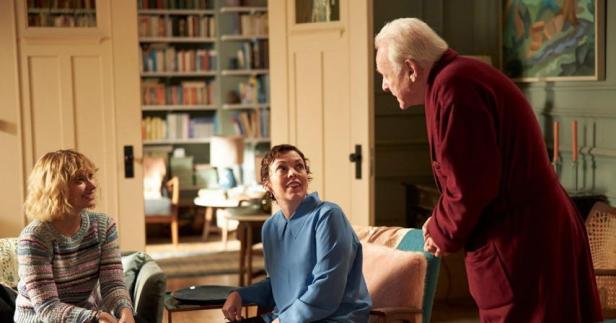
My personal problem is that this is not the type of acting I necessarily enjoy and it is probably fair to say that I have avoided many films which feature either Hopkins or Colman, so I have seen only a handful of their performances out of more than 100 credits for either actor. I think this says a lot about my tastes and the films in which the actors choose to appear. The same holds for the other actors above, although I do like Olivia Williams in the roles I have seen her play. Perhaps my real issue with the film is its representation of the London middle-classes. I’ve done my share of visits to hospital wards and care homes funded by the NHS and Social Care and they are not like this narrative with its spacious, well-appointed rooms and private health consultations. Watching the decline of the NHS over the last 14 years of Tory misrule is not good for my critical faculties when faced with films like this.
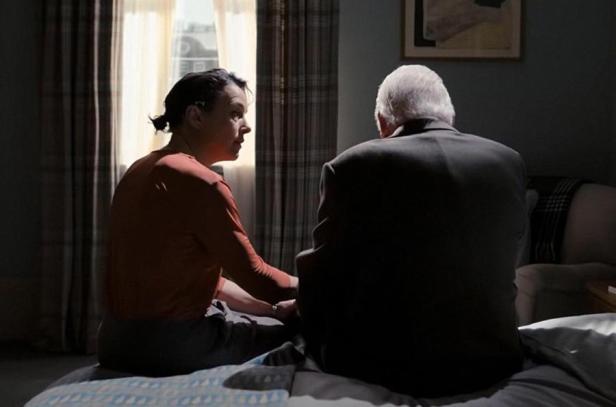
The press notes for the film (on the Unifrance website in French) reveal that my reading of the film above is roughly in line with Florian Zeller’s intentions. I’m relieved that I haven’t misunderstood. I don’t mean to be critical of the choices he made in putting his play on screen. He has pleased a significant audience with what he has put together. My final take is that this is indeed a very well-made film with standout performances. It’s not for me but I’m seemingly very much in the minority – IMDb rates it as No 135 out of the Top 250 films rated by its users. Perhaps a social realist melodrama treatment of the same story would work for me in conveying the emotion?
 itp Global Film
Interesting. I saw it in the cinema when it first came out and thought it was brilliant. I know what you mean about the acting but here I thought it worked because of the theatrical setup being adapted rather than being opened out for cinema. I do wonder if watching in the cinema makes for a different experience, not just the size of screen and the darkness but being in the moment, knowing that you can’t go back and check a shot etc.
LikeLike
I’m sure you are right. I used to hate watching films on a TV or worse still a computer screen, but since lockdown I’ve got used to it and now I get anxious if I can’t go back and check something I thought I saw. It’s perhaps less of a reading process based on emotional responses but on the other hand I do get to learn more about what lies behind the narrative and how it has been achieved. Watching at home and watching in a cinema are definitely different experiences.
LikeLike