
This was the regular ‘classic’ film screened from a 35mm print in the Japan Foundation Film Touring Programme. The programme is a highly anticipated event in the British movie calendar. This year’s programme included 24 titles screening in 30 venues, though only seven of them offered this 35mm film.
Produced in 1959 at the Shochiku Studio the film was shot in colour and in Shochiku Grandscope (2.35:1). The director was Kinoshita Keisuke. Alex Jacoby, in A Critical Handbook of Japanese Directors (2008, Stone Bridge Press) writes;
Having served as assistant at Shochiku to pioneering shomin geki [literally “petty bourgeois film” or “lower middle class film”] director Shimazu Yasujirö, Kinoshita became one of the leading post-war exponents of the studio’s bittersweet, subtly sentimental “Ofuna flavour”.
He admired, in his own words, “beautiful, simple, pure relationships between individuals,” and opposed whatever undermined them. His films often cantered on the suffering of children in repressive circumstances . . .”
Note, the following includes the film’s plot and ending
The film opens in contemporary Japan as a wedding ceremony leaves a village mansion, watched by a crowd of onlookers. This is a contemporary scene set in a rural area. However, the camera, rather than following the procession, follows a young man who runs to a nearby river followed by his panicking mother. There follows flashback to nineteen years earlier when a young star-crossed couple attempted suicide in the same river; the boy dying but the girl surviving. In a series of flashbacks, not presented chronologically, the impact of the earlier tragedy on the main characters is explored and illuminated.
The young couple were Haruko (Kishi Keiko) and Hideo (Kawakane Masanao). He is the younger son of the Nagura family; in 1940 the substantial landlords in the village, lording it over the tenant farmers. Haruko is the daughter of a tenant farmer, Yakichi (Ryū Chishū). The suicide is prompted by the opposition of Hideo’s family to a union and also to his being called up for military service; the Pacific War is approaching or may have even started. We learn later than Haruko’s brother has died in the war. Hideo’s reluctance is motivated by fears for Haruko who is pregnant with his child.
Because of the local gossip the Nagura family take the surviving and pregnant Haruko into their household. However, she is treated more as a servant than a family member, and this continues when her son is born. The head of the Nagura family, Tsuyochi (Nagata Yasushi), is an overbearing and traditional patriarch. And his wife, Tomi (Higashiyama Chieko), shares his values, in particular a fierce determination to preserve the family’s status and fortune. Tsuyochi dictates the birth name of Haruko’s son, Suteo. Haruko is extremely upset by this as the name’s meaning is ‘discarded male’.

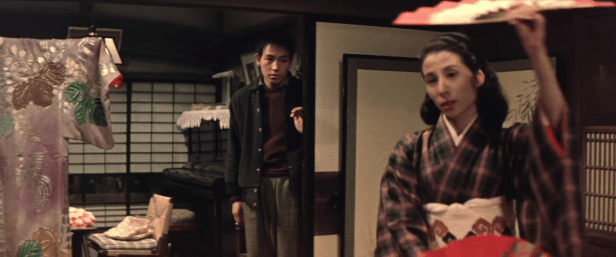
The eldest son is Katsuyuki (Hosokawa Toshio), married to Tatsuko (Igawa Kuniko); a marriage arranged due to the fortune Tatsuko brings with her. They have a daughter Sakura ( Kuga Yoshiko), who is of a similar age to Suteo. Sakura is given a private education to supplement the local school and it includes traditional dance and piano lessons. In the scenes when she is a teenager we see her performing traditional dance for a local audience. We also see her playing the piano for family and friends, but this appears to be westerns style music.
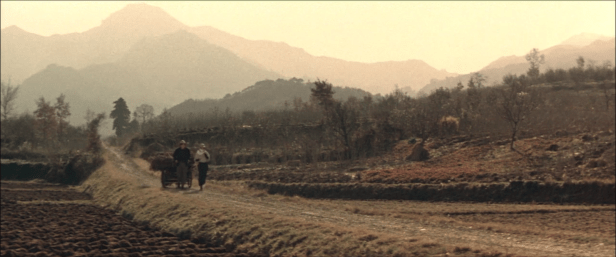
The setting for the film is the Nagano Prefecture. This is a land-locked region in central Japan. It is noted for its mountains. In the film the setting is a flat arable valley or plain which seems surrounded by hills and a prominent mountain. The area is rather isolated from surrounding prefectures and the capital in Tokyo. One of Sakura’s school friends, Sachiko (Arima Ineko), leaves the valley for Tokyo. She returns later in the film, clearly the late 1950s, now married to a young and hard-up artist. But she seems happier than Sakura. And she smokes as she visits, dressed in westerns style clothes, different from the traditional costume worn by Sakura. This emphasises the rather backward nature of the valley and its life.
Over the flashbacks we see a developing friendship between Sakura and Suteo. Suteo himself is subjected to taunts and bullying a the local school, both because of his name and his parentage. Haruko continues in her servant role. She and Suteo live in a small cabin alongside the larger Nagura mansion. Both she and Suteo have to work in the mansion and he in the fields. There are scenes where we see Suteo observing Sakura and it is clear that his emotions are stronger than mere friendship.
An important scene is when Sakura is rehearsing her dance for the local performance. She invites Suteo to attend but he has to remain at the mansion. The performance is watched by an intended suitor for Sakura, clearly enraptured. It is also watched by Haruko, but she has to stand by the door.
The intended suitor for Sakura comes from a wealthy family. And her private schooling has been intended to give her skills and aptitudes that will make her an attractive marriage proposition. The Nagura family has meanwhile lost its dominance. Land reforms at the end of the WW2 mean much of their property has been redistributed to the tenant farmers. The family patriarch, Tsuyochi, has died, his health undermined by his rages and assaults on family members. But his widow, Tomi, continues the autocratic control of the family, including the elder son and his wife. Haruko has herself suffered a family tragedy, as her father, Yakichi, committed suicide on receiving the news of his own son’s death in the war.
The flashbacks have finally arrived back in the present as Sakura is wedded to her chosen suitor. However, what only she and Suteo know is that they have recognised and declared their love. On the eve of the wedding they share an night-time liaison. This is covered by an ellipsis, but the following dialogue suggests that they have consummated their love with coitus. Suteo is left with a token by Sakura; the fan that she uses in her dances and which we also have seen covering a secret letter from Suteo declaring his love.
The film moves on to a final sequence. Haruko has followed Suteo as he runs away to the river, frightened that he will follow his father in suicide. She promises to take him away from the area to a new life. The finals scene shows the couple on the bridge where the original tragedy occurred. As they pause a flurry of snowflakes blows round them. The film’s title is a special word for ‘snow flurry’ or ‘wind flower’. It signals a seasonal change. And Haruko sees this as a positive sign as mother and son set off for a new life.
The film offers the themes identified by Alex Jacoby. The tone is certainly bitter-sweet and the tragic lives of the young people in particular are the result of an overbearing patriarchy. There is also the class dimension between landowners and tenant farmers; though the film offers a lifting of this oppression and exploitation in a post-war Japan. The film also suggests a changing culture in Japan, centred on the capital Tokyo and only slowly reaching out to regions like Nagano. There is also a muted criticism of the war waged by Japan, both in the restrictions on the original couple and several deaths. In the drama the past weighs heavily on the present. The flashbacks trace the continuing impact of the original suicide on peoples’ lives. Even at the end this is only partially resolved.
Sakura’s continuation with the arranged marriage presumably is down to the autocratic family but also she says that it offers an opportunity to escape from this oppressive world. Intriguingly, in melodramas, a single sexual coupling frequently results in pregnancy. So it is possible that Sakura will bear Suteo’s child in the new marriage. In which case the offspring will avoid the repression suffered by his father Suteo, enjoying the affluence of a wealthy household. This is a rather subversive thought as Haruko and Suteo leave the site of their oppression for a new life in a changed Japan.
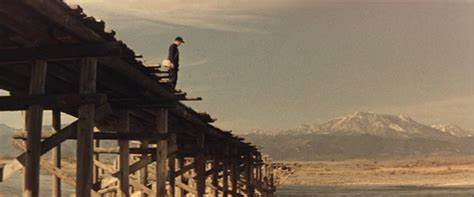
The film uses places and objects to carry connotations through the flashbacks. So the site of Hideo and Haruko’s suicide is a bridge over the river. At one point to field workers comment that Haruko always takes a longer route to where Suteo works in the fields, avoiding the bridge where Hideo died. And at the end it is this bridge where Haruko and Suteo pause and see the flurry of snow. In the Nagura household Sakura’s fan is an object of added meaning. It is an important prop in her dance sequence. And following the dance she leaves her fan on the desk, inadvertently covering Suteo’s letter with his declaration of love. She only reads this sometime later, interestingly prompted by a comment by Sachiko, visiting from Tokyo. Reading the letter leads to her realisation of her own love for Suteo and their night-time assignation. And she leaves the fan as a token for Suteo before she joins the bridal procession.
Alex Jacoby notes that:
the power … of Kinoshita’s best work in general lay in his use of simple techniques. A judicious choice of camera position and excellent performances . . .
The cinematography by Hiroshi Kusuda demonstrates this. In the exteriors the scope framing often draws back to place the characters in the landscape, the form of land ownership that limits their lives. And interiors frequently place the camera to catch both a character and another character observing them. I had recently had eye treatment and I am waiting new spectacles. The Snow Flurry was my first cinema as screening since then; I could follow the images and subtitles but I did not have perfect definition. However, the 35mm print screened seemed to be good both for the widescreen imagery and for the colour.
The film had music by Chûji Kinoshita which combined some western style with traditional Japanese themes; the latter insistently played on the bitter-sweet tone.
The flashbacks, apart from the opening one, were not signalled nor identified by an on-screen title. Despite this I found it straightforward to place events in the larger plotline. The fragmented and non-linear style of the continuity was a little unusual for the period. A noted critic, Donald Ritchie, felt that this pointed forward to the style that was introduced by what is known as the Shochiku New Wave films.
The performances were uniformly good. Apart separate casting for the childhood of Sakura and Suteo the same actors played characters across the nineteen year timescale. There were occasions when this was a little obvious but it did not detract from the movie. A number of the actors were familiar to me. There is Ryū Chishū as Yakichi; like Higashiyama Chieko as Tomi both were familiar to me from the films of Ozu Yazujirö, also working at the Shochiku Studio. However, these rural characters were vastly different from the roles in Ozu’s yomin geki dramas.
Kazabana / The Snow Flurry is something of a classic in Japanese film. And Kinoshita was a highly regarded director at the Shochiku Studio. However, enjoying the film in its original format is something of a rare pleasure. It is available in non-theatrical formats but I am glad that I was able to see it in the full theatrical scope and colour presentation.
 itp Global Film