

Terence Davies died in October 2023 and I’m surprised that there hasn’t been more of a celebration of his career by the BBC – perhaps I missed it? Now, however, his last feature released in May 2022 is available on BBC iPlayer in the UK for the next three weeks. Davies made only nine features plus his initial trilogy of shorter films. The films might be categorised in three ways. First are the autobiographical fictions, to which might be added the memoir-style documentary, Of Time and the City (2008). Second are the four ‘literary adaptations’ – three novels and a play. Finally come his two films about the lives of poets. Benediction is a form of biopic about Siegfried Sassoon and follows A Quiet Passion (2016) about the life and work of the American poet Emily Dickinson.

I started watching Benediction from a point of ignorance of most of Sassoon’s life and his poetry. My only knowledge came from the adaptation of Pat Barker’s novel Regeneration, directed by Gillies McKinnon in 1997. I watched that film as part of my work and introduced a screening for school students. I didn’t myself come across the ‘First World War poets’ in my schooling but more recently they have appeared on school curricula along with an increased exposure of First World War memories, especially during the centenary period of 2014-18. Regeneration focuses on the Craiglockhart War Hospital in Edinburgh where the British Army sent soldiers suffering from ‘shell shock’ and other ‘nervous disorders’. It was here that Siegfried Sassoon met Wilfred Owen when both were patients under the care of Dr. Rivers. There was a strong attraction between them which Davies handles very well.

Benediction begins in 1914 when Siegfried Sassoon (Jack Lowden) is 28 and attending a performance (with his younger brother Hamo) of The Rite of Spring, the revolutionary production by Sergei Diaghilev of Igor Stravinsky’s ballet. Davies offers us Sassoon’s lines as a voiceover as the curtain rises to reveal a montage of First World War film clips and then the enlistment of Siegfried and Hamo into the British Army. The narrative proper opens with Siegfried now in hospital in 1917 and being visited by his mother Theresa (Geraldine James). She is already devastated by the death of Hamo during the Galipoli Campaign. It’s a bravura opening given the paltry budget Davies had available. But there are a few potential problems for an unwary audience. The lines spoken by Lowden as Sassoon are from a 1921 poem ‘Concert Interpretation’. This is the first indication that Davies, as in other films, will present a non-linear narrative, at various times leaping forward or circling back through Sassoon’s memories and underlying emotions. Alternatively, he might simply be aiming for particular effects at particular moments in rolling out the narrative. Most of all, we should not expect a realist drama. This is quite important because the British ‘costume drama’ about upper class families in the early 20th century has a strong appeal for sections of a UK, and arguably a North American, audience (particularly after the success of TV dramas such as Downton Abbey and others). Instead, Davies is out to explore Sassoon’s immersion in the modernist art movement world of the 1920s and 1930s. I recommend the very useful essay about Davies and Benediction by James Slaymaker in Bright Lights Film Journal for much more on this.
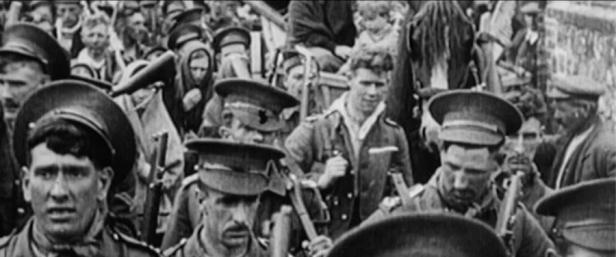
A second problem is the use of newsreel footage (still often called ‘topicals’ in the 1910s, I think). The clips have been cropped heavily to fit in the CinemaScope frame used for Benediction. In some cases they might also have been ‘flattened down’ to fit. Either way they represent the period rather oddly – something similar happens in Of Time and the City and in the film about Gertrude Bell, Letters from Baghdad (UK-US-France 2017). There are also other ‘realist’ issues with the railway shots, but these are not concerns for Davies. Starting the narrative in 1914 does create a lack for the unwary like me. We learn nothing about Sassoon’s early family life, education or his time as a young man before 1914. Not knowing his background means that it is quite difficult to fully understand his later actions, or more importantly perhaps, his emotions. When the film ended I rushed off to find just a few facts. Siegfried was the middle one of three sons, born to a mother from an upper-class family, the Thornycrofts. She was a painter and sculptor and the family included other artists and engineers, including the founder of the Thornycroft shipping company, later known as Vosper Thornycroft. Siegfried’s father came from a Jewish-Iraqi family which became one of the wealthiest merchant families across Asia. Because he ‘married out’, Alfred Sassoon was cut out of the family business and he left his wife and children when Siegfried was just 4 years old. He died of TB in 1895. Siegfried grew up in a still wealthy household and as a young man had enough income to be able to be a man of leisure developing as a poet and pursuing prey as a huntsman. This leisure supported by a private income continued after the war and later he received a legacy from an aunt which enabled him to buy a large house. He was also ‘well connected’ in terms of the upper echelons of British society.

Terence Davies is not interested in the family background. His concern is to follow Siegfried on a series of romantic adventures among the well-heeled young men of the 1920s and 1930s who because of their wealth and connections were able to be more or less ‘open’ about their sexuality despite the the prohibitions of the law. Davies perhaps felt that towards the end of his life he could vicariously enjoy the relationships that he himself found so difficult as a young man. Here’s what he said to Ben Walters for an interview feature in Sight and Sound June 2022:
I had to look at his life and think, “What do I respond to?”. Obviously he’s gay, so am I, so I responded to that. And the almost unquenchable need for validation – trying to find self-worth in other people – I’m afraid to say that I share that too. And the revelation of that is you can only find it within yourself. He never found it and, quite frankly, I don’t think I have either.
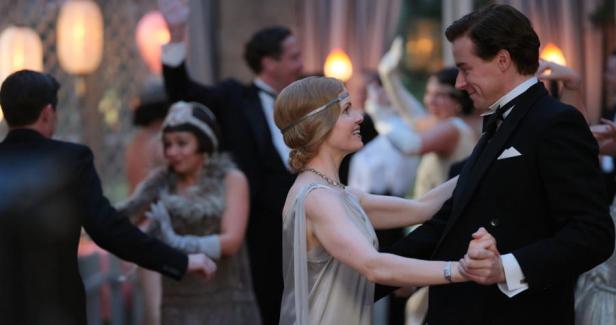
The result is that the film focuses on Siegfried’s visits to various country houses, arts performances and meetings with lovers. We never see Sassoon actually working as an editor or novelist. (He was the literary editor of the Daily Herald and dabbled in Labour Party politics in the 1920s). What we do get is more ‘leaps forward’, to the 1960s when Peter Capaldi plays the older Siegfried, first seen at the time he converted to Catholicism – his mother had been Anglo-Catholic (high church Anglican). Sassoon does marry, as many gay men did at the time, for various different reasons. His wife moved out later in the marriage (when she is played by Gemma Jones) but the couple kept in touch. Throughout the film, Davies leavens the the rather waspish or satirical dialogues between Siegfried and his modernist friends and acquaintances. We see Ivor Novello (Jeremy Irvine) singing at the piano and Edith Sitwell (Lia Williams) performing Façade – An Entertainment (poetry with music by William Walton) and earlier the patients at Craiglockhart singing in unison. In the 1960s the older Siegfried rails against the ‘noise’ of a Helen Shapiro record played by his son – much as Davies railed against pop music in Of Time and the City. Sassoon’s son George then takes him to the musical Stop the World – I Want to Get Off by Leslie Bricusse and Anthony Newley. The credits don’t tell us who was singing ‘Typically English’ on stage but just seen through the cigarette smoke (in a box) the older Siegfried seems to enjoy the song. The singer might be Kellie Shirley who appears in the credits as ‘girl singer’ – not very helpful. It wouldn’t be a Terence Davies film without several musical pieces. There is a surprising use of ‘Ghost Riders in the Sky’ by Vaughn Monroe from 1949 and two Vaughan Williams pieces. Benjamin Woodgates is credited as musical director and arranger. The performances in the film are generally very good and in the central role, Jack Lowden is excellent.I must also mention Nicola Daley, the Australian cinematographer who shot the film and composed some of the tableau scenes which are panned, wiped or dissolved by editor Alex Mackie to reveal different scenes. There are still too few women getting prestige shooting gigs so this pairing is to be applauded. I should also mention Andy Harris as production designer (he also worked on Sunset Song (2015) for Davies and on Regeneration).

In the end, I’m not sure what I make of the film. It is certainly a film made with commitment, vision and imagination. But it is over 2 hours long and still there isn’t room to put everything in. Unfortunately, I suspect that what is left out is material I would rather see than some of what is included. The upper middle-class milieu is not really very interesting to me unless they are actually doing something interesting and I don’t respond to the modernist artworks of the period. I do understand why Davies chose his focus but I wish some of the men Siegfried meets were less unpleasant. There is also the case that several of the beautiful young men look rather similar and I sometimes forgot who was who. The real shame for me and Sassoon himself was the all too brief appearance of Wilfred Owen (Matthew Tennyson) sent back to the war and killed in 1918. Finally, I’m still baffled by the title ‘Benediction’. The term means a blessing, the state of being blessed, or in the Catholic church a service in which the congregation is blessed with the sacrament. But this story is a tragic tale of a talented man who could never come to terms with who he was or what he wanted out of life. Davies himself was a lapsed Catholic, and I feel that I should understand more about what he was trying to achieve here. The film was very well received by most critics who found themselves moved by the emotional narrative. I fear I can’t say the same. Despite the strong critical support the film struggled to find its audience. I was surprised to find it was distributed in the UK by Vertigo but it was acquired in the lockdown period when some smaller distributors were trying to release more films. I do think it is worth watching and especially if you are more literate than me in terms of poetry.
The trailer below is in 1.85:1 rather than ‘Scope (2.39:1). I’m not sure why. The film is available on most of the streaming services if you can’t access it on iPlayer.
 itp Global Film