

This is an unusual film for several reasons. It is a very rare example of a feature-length ‘documentary fiction’ filmed at sea in Technicolor on 35 mm filmstock during wartime. It was designed to show the working lives of merchant seaman during the ‘Battle of the Atlantic’. It really serves as a showcase of the bravery and tenacity of the merchant navy in wartime, its propaganda value being slightly muted as it didn’t go on general release to British cinemas until January 1945 and outside the UK screenings didn’t begin in liberated Europe until September 1945. It wasn’t shown in the US until 1946.
The ‘Western Approaches’ is the term given to the area of the Atlantic which extends from the Western coastlines of Great Britain and Ireland (i.e. the two islands) westwards as far as the 30° meridian. ‘Western Approaches’ has been used by the Royal Navy as the title of a specific command relating to both naval and air operations protecting British shipping. In the Second World War this area was targeted by German U-boats as all ships approaching British ports had to pass through it. The command was based in Liverpool with a second base in Derry, Northern Ireland during the Second World War. The film was conceived as the naval equivalent of the Crown Film Unit’s earlier RAF ‘documentary fiction’ Target For Tonight (UK 1941) which had proved popular on a general cinema release. Pat Jackson, who had ten years experience of work in British documentary, was charged with direction of the film with Ian Dalrymple producing. Technicolor was expensive and had to be shipped in from the US. Jack Cardiff, who had been an operator on Powell and Pressburger’s Technicolor film The Life and Death of Colonel Blimp (UK 1943) was made cinematographer and he had the task of getting the bulky Technicolor camera into a lifeboat. It didn’t help that he was often sea-sick. There were only three Technicolor cameras in the UK and two were in use for Henry V and This Happy Breed (both films UK, 1944). Jackson wasn’t allowed to take one on a convoy ship so had to use a Monopak (which allowed shooting on a normal camera rather than a three strip Technicolor beast). But the Monopak proved very delicate, especially in terms of temperature and was prone to jamming as well as producing footage difficult to edit with the three-strip stock.
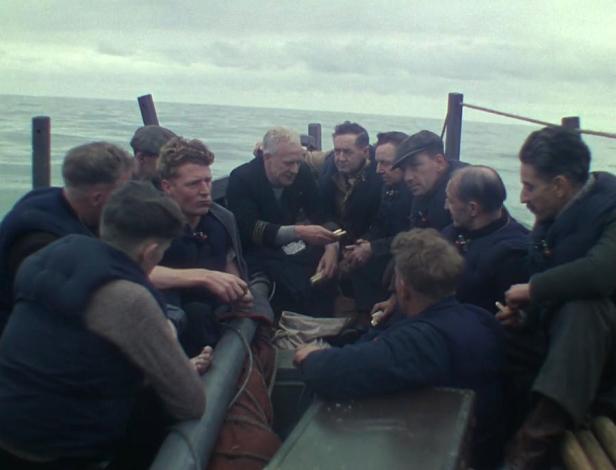
Jackson was at first stumped by how to make an interesting and engaging feature about what was, for the large part, a long shipping voyage with little visual excitement. But it was a dangerous activity and Jackson eventually decided to create a fiction around a U-boat attack. (One of the extras on the Blu-ray of the film is a ‘making of’ film in which Cardiff tells us that on the voyage back from the US the convoy was attacked for real.) The film narrative was built partly around the voyage of the armed merchantman S.S. Leander carrying aircraft in kit form and a railway locomotive on deck from New York to the UK in a convoy. But to make things more interesting, Jackson opened the film with a lifeboat and 22 seamen from S.S. Jason, the survivors of an earlier sinking by U-boats. The lifeboat eventually gets under sail in the Western Approaches and hopes to be found after sending out SOS radio signals, but this first attracts a U-boat. The German submarine captain decides to use the lifeboat as a decoy and hopes it will attract a larger vessel for his two remaining torpedoes. Leander is detached from the convoy because of reasons explained in the opening section of the narrative where we join the convoy commander’s briefing of all the ships’ captains in New York.

Jackson thus achieves his dramatic finale as the lifeboat captain, aware of the U-boat presence, tries to warn the Leander before it gets too close. I won’t spoil the final action scenes. The narrative is relatively straightforward but the film achieves its power from Jackson’s approach and the decision to use Technicolor. Most of the wartime films about the ‘the war at sea’ made in the UK used one of two different types of footage. As in films depicting RAF or Army operations, footage of action was take, usually at some distance from the action itself. In the best known example of a film entirely made up of such material Desert Victory (UK 1943) documented the 8th Army campaign against the Afrika Korps in North Africa. As well as footage taken by photographic units of the Army and the RAF, the film also used captured German newsreel footage. The more conventional fiction film approach staged action scenes on location or, in the case of naval battles in studio tanks. Individual sailors, played by actors enabled a much closer coverage of the action.

Western Approaches used only merchant seamen and officers without identifiable actors and certainly no ‘stars’. There is an inevitable stiffness and hesitation in some scenes but this is forgotten very quickly and the lack of ‘performance’ as such is compensated for by the realisation that these are men who understand what they are doing, what the dangers are and how they learn to cope. These sailors are able to express an ’emotional realism’ about their situation which is arguably not possible for an actor with a script. The cinematography is also remarkable. You can’t produce waves quite like these in a tank and the colour vividly represents the seas and skies over the Atlantic. I’ve seen reviews that suggest Western Approaches is similar to Rossellini’s Rome, Open City (1945) and that this is an early British version of neo-realism. There is something in those claims but the Italian films use actors in many roles, as well as music as part of their melodramas. We might instead compare Western Approaches with Powell & Pressburger’s Battle of the River Plate (UK 1956). Powell and Pressburger focus more on the officers and the crews of seamen only appear for specific narrative purposes. The Archers were able to film naval exercises and to use genuine warships used in the Second World War. Both films are very fine examples of how to represent ‘war at sea’ and in both cases, colour adds to their impact. Pat Jackson’s film does, however, offer something unique in its use of ‘real’ seamen.
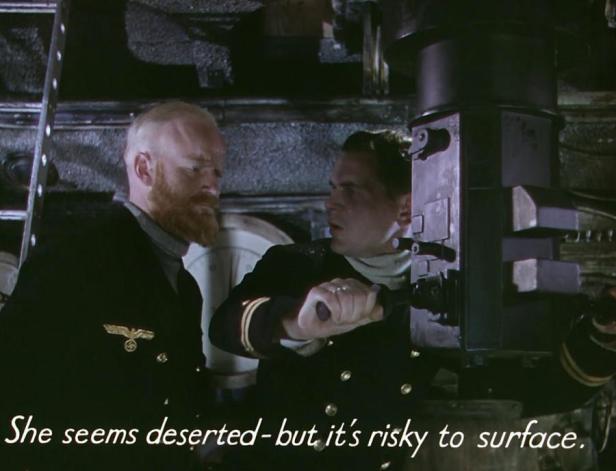
The institutional aspects of the production and distribution of Western Approaches also offer some useful insights into the differences between British and American cinema re wartime cinema. Hollywood studios offered considerable support for the US war effort. Many stars, production staff and creative teams were involved in both feature films and documentaries in both Hollywood and the UK but there does appear to have been differences. American documentaries had more support and boated big name directors such as John Ford and George Stevens. It appears that the Production Code Administration in the US were not prepared to allow Western Approaches to be shown without cuts because of the language used by the seamen. Mild ‘bad language’ posed a threat to American audiences apparently. There were no such problems for the British Film Censors. In an interview in 2001, Pat Jackson says the film was nominated for an Oscar as ‘best film from any source’. I haven’t been able to verify that but it may have been a BAFTA Award (‘Baftas’ started in 1947). It appears difficult to track down all Oscar Nominations. Jackson made the comment not to boost his own status but to assert that his non-professional actors were recognised for the great job they did. The film was warmly received by critics and proved popular in British cinemas. Jackson was offered a contract by MGM. I should also mention Clifton Parker’s music score for the film which was well received by critics. As is often the case I didn’t really notice the score on my TV, but I think that means it was doing its job well.
There was also a reaction of sorts in the UK to the depiction of the German U-boat crew in action. Getting inside the U-boat and seeing the crew up close certainly ‘humanises’ the enemy and as Robert Murphy points out in his book British Cinema and the Second World War (2000), Jackson’s presentation of the U-boat crew presents a problem for the narrative resolution of the film, which must remain open. Do we care what might happen to the U-boat crew if they lose the battle with the convoy?
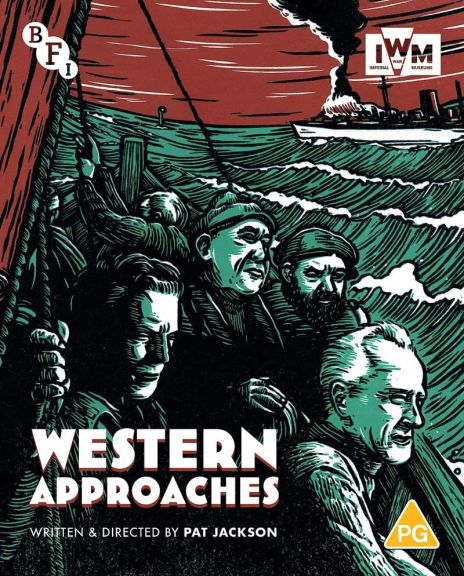
The BFI and Imperial War Museum produced a Blu-ray of the restored film in Summer 2023. The disc has several other gems including a couple of ‘making of’/’memory’ films featuring Jackson and Cardiff, plus other documentaries, including Ferry Pilot (UK 1942), also directed by Pat Jackson and telling a story that is still not that well-known by contemporary audiences. I recommend the Blu-ray disc highly. If you are interested in documentary or representations of wartime action or just simply great films, this is a must watch. The Liverpool War Museum offers a chance to explore the wartime operations bunker as represented in the film. It sounds terrific. I must go and experience it.
 itp Global Film