
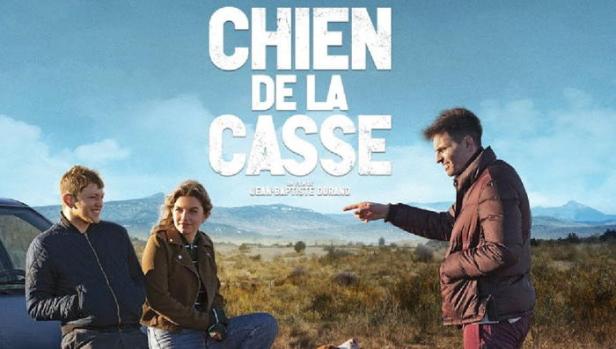
My second selection from My French Film Festival is a début feature from Jean-Baptiste Durand. The most distinctive aspect of the film is its main location in the village of Le Pouget in Hérault, Occitanie. We are in the low hills not far from the sea in the south of France, but to be honest we could be in virtually any of the countries bordering the Mediterranean. It’s quite beautiful in its own way. I presume it is meant to be winter since most characters wear several layers when they are ‘chilling’ in the small public places. The cinematography by Benoît Jaoul presents the landscape in long shots in the ‘Scope frame as opposed to the closer framings of the scenes set in the village.

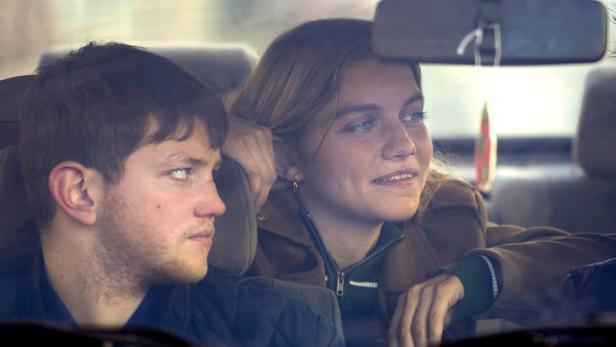
The central relationship in the narrative is between two young men who have known each other since their local schooldays. Mirales (Raphaël Quenard) is tall and lives with his mother, an artist, and his dog ‘Beefcake’. ‘Dog’ is the nickname for the other character Damien, played by Anthony Bajon, who is shorter and stockier and appears younger. I’m not sure how old the characters are intended to be but the actors are in their late twenties/early thirties. They appear to be surviving economically by selling drugs locally – cannabis as far as we can see. They both have access to a vehicle – essential in a rural area. There is no sign of public transport. The drugs are sold to the locals, people they have known all their lives. The relationship between the two men is close but spiky. Mirales reads and cooks but he treats Dog quite badly. It’s a familiar scenario with Dog seemingly less articulate and suffering in silence. Mirales tells him that they are ‘brothers’. The inciting incident in the opening section of the narrative is the arrival in the village of Elsa (Galatéa Bellugi), a young woman who has come to ‘house sit’ for an aunt for a few weeks. Dog meets her first when he gives her a lift into the village and soon they become a couple. Mirales is not impressed and his treatment of Dog becomes even more aggressive.
It’s difficult to categorise this film. MUBI’s introduction suggests it is “a coming-of-age tale with neo-western stylings”. I’m not sure about that description as the characters appear to be older than the usual characters for that categorisation. It also implies a form of generic narrative but the feel of this film is more like that of an art film. Having said that, there is a chase and a climactic moment, followed by an epilogue in which a new equilibrium appears to have been found in the small community and for Mirales and Dog, in different ways. I found the interview with writer-director Jean-Baptiste Durand helpful in making sense of the film. He trained in Montpellier the nearest big town, first as an artist and his sketches of the characters appear in the notes. He is clearly wedded to his home region and he grew up in a village like the one in the film. His short films began his attempts to represent the communities he knows and he makes the key observation that films generally use these kinds of rural locations in France as either the basis for historical narratives or about the difficulties of life for small farmers etc. They don’t feature the kinds of younger characters who appear in ‘urban films’. I did think of a film like La haine (1995) because of the ‘joshing’ and ‘banter’ of the young men, the dope smoking and the rap music, all of which appear in Junkyard Dog. Durand also suggests that there is an assumption in some films set in rural areas that villagers don’t read or listen to classical music. Mirales is shown to challenge this. He reads Herman Hesse and visits an elderly woman who is a classical pianist and whose playing is enjoyed by her neighbours. Certainly, it is a narrative about how two young men eventually ‘find themselves’ after a prolonged form of adolescence. But it is also about the village and some of its older inhabitants as well.
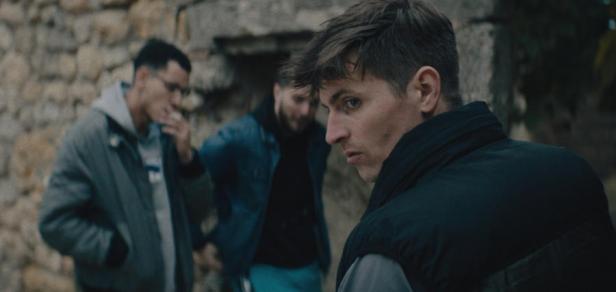
Music is very important in the film, both diegetic as in the piano playing, and non-diegetic in terms of the score. I enjoyed the score from Delphine Malaussena and Hugo Rossi, especially the cello that Durand says is in alliance with human voices. I thought the three central performances were very good. Anthony Bajon is an established young actor who was cast first and Galatéa Bellugi was seen by the director in L’apparition (France 2018). Both Bellugi and Bajon looked familiar to me and I realise that I have seen them in supporting roles in other films. Raphaël Quenard had only limited acting experience when he was cast later. Many of the other actors are friends of the director or had appeared in his earlier short films. Only a few roles went to non-professionals. As Durand puts it: “. . . but if part of the cast is from the area and had never acted [the gang of youths], I am also making a cinema written with staging, fiction and intelligent actors serving a text”. Here again, he implies that the film refuses simple categorisation. It isn’t simply a social realist account or a documentary style drama, but a more personal expression of what it means to live in a small community in this specific region. What isn’t is a social commentary on the isolation of communities in rural France. It’s more an insider’s view of what it is like to grow up there.

There are plenty of things to like about this film. Mirales and Dog are believable as ‘brothers’ and the presentation of the village and its inhabitants is very good. I’m tempted to make a train trip to see the region. Perhaps Montpellier, not far away could be a base for exploring?
 itp Global Film